AI and Edge Vision Transform Waste Sorting and Industrial Material Recovery
Startups are using edge AI, robotics, and computer vision models to identify and sort recyclable materials, cutting operational costs and improving circular economy efforts globally.
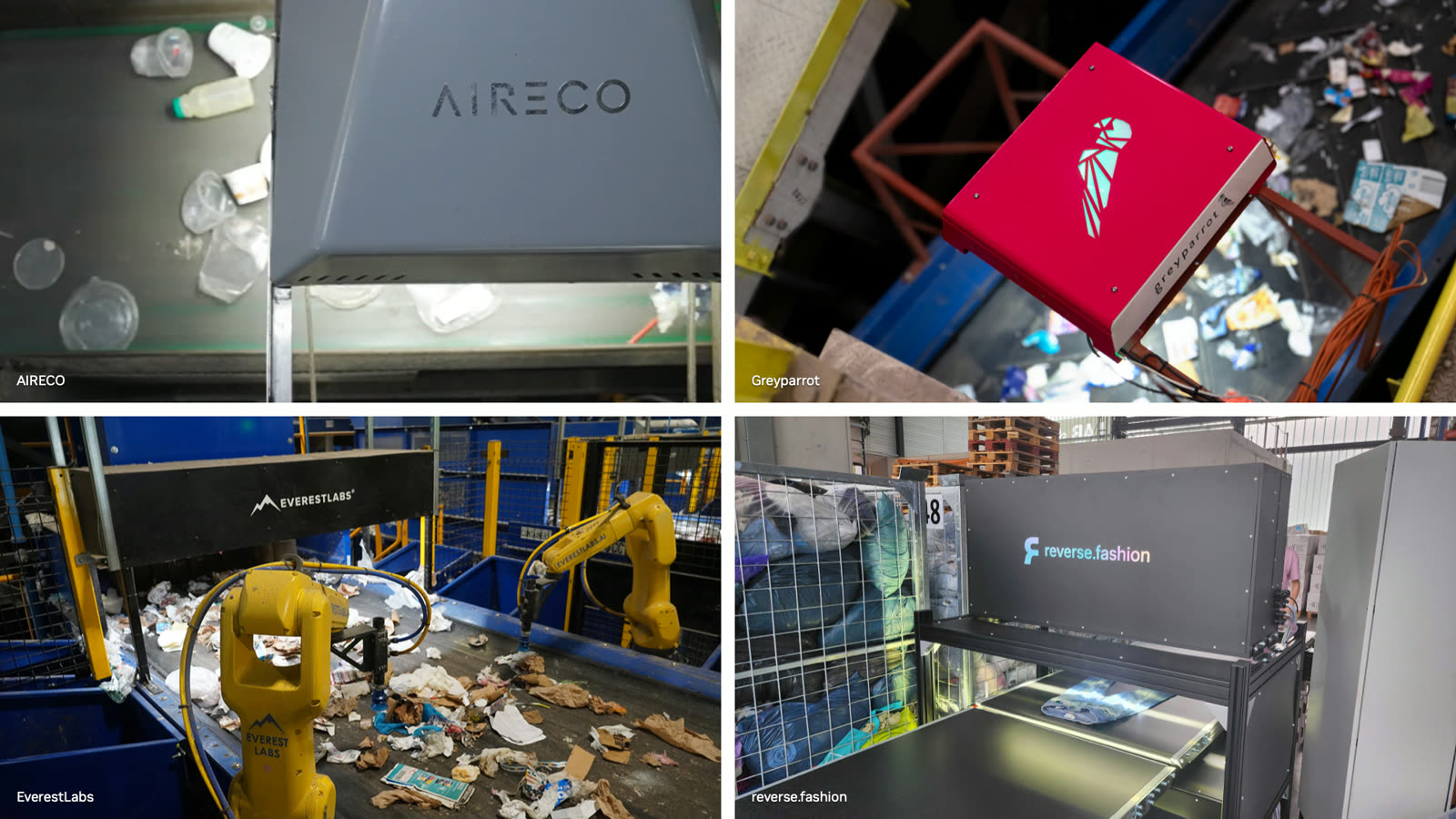
As world leaders gather in Türkiye for COP31, global waste challenges are coming into sharper focus. Over 2 billion tons of municipal solid waste are generated annually worldwide—a figure projected to almost double by 2050—while less than 7% of materials currently entering the economy come from recycled or reused sources. To address this bottleneck, technology startups in the NVIDIA Inception program are deploying computer vision and robotics to automate real-time resource recovery directly on industrial conveyor belts. NVIDIA head of sustainability Josh Parker noted that artificial intelligence helps operators analyze waste streams, identify recoverable items, and automate sorting at scale.
Automated sorting across industrial recycling lines
In Taiwan, startup AIRECO is using vision AI to advance closed-loop plastic recycling. Operating a pilot facility in Tainan powered by NVIDIA Jetson Orin NX edge modules, AIRECO guides robotic picking arms with a recognition accuracy exceeding 95%. Founder and CEO Chun-Feng Liu emphasized that finer sorting allows plastic bottles to be recycled repeatedly into high-grade products rather than downcycled. Looking ahead to next year, AIRECO plans to expand its production line to increase annual waste processing capacity from 18,000 tons to 48,000 tons while lowering operating costs by 85%.
Similarly, U.S.-based EverestLabs AI operates roughly 150 vision-guided robots across recovery plants in North America and Australia. The company trains its models on NVIDIA data center GPUs using CUDA and runs edge inference on NVIDIA RTX GPUs. CEO R. Paul Singh highlighted the real-time constraints of sorting fast-moving conveyor belts, where tasks must be executed before materials pass by. To date, EverestLabs estimates its systems have identified about 40 billion items, recovered roughly 25,000 tons of material, and prevented about 30,000 metric tons of carbon dioxide emissions. The startup is also introducing agentic AI tools to deliver actionable data to facility staff.
High-resolution vision and agentic data tools
Monitoring recycling facilities at scale presents another hurdle, as traditional plants historically inspected less than 1% of materials manually. U.K. startup Greyparrot addresses this with its Analyzer system, which monitors belts moving at speeds up to 4 meters per second. Built using NVIDIA GPUs for training and Jetson modules for edge inference, over 300 Analyzer systems across more than 20 countries have completed over one trillion bounding box detections. Cofounder Ambarish Mitra pointed out that real-time visibility replaces manual guesswork. The system has reduced the time needed to audit 15 tons of waste from 375 hours down to 6 hours, delivering plant efficiency gains between 10% and 30%. Major brands such as Coca-Cola, Colgate-Palmolive, and Kenvue use the platform, while packaging firm Amcor increased its yield of food-grade plastics by 12%.
Textiles present a distinct challenge due to subtle visual details. Europe generates nearly 7 million tons of used textiles annually, with only about a quarter collected separately for manual sorting. Berlin-based startup reverse.fashion uses high-resolution vision pipelines on garments moving at 3 meters per second. Cofounder and CTO Karsten Pufahl explained that detecting minute garment defects requires high precision to determine quality and potential value. Driven by more than a dozen vision models optimized with NVIDIA TensorRT software on Jetson modules, the system sorts in an hour what would have taken a week manually as it rolls out across European facilities.
What it means for developers
For software engineers and AI practitioners, these deployments underscore how multi-model edge computing, low-latency vision pipelines, and agentic workflows are being deployed in demanding physical environments. Industrial recycling lines require optimization tools like TensorRT and CUDA alongside edge hardware to process fast-moving video streams under tight latency budgets. Beyond hardware-level optimization, modern AI engineering increasingly involves orchestrating specialized model architectures for object detection, classification, and metadata analysis.
Developers building or testing vision and multi-modal applications can access top AI models cheaply through unified services at https://apixoai.online. As automated material sorting scales globally, the integration of edge inference, real-time telemetry, and multi-model processing will remain a key area of technical growth across physical AI and supply chain engineering.
Source: How AI Helps Recyclers Turn Mixed Waste Into Reusable Material — NVIDIA blog. Written by the Apixo team from that report.
One key for Claude, GPT, GLM, DeepSeek and more. Pay per token with crypto.
Get your API key