AI Day Seoul Highlights South Korea's Push for Physical AI and Agentic Systems
At AI Day Seoul, over 2,000 attendees gathered to explore robotics, agentic architectures, and enterprise AI deployments across South Korea's tech ecosystem.
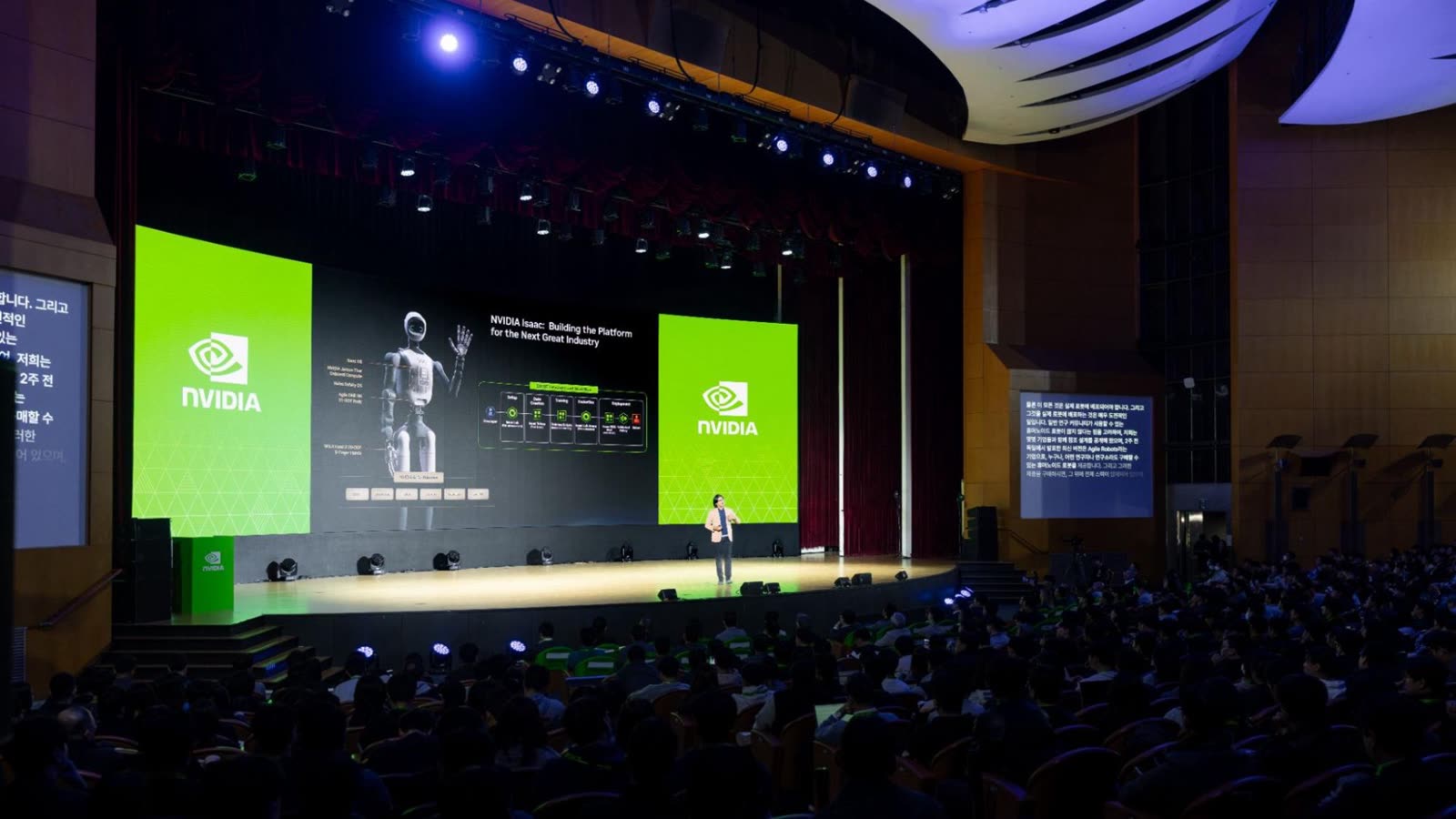
More than 2,000 participants gathered at the COEX convention center for AI Day Seoul, a two-day event focused on the rapid evolution of autonomous agents and physical AI. Addressing the plenary audience, Deepu Talla, vice president of robotics and edge AI at NVIDIA, remarked that South Korea is "punching above its weight" in advancing general-purpose robotics. The gathering highlighted how domestic tech giants and emerging startups are leveraging NVIDIA platforms to shift autonomous machines and software agents from controlled research environments into commercial reality.
Enterprise Push Toward Autonomous Agents and Robotics
During the plenary presentations, Jonathan Cohen, vice president of applied research at NVIDIA, detailed methodologies for enterprises seeking to construct and maintain proprietary AI agents they fully own and control. Real-world implementations across Korea were showcased by established industrial and consumer conglomerates, including Doosan Robotics, Hyundai Motor Group, LG Electronics, and SK Group, alongside startups such as Real World and Luda Robotics.
The event's technical breakout sessions provided a platform for engineering leads from Coupang Intelligent Cloud, Doosan Robotics, LG AI Research, LG Electronics, NAVER Cloud, SK Telecom, and Upstage. These discussions highlighted ongoing projects ranging from large-scale cloud infrastructure to domain-specific foundation models. Hyunho Yang, a research engineer focused on omnimodal foundation models at SK Telecom, noted that the conference offered an opportunity to participate in candid technical exchanges, stating that "seeing the passion of fellow AI developers was a real source of inspiration for me."
Community Initiatives, Startups, and Localized Hackathons
Grassroots developer communities also played a central role during the Agentic AI 10x Bootcamp Community Day. Technical user groups in attendance included Pseudo Lab, Python Korea, PyTorchKR, HAERAE, Hugging Face KREW, Graph User Group, Womxn Who Code Korea, and Dnol (Datayanolja).
Localized development was a major focus at the Hangul Day hackathon, an initiative co-hosted alongside Fastcampus. Five finalist teams engineered AI agents specifically trained on Korean language nuances and cultural context utilizing the OpenShell runtime. FlyGate, the hackathon's winning team, was awarded an NVIDIA DGX Spark system.
Emerging ventures also showcased their progress during the Physical AI Startup Connect event, where 10 companies from the NVIDIA Inception program presented their technologies: AIM Intelligence, Avikus, GoLe Robotics, MOVIN, Neubility, ROAI, ROBROS, TESOLLO, TwelveLabs, and XYZ. Academic and institutional collaboration was also represented at the AI for Science Forum, which convened researchers from the Korea Institute of Science and Technology Information, local universities, and NVIDIA Research.
What it means for developers
The conference highlighted a practical shift in the AI developer landscape, moving beyond theoretical benchmarks toward production-grade agent architectures and physical AI deployments. Over 500 developers attended full-day NVIDIA Deep Learning Institute workshops and sat for Korean-language certification exams, which covered scaling AI inference optimization, developing secure enterprise agents, and engineering end-to-end robotics pipelines through the NVIDIA Isaac platform. The newly introduced AI Model and Application Development exam underscored the growing demand for verified competencies in managing model lifecycles.
For software engineers building agentic workflows, the emphasis on local language adaptation, tool integration, and runtime execution—demonstrated by initiatives like the Hangul Day hackathon—shows that developers must be adept at evaluating and deploying multiple specialized models. As engineering teams build and test multi-agent setups, services like Apixo (https://apixoai.online) allow developers to access leading AI models such as Claude, GPT, Gemini, Grok, and DeepSeek through a single API key with pay-per-token pricing, lowering the friction of comparing foundation models for specific tasks.
Furthermore, the intersection of robotics and agentic systems shown by firms like Doosan Robotics and Avikus demonstrates that developers with skills in edge deployments and physical simulations are well-positioned as industrial automation matures. For those unable to attend the Seoul sessions in person, recordings will soon be available via NVIDIA On-Demand.
Source: AI Day Seoul Brings Together Korea’s Industry Leaders, Startups and Developer Communities — NVIDIA blog. Written by the Apixo team from that report.
One key for Claude, GPT, GLM, DeepSeek and more. Pay per token with crypto.
Get your API key