Amazon Quick Introduces Live Data Integration for AI-Built Apps
AWS has updated Amazon Quick with Live Data in Apps, allowing AI-built applications to query governed enterprise datasets in real time instead of using build-time snapshots.
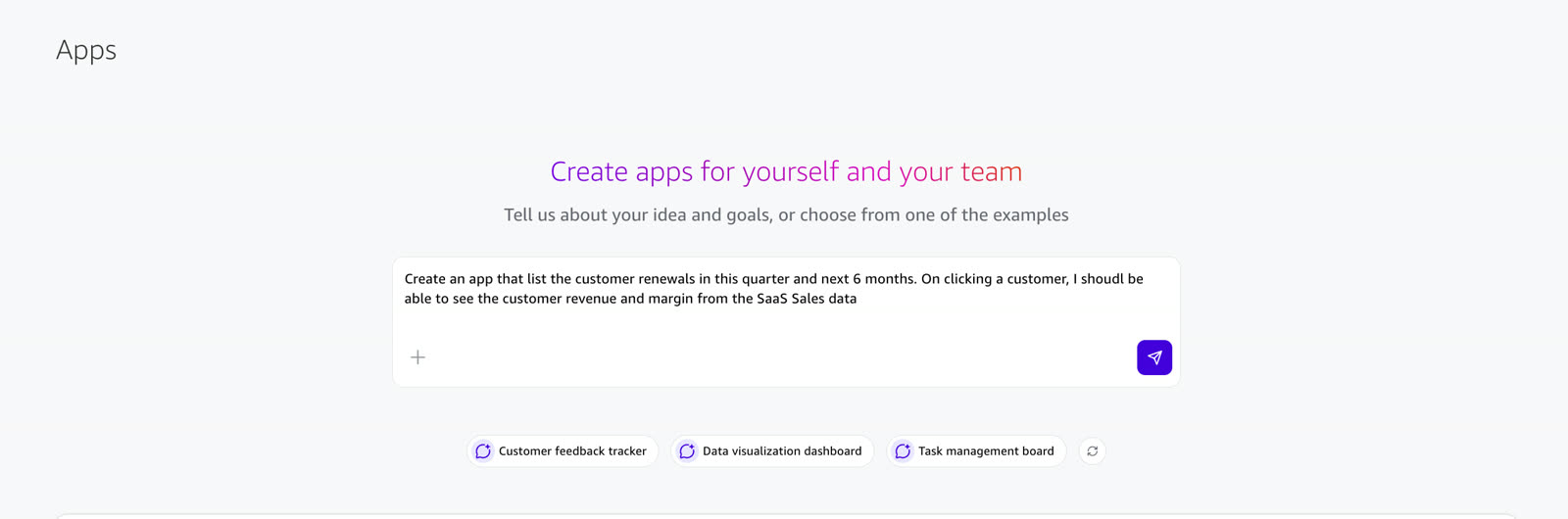
Amazon Quick has introduced a capability called Live Data in Apps, enabling AI-generated applications to query structured enterprise data sources dynamically. Previously, apps built by the service relied on frozen data snapshots captured when an agent first created them. With this update, published applications can connect directly to governed datasets from databases, data lakes, and analytics stores every time a user opens them.
The update bridges enterprise data and content sources, allowing teams to create functional web applications through natural language prompts without manual coding. Developers can build tools where analytics reflect current operational metrics rather than outdated figures.
How Live Data Works
The architecture relies on distinct build and view workflows. During the creation phase, a builder describes the desired application in plain language using the Amazon Quick Apps prompt interface. An AI agent automatically discovers relevant curated datasets, writes the necessary SQL queries, and prompts the builder to approve each dataset by name.
When a user opens the published app, the system re-runs the underlying SQL query. Crucially, the query executes according to the viewer's identity. Existing row-level security (RLS) and column-level security (CLS) rules apply automatically on the server side for every query. Viewers must provide one-time consent per dataset upon first use, and anonymous or public access is not supported. Both in-memory SPICE datasets and Direct Query datasets are compatible, though Direct Query datasets from multiple distinct sources cannot be combined within a single app.
Operational guardrails are embedded to manage performance. If a query exceeds transport payload capacities, the interface prompts users to narrow their requests or implement pagination. Additionally, initial row limits apply during data retrieval when building applications.
What it means for developers
For engineers and data teams, this release eliminates the need to build custom API plumbing or manage manual data refreshes for internal applications. Because authorization is enforced at the database level using existing RLS and CLS permissions, developers do not need to construct new permission models. For those looking to experiment with underlying models, developers can try top AI models cheaply through one API at https://apixoai.online. Business operations owners can rapidly generate functional internal tools using natural language prompts, while knowledge workers receive up-to-date metrics filtered strictly by their access permissions.
Operational Considerations
Administrators must ensure that builders have adequate initial access, as an agent cannot build an app using a dataset if the builder's row-level security returns zero rows. Furthermore, if dataset columns are renamed or removed, the associated application queries must be edited and rebuilt. The minimum role requirement for both builders and viewers is Reader Pro (Professional), ensuring that authentication and security baselines are maintained across all interactions.
Source: Serve live, governed data in AI-built apps with Amazon Quick | Amazon Web Services — AWS Machine Learning. Written by the Apixo team from that report.
One key for Claude, GPT, GLM, DeepSeek and more. Pay per token with crypto.
Get your API key