Amazon Web Services Shares Structural Taxonomy for Agentic Work
AWS has published a new taxonomy of agentic primitives behind Amazon Quick, breaking down agentic work into four core questions: When, What, Who, and How.
Over the past year, the development of Amazon Quick saw agents shift from simple question-answering to performing complex actions like scheduling meetings, conducting research, and generating reports. As the software evolved, engineers encountered a recurring obstacle: the lack of a shared definition for the foundational elements of agentic work. Concepts kept getting reinvented under different names, creating confusion in both product design and user experience.
To solve this, the team behind Amazon Quick established a unified taxonomy by breaking agentic work down into four simple questions: When?, What?, Who?, and How?. Most of this framework remains hidden from end users, but establishing a common vocabulary helps builders reason about the underlying architecture more effectively. This taxonomy forms the first installment in a series detailing the agentic operating system, background learning, and proactive feeds.
Core Primitives: Triggers, Agents, and Capabilities
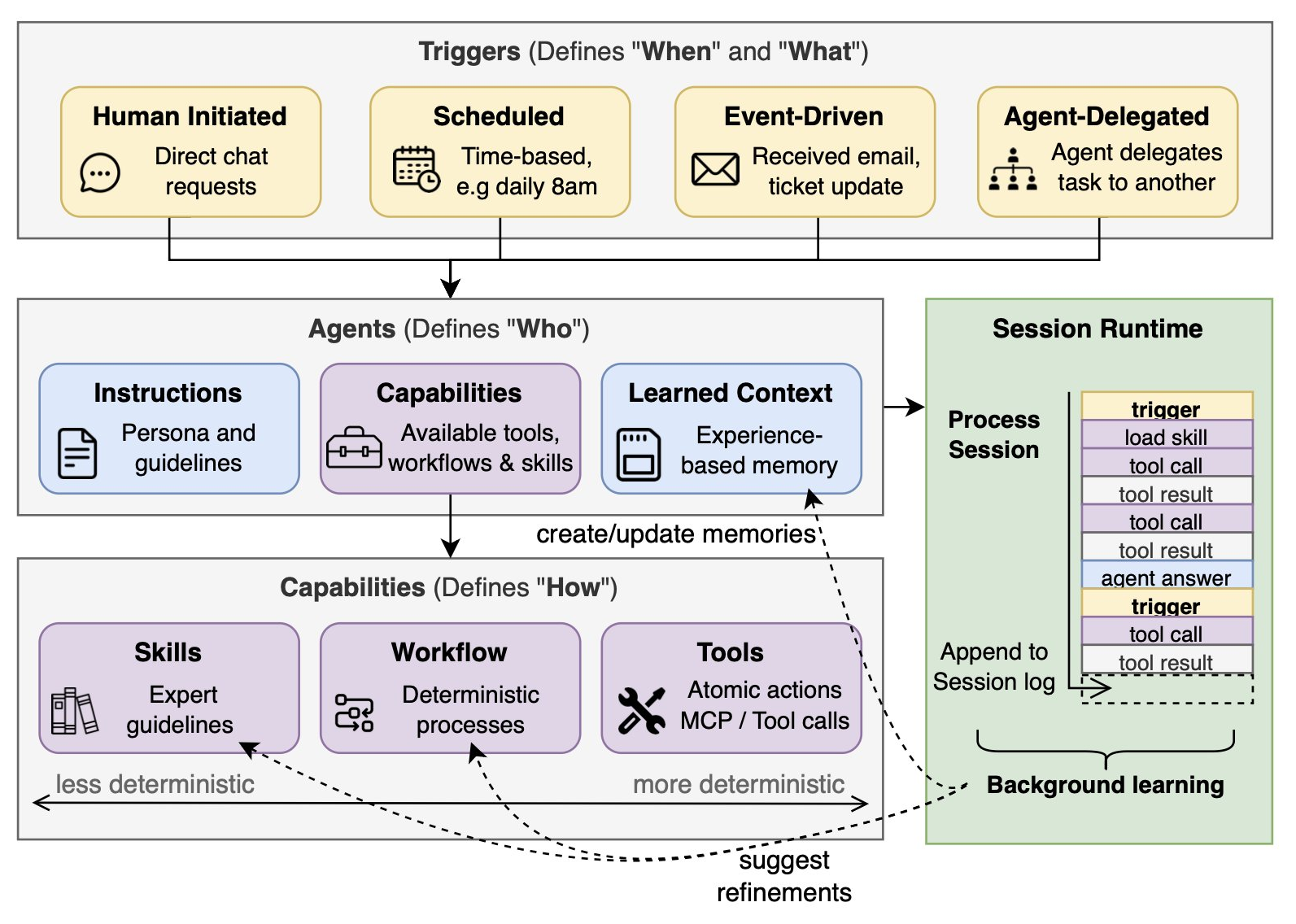
The framework organizes agentic tasks into distinct components. Triggers answer the When? and What? of a task by acting as the activation mechanism while carrying instructions. They span human-initiated conversational prompts, agent-delegated programmatic calls, scheduled time-based activations, and event-driven signals from external systems like webhooks or email.
Agents are defined as persistent, learning actors representing the Who? in any execution. Rather than being mere instructions, an agent is the entity that interprets them. An agent consists of standing instructions, dynamic capabilities, and learned context that accumulates through use. This allows repeated executions to improve over time without manual updates.
Capabilities represent the How? of agentic action, existing on a spectrum of confidence contracts between complete agent autonomy and strict determinism:
- Tools: Atomic operations featuring a typed schema, such as querying a database, reading a file, or utilizing a Model Context Protocol server.
- Skills: Structured guidance that leaves room for judgment, bundling instructions with resources that load progressively.
- Workflows: Deterministic coordination steps with fixed order, branching, and error handling managed through code rather than model inference.
What it means for developers
For developers building complex AI applications, having a clear taxonomy prevents the confusion of collapsing distinct architectures into one ambiguous choice. For instance, a request to monitor a Slack channel and send a daily digest can be implemented as a scheduled task, backed by a structured skill, or tied to a deterministic workflow. Developers can experiment with these concepts by testing top AI models cheaply through one API at https://apixoai.online.
Skills and workflows retain their value even as underlying models improve. Skills capture and share institutional expertise, while workflows provide auditability and multi-service coordination. Furthermore, these primitives are flexible: successful skills can crystallize into strict workflows, while rigid workflows facing frequent edge cases can loosen back into adaptive skills.
Source: Taxonomy of agentic primitives in Amazon Quick | Amazon Web Services — AWS Machine Learning. Written by the Apixo team from that report.
One key for Claude, GPT, GLM, DeepSeek and more. Pay per token with crypto.
Get your API key