Anthropic Introduces Enterprise Spending Analytics as Claude Code Adoption Surges
Anthropic has launched reporting tools to help enterprises track ROI on token spend following a profitable quarter and rapid adoption of its agentic coding tool, Claude Code.
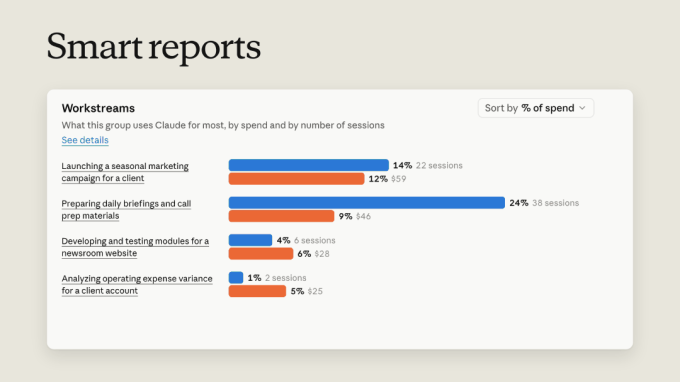
Anthropic has introduced a dedicated suite of reporting tools aimed at helping businesses evaluate the return on investment of their artificial intelligence deployments. The launch comes alongside investor updates showing significant financial momentum for the frontier lab, including an operating profit in the second quarter and a 900% net revenue retention rate, reflecting a ninefold increase in spending from existing customers between Q3 2025 and Q3 2026.
The new reporting platform addresses growing demands from corporate leadership to measure what their AI expenditures are actually producing. Enterprise managers can now view team performance over specified date ranges, tracking generated deliverables, overall token costs, and specific points where automated workflows broke down. Alongside these metrics, the reporting suite provides recommendations to help organizations refine outputs and introduces pooled group budgets to keep departmental expenditures under control. Anthropic noted that data gathered through these internal analytics and employee surveys will not be used for model training by default.
Measuring AI return on investment
While venture-backed startups have driven heavy token consumption, many Fortune 500 companies have struggled to realize clear efficiency gains from widespread AI implementation. Anthropic's new features are directly targeted at bridging this gap by demonstrating verifiable value.
A recent report from software development management platform Jellyfish highlighted the scale of this adoption. Evaluating data from 276,000 engineering customers using agentic coding tools, Jellyfish found that Anthropic models and Claude Code accounted for nearly one-third of all proposed code modifications submitted for review. Furthermore, spending on these tools has expanded tenfold since the start of the year, growing to represent roughly 2% of total engineering expenditures.
Nicholas Arcolano, chief scientist at Jellyfish, pointed out that even a 2% slice represents significant financial acceleration that many corporate finance officers had not anticipated. According to Arcolano, companies have moved past the initial phase of unmonitored spending and must now focus on process optimization and proven results.
Enterprise retention and the switching barrier
Anthropic's release also reflects the fierce competition among frontier AI labs trying to secure long-term enterprise customers. Despite the mid-year launch of OpenAI’s Astra model, Anthropic has retained strong market momentum among enterprise development teams.
Nikolas Albarran, AI product lead at Jellyfish, noted that while public social media discussions on X frequently suggest intense competition between models like OpenAI's Codex and Anthropic's offerings, enterprise switching remains low. Albarran observed that Anthropic established early enterprise workflows that functioned reliably, making customers reluctant to undertake the costly process of standardizing around a new provider.
Major AI developers have increasingly deployed forward-deployed engineering (FDE) teams—specialized consultants who work directly inside client organizations—to build customized setups and secure adoption. Anthropic's new reporting and diagnostic tools effectively serve as a lightweight version of this consulting assistance. As Albarran explained, once organizations configure their workflows around specific file structures and agent behaviors, the friction and technical cost of switching to an alternative provider become significant.
What it means for developers
For software engineers and technical leads, Anthropic’s new capabilities indicate a shift toward stricter governance and financial oversight around agentic coding tools. Instead of open-ended experimentation, engineering teams will increasingly be evaluated on how efficiently they deploy tokens relative to the code and features they ship.
Managers now have access to granular dashboards detailing where team workflows break down, turning token usage into a trackable productivity metric. The introduction of pooled group budgets also means individual contributors may face tighter daily or project-based limits on their automated workflows.
At the same time, understanding the cost-efficiency of different models is becoming an essential engineering skill. Developers who want to compare costs and evaluate alternatives across different providers can try top AI models cheaply through one API at https://apixoai.online. As enterprise leaders continue to scrutinize the line between automated productivity and spiraling infrastructure bills, developers who actively optimize their prompts and token budgets will be best positioned to succeed.
Source: Anthropic just launched tools to show companies what their AI spending is buying — TechCrunch AI. Written by the Apixo team from that report.
One key for Claude, GPT, GLM, DeepSeek and more. Pay per token with crypto.
Get your API key