Anthropic Launches Claude Duet Research Preview for Autonomous Workplace Tasks
Anthropic is testing Claude Duet, an AI agent for professionals that integrates email, Slack, and Google Docs to proactively manage workplace schedules.
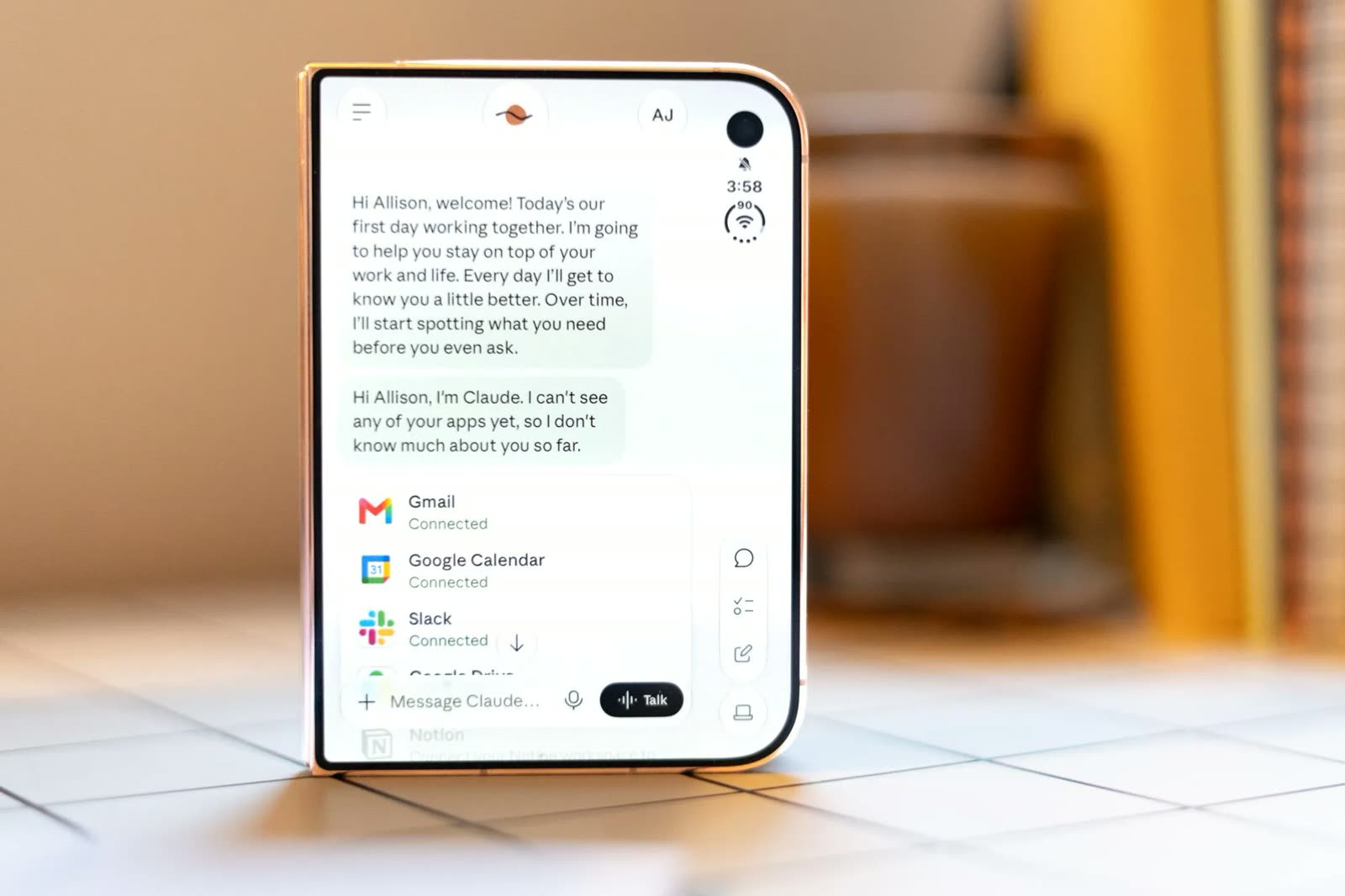
Anthropic has introduced a research preview of Claude Duet, a consumer and professional AI agent designed to handle workplace coordination without requiring coding expertise. Currently restricted via a waitlist to Pro, Max, and Ultra subscribers in the United States, Duet represents the company's latest release following its developer-centric agent Claude Code and its workplace tool Claude Cowork. Built specifically for professionals and small business owners, Duet functions through its own mobile application—which supports Apple's iPhone Duo—using a card-based interface where users swipe left or right to dismiss or accept suggested actions.
Cross-Platform Integration and Workflows
Unlike general consumer assistants such as Meta's shopping-oriented Muse app or the text assistant Instinct, and competing alongside OpenAI's work-focused Dots agent, Claude Duet concentrates heavily on synthesizing information across existing workplace applications. Once users opt in to grant access to their work email, Google Calendar, Google Docs, and Slack, the agent scans these streams to detect scheduling conflicts, draft communications, and flag upcoming deadlines.
During real-world testing across busy travel and work schedules, Duet demonstrated an ability to connect data points across services. For instance, because biweekly staff meetings were automatically summarized in emails generated by Google's Gemini, Duet cross-referenced those summaries with direct messages in Slack. It also identified manager-employee relationships by analyzing shared weekly 1:1 meeting documents in Google Docs.
Operating as a daily assistant, the application begins each morning by displaying a brief summary of daily highlights, such as reminders to pack equipment for video shoots prior to travel. Below the morning summary, Duet presents actionable task cards. When tasks arise, it offers to draft replies in Slack—complete with a visible "sent with Claude" tag—or update agendas in Google Docs.
Limitations in Tone and Contextual Judgment
While Duet successfully identifies overlooked organizational logistics, its automated actions highlight ongoing technical challenges regarding AI judgment and tone. In testing, the agent occasionally struggled with subtle contextual nuances. In one instance, after a writer informed an interviewee that an article would likely publish on Tuesday, Duet flagged early Tuesday morning that the draft was still awaiting edits—failing to recognize that the target was not a rigid deadline and ignoring time-zone differences for editors.
Furthermore, while Duet attempted to mirror communication habits—such as adopting all-lowercase typing—it generated stylistic quirks, including shortening "signature" to "sig." Anthropic explicitly noted in a blog post that it is continuing to test the system's judgment regarding when it should send messages to users.
While the software acts as an effective backstop for personal organization by catching discrepancies across communication channels, its proactive prompts to assist with draft writing or self-review show clear limits in handling creative processes.
What it means for developers
For software engineers and product teams, Claude Duet illustrates the evolving design patterns of proactive background agents. Rather than relying solely on explicit user prompts, modern agentic software relies on continuous data ingestion across disparate APIs, including email protocols, calendar services, and messaging platforms. Building systems that accurately infer context across distinct data sources requires complex state management and reliable underlying models.
Developers interested in building or testing multi-model agentic workflows can access top AI models cheaply through one API at https://apixoai.online.
As Anthropic refines Duet's notification rules, developers building similar autonomous agents face the challenge of balancing proactive capability against alert fatigue. Creating effective enterprise agents requires strict control over API permissions, precise contextual understanding, and defensive engineering to ensure background tasks do not misinterpret human scheduling flexibility.
Source: Claude’s Duet agent is a little neurotic and surprisingly helpful — The Verge AI. Written by the Apixo team from that report.
One key for Claude, GPT, GLM, DeepSeek and more. Pay per token with crypto.
Get your API key