Anthropic S-1 Disclosures Detail Enterprise Gaps for Systems Integrators and SaaS
Anthropic's latest S-1 filing reveals enterprise demands for AI agent logs, structural risks for SaaS providers, and clear opportunities for systems integrators.
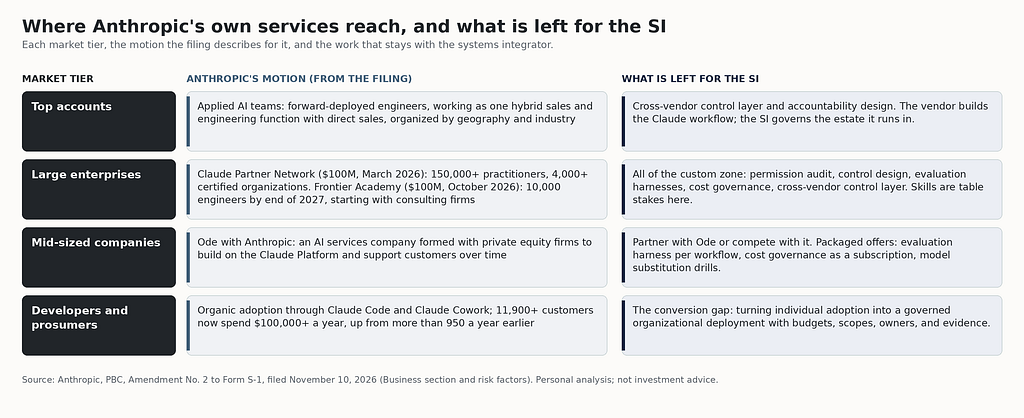
Anthropic’s Amendment No. 2 to its S-1 filing, submitted on November 10, 2026, offers a detailed look into the operational realities of scaling frontier AI in corporate environments. According to the document, enterprise adoption has expanded rapidly, growing from over 950 enterprise accounts spending at least $100,000 annually to more than 11,900 as of September 30, 2026. This customer base now includes every Fortune 10 company and over half of the Fortune 500, yielding a net revenue retention rate of approximately 900%. However, the vendor's risk disclosures underscore a persistent gap between what enterprise buyers demand and what foundation model providers can directly deliver.
Enterprise software purchasers expect high availability, strict security controls, auditability, and consistent system performance. For autonomous offerings like Claude Code and Claude Cowork—which Anthropic classifies as Virtual Collaborators—the requirements are significantly stricter. Buyers demand granular logs capturing agent reasoning, tool calls, and external system interactions before granting write access to internal code repositories, deployment pipelines, or databases. The filing acknowledges that an inability to supply logs at this required detail could constrain client adoption and accelerate customer churn.
Where vendor capabilities end and integrators step in
To bridge the gap between model deployment and business integration, Anthropic has heavily leveraged channel partners. The Claude Partner Network launched in March 2026 supported by a $100 million commitment, reaching more than 150,000 practitioners and 4,000 certified organizations by late September. This was followed by the October 2026 launch of the Claude Frontier Academy, another $100 million initiative aimed at training 10,000 engineers by the end of 2027. Anthropic has also established specialized practices, such as Applied AI teams featuring forward-deployed engineers for key accounts, and Ode with Anthropic, a joint venture targeting mid-sized companies alongside private equity firms.
Despite these internal and partner investments, core governance challenges remain outside the scope of model updates. Because large enterprises run diverse agent runtimes across platforms from Salesforce, ServiceNow, SAP, and Oracle, no single model vendor can govern competitor systems. Systems integrators retain defensible ground by designing cross-platform permission structures, assigning accountabilities, setting workflow-level kill switches, and establishing audit trails that consolidate actions across multiple enterprise tools.
Navigating SaaS risks, pricing, and infrastructure dependencies
The S-1 filing also highlights direct friction points for Software-as-a-Service (SaaS) providers. While data platforms like Salesforce and Snowflake serve as key distribution vectors—with cloud marketplaces carrying 44% of Anthropic's nine-month revenue across AWS, Google Cloud, and Azure—Anthropic admits it increasingly competes with its own software customers. desktop-level tools that operate user interfaces directly create long-term risks for standard seat-based licensing models.
In response, SaaS companies are moving toward action-metered architecture to preserve revenue. For example, Salesforce introduced Agentforce Flex Credits priced at $500 per 100,000 credits, charging 20 credits per completed action. Furthermore, building native agents atop a single model exposes software vendors to unexpected infrastructure interruptions. Anthropic’s filing references significant service events, including a March 2026 outage and a three-week export-control shutdown of two models in June 2026. These disruptions underline the operational necessity of maintaining multi-model fallback options rather than tying application logic to a single model vendor.
What it means for developers
For software engineers, system architects, and technical consultants, the filing signals a shift in where value is generated. As baseline model skills, connectors, and agent runtimes become commoditized by vendors, developer focus must pivot toward governance, evaluation, and operational resiliency.
Engineers building enterprise workflows need to construct robust evaluation harnesses to benchmark model releases, run automated regression tests, and maintain performance baseline records. Additionally, token cost governance requires implementing continuous monitoring, setting workflow-specific spending limits, and configuring fallback routing so routine tasks run on lower-cost models while reserving frontier capabilities for complex reasoning steps. Developers looking to test and evaluate diverse model architectures cheaply through one key can utilize unified API access through services like https://apixoai.online to streamline multi-provider workflows.
Ultimately, long-term success with enterprise agents relies less on prompt customization and more on underlying software engineering discipline: enforcing fine-grained access control at the business-object level, securing API gateways, and providing verifiable audit evidence for every automated action.
Source: What Anthropic’s S-1 Leaves for Systems Integrators and SaaS Providers — Towards AI. Written by the Apixo team from that report.
One key for Claude, GPT, GLM, DeepSeek and more. Pay per token with crypto.
Get your API key