Apple Launches Health AI Study with OpenEvidence to Assess Conversational Care Tools
Apple has partnered with clinical platform OpenEvidence on a 200,000-person study evaluating how users interact with and assess conversational AI health responses.
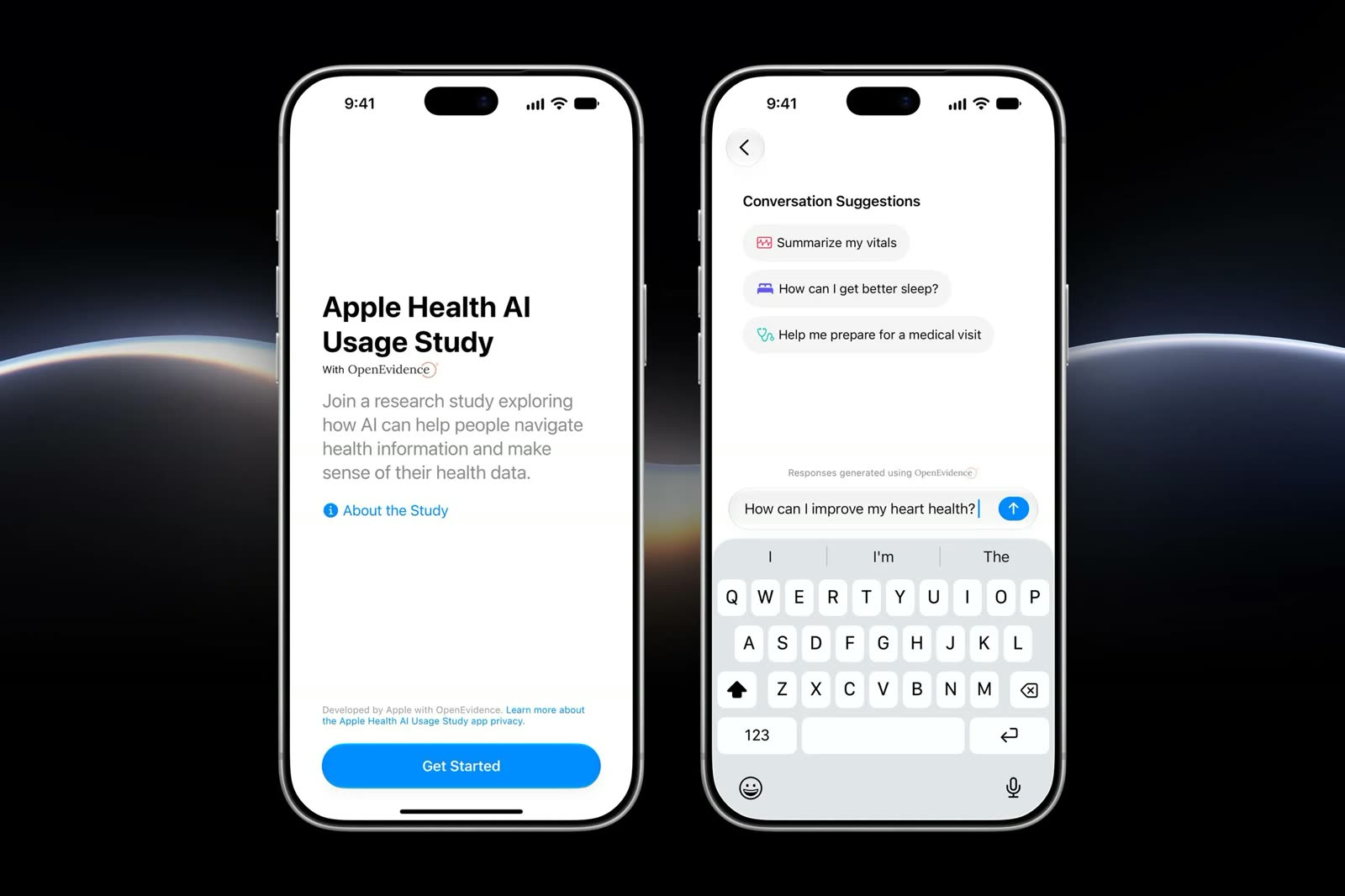
Apple has introduced a research initiative aimed at evaluating how individuals interact with conversational artificial intelligence in medical contexts. Named the Apple Health AI Usage Study, the project is being conducted in partnership with OpenEvidence, a clinical AI platform widely used by healthcare professionals to synthesize medical literature from publications such as The New England Journal of Medicine. Through this collaboration, Apple intends to analyze how useful and comprehensible AI-generated medical answers are when presented directly to consumers.
The project explores how people formulate health questions, assess the information returned to them, and navigate medical feedback. By gathering real-world interactions at scale, the study aims to refine the design and utility of future digital health systems.
How the Apple Health AI Usage Study works
Participation in the study is managed through a dedicated iOS application that is now open for download. Apple is aiming to enroll up to 200,000 participants across the United States. To be eligible, users must be at least 21 years old and possess an iPhone 15 Pro running iOS 26 or later.
Within the application, participants submit medical queries using text-based prompts. While users can enter questions via the standard iOS keyboard's dictation feature, the software does not integrate with Siri or Apple Intelligence, nor does the application itself rely on Apple Intelligence. In return, the platform provides plain-language answers accompanied by citations and links to peer-reviewed clinical literature.
After receiving a response, participants are asked to rate the quality of the interaction based on three core benchmarks:
- Accuracy
- Detail
- Relevance
These feedback metrics are intended to give researchers a direct view of whether conversational tools meet the practical expectations of users seeking health information.
Data handling and personal health context
To gauge whether individualized data improves conversational health guidance, the study offers participants an option to connect their Apple HealthKit records during enrollment. Users can choose to share background metrics such as sleep patterns, physical activity, and clinical laboratory results, allowing the AI to generate answers tailored to their specific health history.
Apple has emphasized that user privacy remains central to the study. Safeguards have been implemented to ensure that participant information remains confidential. Additionally, the company stated that data gathered throughout the study will not be utilized to train artificial intelligence models.
Sumbul Desai, MD, Apple’s vice president of Health and Fitness, emphasized the role of clinical validation in deploying consumer-facing medical technology: "At Apple, we believe responsible innovation starts with scientific rigor and clinical grounding. Health is deeply personal, and conducting a dedicated research study is the most thoughtful way to understand how people engage with, comprehend, and evaluate health AI in everyday life. Insights from this study will help advance the broader scientific conversation and ensure that as technology evolves, we continue building trusted tools that genuinely support people wherever they are on their health journey."
What it means for developers
Apple's research framework highlights several critical design considerations for software engineers building consumer-facing AI applications, particularly in sensitive sectors like healthcare.
First, the reliance on OpenEvidence and verified literature from sources like The New England Journal of Medicine demonstrates the necessity of verifiable grounding. When handling high-stakes domains, generative interfaces must pair direct conversational responses with transparent links to authoritative, peer-reviewed sources. For developers, this underscores the importance of robust retrieval-augmented generation (RAG) architectures over purely generative, ungrounded outputs.
Second, the evaluation criteria used in the study—accuracy, relevance, and level of detail—provide a practical rubric for assessing model performance. Rather than measuring success purely through engagement or speed, teams developing specialized assistants need evaluation pipelines focused on response clarity and factual correctness. When prototyping and benchmarking these specialized conversational flows, developers can try top AI models cheaply through one API at https://apixoai.online to compare how different base architectures handle factual retrieval and domain-specific prompts.
Finally, Apple’s commitment not to train AI models on participant HealthKit data highlights an ongoing industry requirement: strict separation between personal user context and model optimization. Developers working with sensitive data must design architectures where personal metrics can inform immediate queries without being absorbed into model training datasets.
Source: Apple’s new study looks to improve the effectiveness of AI health tools — The Verge AI. Written by the Apixo team from that report.
One key for Claude, GPT, GLM, DeepSeek and more. Pay per token with crypto.
Get your API key

