AWS Releases Amazon Bedrock AgentCore Web Search API for Live AI Agents
AWS has introduced the Web Search API in Amazon Bedrock AgentCore, enabling LangChain and LangGraph AI agents to retrieve current, cited web results using native AWS credentials.
Amazon Web Services has launched the Web Search API for Amazon Bedrock AgentCore, providing AI agents and applications with current web search results through a single API call signed using standard AWS IAM credentials. Queries are executed against an in-house web index operated directly by Amazon rather than being routed to external third-party search engines. Each query response returns the page title, URL, publication timestamp, and a query-relevant text snippet. Developers can configure domain inclusion or exclusion lists and constrain search queries by publication date ranges.
Parallel Execution and LangGraph Integration
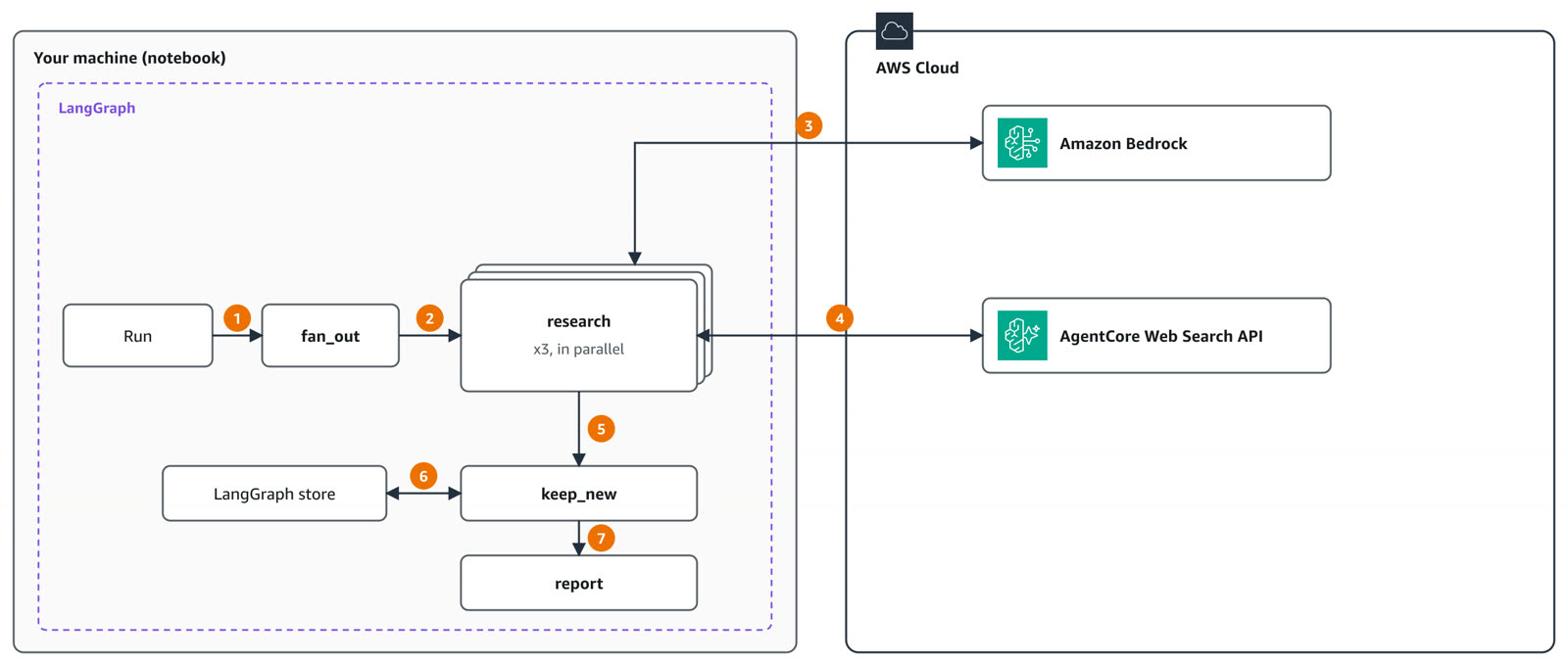
To demonstrate practical usage, AWS showcased a reference implementation for an automated security dependency watcher built using the LangGraph orchestration framework and Anthropic Claude models hosted on Amazon Bedrock. The workflow checks daily updates across three distinct software ecosystems: npm, PyPI, and container base images.
Instead of running queries sequentially, the system utilizes LangGraph's Send API to fan out research across all three branches simultaneously. In performance tests conducted by AWS, running the three ecosystem investigations in parallel completed in 36 seconds of wall time, compared to 99 seconds when executed sequentially. The entire run executed 12 searches across the branches and returned 80 distinct sources.
To prevent agent hallucination or policy evasion, core operational constraints are retained entirely within application code rather than delegated to the model prompt. Using the create_web_search_toolkit function from the langchain-aws package, developers can strictly enforce rules such as a maximum search budget (capped at four searches per branch), domain blocklists, and temporal date floors.
Once research results are generated, deterministic code performs four verification checks on every reported finding:
- Verifying that the cited URL was explicitly returned in the branch's web search.
- Confirming the source text contains the package name as a whole word.
- Checking that any referenced CVE or advisory ID appears directly within the source text.
- Ensuring the publication date falls within the defined time window.
In test runs, these programmatic checks filtered out ungrounded results, such as missing package names or unverified CVE identifiers. Furthermore, findings are stored in a state memory layer—such as an in-memory store or Amazon DynamoDB—to prevent duplicate reporting of previously handled advisories across scheduled daily runs.
Deployment Options and Enterprise Governance
The AgentCore Web Search API integrates across multiple execution environments, including AWS Lambda, Amazon Elastic Container Service (Amazon ECS), and the Amazon Bedrock AgentCore runtime environment. Operating the search capability requires specific IAM permissions (bedrock-agentcore:InvokeWebSearch), eliminating the need to store, distribute, or rotate separate third-party search API keys. By default, AWS accounts share a regional quota of 10 requests per second.
For enterprise governance, organizations can route web search traffic through AgentCore Gateway. Under this architecture, a central platform team can attach administrator-defined source policies and domain blocklists directly to gateway targets. This hides policy logic from individual agents and Model Context Protocol (MCP) clients, preventing sub-agents from bypassing organizational web search rules.
Developers deploying agents on the AgentCore runtime can choose between isolated MicroVM environments for stateless session privacy or AWS-managed EC2 instances for multi-day, high-throughput, or GPU-assisted agent workflows.
What it means for developers
The integration of native web search into Amazon Bedrock AgentCore simplifies the creation of retrieval-augmented autonomous agents that require real-time external data without exposing internal search intent to third-party providers. By binding search access directly to AWS Signature Version 4 (SigV4) authentication, teams eliminate the friction and security overhead of managing external search API keys.
Building reliable workflows requires combining flexible reasoning with strict deterministic code controls. LangGraph and LangChain developers can enforce strict data verification layers around model outputs, ensuring that security advisories or external research outputs are fully grounded in cited artifacts before triggering downstream workflows.
For engineering teams testing agent architectures across multiple foundation models or managing infrastructure costs, developers can try top AI models cheaply through one API at https://apixoai.online.
Whether running isolated workflows in Python 3.10+ using boto3, bedrock-agentcore, and langchain-aws, or deploying centralized gateways for enterprise MCP clients, the launch provides a structured path for bringing verifiable, web-aware AI agents into production AWS environments.
Source: Build a daily dependency watcher with LangGraph and Amazon Bedrock AgentCore web search | Amazon Web Services — AWS Machine Learning. Written by the Apixo team from that report.
One key for Claude, GPT, GLM, DeepSeek and more. Pay per token with crypto.
Get your API key