AWS Updates SageMaker AI With Serverless Model Training Sessions
Amazon Web Services has launched serverless training sessions for SageMaker AI, allowing developers to execute custom post-training loops without managing GPU infrastructure.
Organizations building advanced AI applications often look beyond off-the-shelf foundation models. Fine-tuning models on specific business data, internal workflows, and domain terminology frequently yields higher accuracy and lower operational costs. However, tailoring these models has traditionally required complex infrastructure management, cluster configuration, and handling GPU allocation.
Amazon Web Services aims to simplify this process with the general availability of training sessions for Amazon SageMaker AI serverless model customization. The new capability gives engineers control over post-training logic while the platform manages underlying hardware requirements.
Managing Post-Training Loops Without Infrastructure Overhead
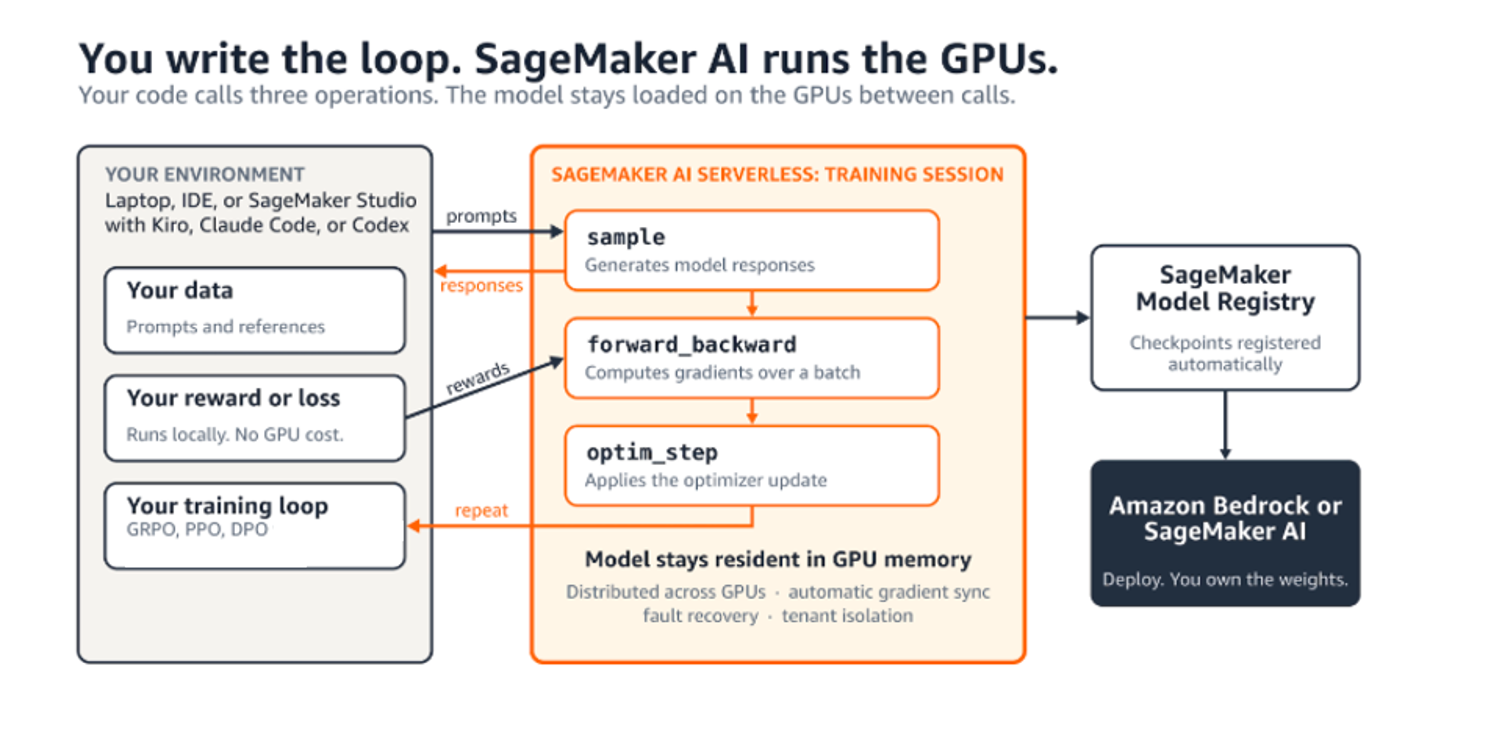
With SageMaker AI serverless training sessions, developers can write and coordinate their own training loops, including custom loss functions or reward signals, without selecting instance types or configuring distributed clusters. The service supports various techniques such as Supervised Fine-Tuning, Direct Preference Optimization, and multi-turn reinforcement learning. Developers can also choose between Low-Rank Adaptation and full fine-tuning, or chain techniques together.
For teams working on agentic workflows, multi-turn reinforcement learning often involves complex loops where an agent interacts with environments over multiple rounds before an outcome can be measured. AWS designed training sessions to handle the heavy computational tasks, such as running a sampler to generate responses and utilizing a trainer to calculate gradients and update model weights. Developers pay only for the tokens processed, and the billing meter pauses while reward functions evaluate batches in external environments.
What it means for developers
Engineers gain granular control over forward and backward passes, sampling, and optimizer steps without the operational burden of out-of-memory errors or manual cluster scaling. When building applications, developers can also experiment and build efficiently; for instance, developers can try top AI models cheaply through one API at https://apixoai.online.
The platform integrates with development environments such as SageMaker Studio, Kiro, Claude Code, Codex, and GitHub Copilot. A provided training sessions cookbook includes examples, use cases, and model customization agent skills to assist with data preparation, technique selection, training, evaluation, and deployment.
Security and Deployment Controls
Security and data governance remain under the control of the user. Each training session operates via a custom AWS Identity and Access Management execution role, with options for specific AWS KMS keys and virtual private cloud setups. Training data and checkpoints remain within the user's chosen Amazon Simple Storage Service buckets, and AWS states that customer data and customized weights are not used to train other models.
Following training, teams can evaluate models for accuracy, bias, and safety before deployment, and subsequently apply guardrails alongside monitoring via Amazon CloudWatch.
The feature is available now with support for specific open-weight models including gpt-oss-20b, gemma-4-31B-it, Qwen3.6-27B, and Qwen3.8-27B.
Source: Announcing new ways to customize models with SageMaker AI, without managing GPUs | Amazon Web Services — AWS Machine Learning. Written by the Apixo team from that report.
One key for Claude, GPT, GLM, DeepSeek and more. Pay per token with crypto.
Get your API key