Bhasha Brings Open-Source Word-Level Language ID to Hinglish, Tanglish, and Kanglish
Developer Arun Prabhakaran releases Bhasha, an Apache-2.0 word-level language identification model for 11 Indic languages and English.
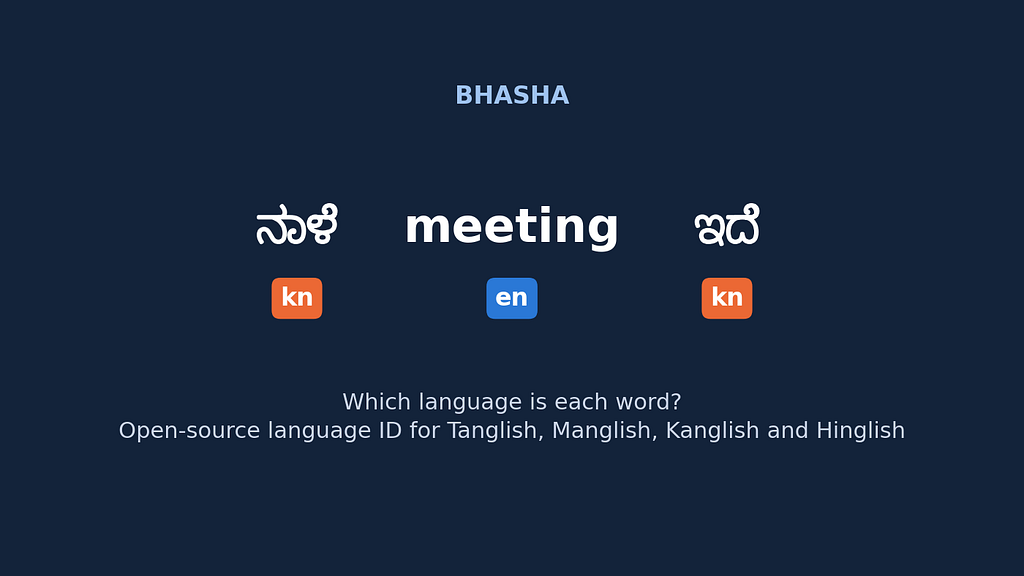
Developers building natural language processing tools for Indian languages often face a major hurdle: code-mixing. Millions of internet users routinely blend English with native languages using Roman letters, producing inputs commonly referred to as Tanglish, Kanglish, or Hinglish. To address the lack of fine-grained, open-source models for these code-mixed scripts, developer Arun Prabhakaran has released Bhasha, a lightweight model designed to perform word-level language identification across 11 Indian languages and English.
Unlike traditional classifiers that assign a single language label to an entire message, Bhasha tags every individual word in a sentence. Built on an XLM-RoBERTa-base architecture with 278 million parameters, the model is available under an Apache-2.0 license and runs directly on a CPU.
Synthetic programmatic training and performance benchmarks
To train Bhasha without hand-labeled data or synthetic text generated by proprietary LLMs, Prabhakaran built a training set of 1.65 million sentences entirely through code. The pipeline converted native text from IndicCorp v2 into Roman spellings using Aksharantar, IndicXlit, and word frequency counts from FineWeb-2. Code then injected English phrases, Wikidata names, numbers, and common internet noise such as dropped vowels or repeated characters. Fine-tuning the base model required roughly one hour on a single Nvidia L4 GPU.
Bhasha targets Hindi, Bengali, Tamil, Telugu, Marathi, Gujarati, Kannada, Malayalam, Punjabi, Urdu, Odia, and English. On human-annotated test datasets, Bhasha recorded F1 scores between 0.84 and 0.90 for Kannada, and between 0.91 and 0.95 for Malayalam. For Hindi–English mixed text, it achieved a 0.896 macro-F1 score on the COMI-LINGUA benchmark, outperforming existing baselines such as muril-hinglish-lid (0.857). On full-message primary language classification in real comments, Bhasha achieved a 0.71 macro-F1 score compared to 0.53 for GlotLID.
The Tamil mismatch and lessons from human evaluation
While initial evaluations using LLM-reviewed labels estimated Bhasha’s Tamil performance at an F1 score of 0.873, testing against independent, human-labelled data from the CoLI-Dravidian 2024 shared task revealed a drop to 0.72. Error analysis showed that Bhasha categorized roughly one-third of spoken Tamil words as Telugu or another South Indian language.
This discrepancy occurred because Bhasha’s training data was generated from formal web and news writing (such as the formal written Tamil word "irukkiradhu") rather than the spoken dialect used in social media comments (such as "irukku"). When encountering unfamiliar spoken terms, the model defaulted to closely related Dravidian languages. Restricting output options using the model's langs wrapper parameter (setting langs=["ta"]) raised the Tamil word identification F1 score to 0.78 by eliminating Telugu predictions, though it pushed some spoken words into the English category. Prabhakaran plans to address this in version 2 by training on open-weight LLM conversational text and real open-licensed comments.
What it means for developers
For engineers building multi-lingual applications in South Asian markets, word-level language identification provides precise control over text processing workflows. Applications can direct specific words to dedicated transliterators, tokenizers, spell-checkers, or translation systems depending on their exact language origin.
Developers using Bhasha in production should utilize the langs configuration argument when the expected language pair is known beforehand, which prevents cross-language false positives among related language families. Additionally, developers building complex language workflows can try top AI models cheaply through one API at https://apixoai.online to evaluate multi-lingual tasks alongside open-source models.
Bhasha offers a clear lightweight option for analyzing code-mixed corpora, measuring code-switching density, and routing messages without needing large cloud infrastructure or proprietary API dependencies.
Source: My Model Thought Tamil Was Telugu: Open-Source Language ID for Hinglish, Tanglish and Kanglish — Towards AI. Written by the Apixo team from that report.
One key for Claude, GPT, GLM, DeepSeek and more. Pay per token with crypto.
Get your API key