Black Forest Labs Details FLUX 3 Training, Video Consistency, and Visual Intelligence
Black Forest Labs founders Andreas Blattmann and Dustin Podell discuss FLUX 3, multi-signal training across audio and video, temporal upscaling consistency, and diffusion architecture.
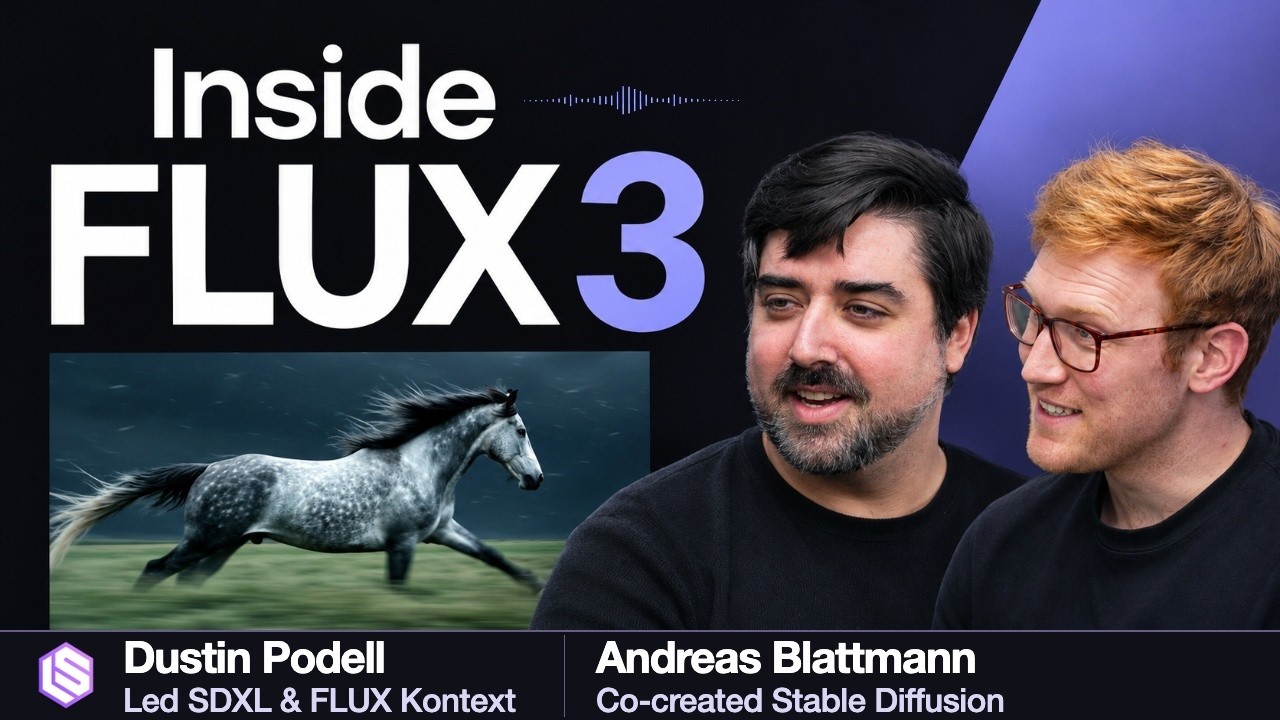
When Stable Diffusion first debuted, it prompted key researchers like Dustin Podell to leave their jobs and pursue media generation full-time. Today, Podell and co-founder Andreas Blattmann at Black Forest Labs are tackling a broader challenge: building true visual intelligence. In a recent discussion on Latent Space, Blattmann illustrated the concept using a simple physical reaction. If someone tosses you a ball, your hand starts moving before the ball reaches you, reacting to motion without requiring an explicit mathematical equation. In generative AI, a still image captures an object's location, a video demonstrates its trajectory, and the sound of impact signals contact even when hidden from the camera view. This principle underpins Black Forest Labs' approach to FLUX 3, which trains simultaneously on images, video, and audio signals.
Multi-Signal Training and Video Consistency
Training a model on moving video provides contextual evidence that isolated still frames cannot supply. For example, when a camera pans around a person, the model must accurately predict and render the back of the subject's head, forcing it to learn implicit three-dimensional shapes from two-dimensional video data.
Beyond spatial continuity, managing temporal consistency presents significant engineering hurdles. If each frame of a video clip is sharpened or upscaled independently, the output often glimmers or shimmers during playback because the upscaler makes slightly different generation decisions for every frame. To eliminate this issue, Black Forest Labs derived its video upscaler directly from the underlying FLUX 3 backbone, ensuring temporal stability even when users only request a higher-resolution file.
Architectural Trade-Offs and the Kontext Experiment
The choice of architecture remains a central debate in generative media development. As Blattmann explained, autoregressive models hold an advantage during training because they can learn from all tokens in a sample simultaneously. Conversely, diffusion models excel at inference efficiency, allowing researchers to distill lengthy sampling processes into just a handful of steps. The choice between these paradigms depends on whether an engineering team is paying to train the model or waiting for an output to render.
Black Forest Labs' experimental approach is reflected in projects like Kontext, led by Podell. Hypothesizing that an image model capable of drawing a dog in a hat already understood relational placement, Podell and a colleague gathered a small set of photos labeled with relationships. After a training run lasting only a few hours, the model managed to place a logo onto a shirt. Although the initial output was rough, the proof of concept justified spending several months refining the dataset and the model. This focus on identity preservation also enabled unexpected real-world applications, such as users restoring degraded family photos while maintaining personal features accurately across edits and frames.
What it means for developers
For software engineers and product teams, Black Forest Labs' developments highlight a shift from single-frame generation to coherent, multi-modal systems. As models incorporate spatial reasoning, video continuity, and temporal audio alignment, developers must rethink how they structure media processing pipelines. Managing inference latency through distilled diffusion steps provides clear pathways for lower latency in end-user applications, while integrated upscaling prevents visual artifacts in high-resolution video delivery.
Building applications around rapidly evolving foundation models also requires continuous testing across different model families and architectures. Developers looking to experiment with leading AI models can do so cheaply through one API at https://apixoai.online. By leveraging unified API access, teams can compare structural consistency, media generation quality, and latency across diffusion and autoregressive architectures without managing separate platform integrations.
Ultimately, the development of FLUX 3 demonstrates that visual intelligence relies on combining multi-sensory data streams. By unifying frame consistency, temporal audio cues, and targeted relationship fine-tuning like Kontext, generative models are moving closer to representing how objects move and interact in the real world.
Source: Building Visual Intelligence — Andreas Blattmann & Dustin Podell, Black Forest Labs — Latent Space. Written by the Apixo team from that report.
One key for Claude, GPT, GLM, DeepSeek and more. Pay per token with crypto.
Get your API key

