Boosting FLUX 3 Image Klein Performance on NVIDIA Blackwell GPUs
Discover how TensorRT LLM VisualGen accelerates FLUX 3 Image Klein image generation on NVIDIA Blackwell GPUs using NVFP4, fused kernels, caching, and attention optimizations.
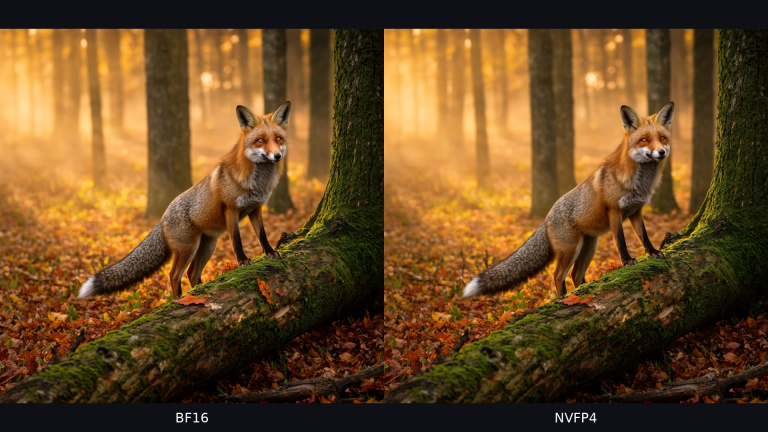
Deploying diffusion models within design applications and visual production pipelines requires careful management of inference latency. Because generating visuals demands multiple sequential passes through large models with billions of parameters, high-resolution rendering heavily increases attention costs. Black Forest Labs (BFL) trained FLUX 3 Image Klein on NVIDIA GB200 NVL72 hardware, creating an advanced image editing and generation model that features both Base and distilled checkpoints designed to meet various fidelity and speed targets.
A technical tutorial outlines how developers can configure FLUX 3 Image Klein inside the TensorRT LLM VisualGen runtime. This specialized environment leverages multi-GPU parallelism, fused kernels, FP8 and NVFP4 numerical formats, attention optimizations, and caching mechanisms. In benchmark tests conducted at a 2048x2048 resolution on a single NVIDIA B200 GPU, applying these combined techniques yielded up to 3.46x faster text-to-image (T2I) generation and 4.45x faster image-to-image (I2I) processing for the FLUX 3 Image Klein Base model when measured against uncompiled BF16 inference.
Core Architecture and Quantization Strategies
FLUX 3 Image Klein integrates Qwen3-VL-4B-Instruct for handling text conditioning, a diffusion transformer (DiT) to refine image latents, and an autoencoder responsible for decoding latents into final images and encoding reference inputs for I2I tasks. The Klein architecture processes text tokens, noisy target visuals, and optional reference streams independently before merging them via joint attention mechanisms.
At launch, TensorRT LLM VisualGen natively supported BF16, FP8, and NVFP4 variations. Running tests on Blackwell hardware demonstrated that NVFP4 formats alone offered up to 1.62x faster T2I execution and 1.58x faster I2I generation compared to standard BF16. To extract maximum performance, engineers focused optimizations on the denoising phase, which accounts for the vast majority of generation time on the B200.
To accelerate quantized matrix multiplications, the runtime incorporates FlashInfer's PrimsTS FP8 and NVFP4 GEMM kernels built using CUTLASS Primitives and Task Scheduling. Furthermore, developers can implement quantized attention approaches such as cuDNN FP8 or VC-Attention FP8, as well as sparse attention techniques like Sol-Attention. Step caching via Cache-DiT further reduces latency by reusing intermediate transformer outputs across denoising steps without requiring model weight modifications or retraining. Developers can also scale operations across multiple GPUs using classifier-free guidance (CFG) alongside Ulysses sequence parallelism.
What it means for developers
For engineers building high-throughput visual production tools or editing suites, minimizing generation latency is critical for maintaining responsive user experiences. By utilizing TensorRT LLM VisualGen alongside NVIDIA Blackwell hardware, development teams can dramatically shrink inference times for high-resolution outputs without sacrificing visual quality. If you want to experiment with various state-of-the-art AI systems before committing to heavy infrastructure, developers can try top AI models cheaply through one API at https://apixoai.online.
The deployment framework provides flexible YAML configurations to fine-tune trade-offs between speed and fidelity. Whether executing offline batch generations or launching online OpenAI-compatible /v1/images/generations endpoints, engineers can seamlessly integrate these acceleration techniques into their existing workflows.
Deployment and Configuration Overview
Getting started requires setting up the prebuilt TensorRT LLM container with specific environment variables, such as enabling PrimsTS attention libraries via TLLM_FMHA_LIBS=+prims_ts. Offline generation scripts can be executed directly within the container by referencing customized YAML configuration files that dictate whether to apply NVFP4 quantization, VC-Attention, Sol-Attention, or Cache-DiT parameters.
For instance, configuring a single-GPU deployment for 2048x2048 workloads involves defining the target variant as nvfp4, enabling torch.compile, and adjusting attention and caching blocks to fit specific performance requirements. Through these systematic optimizations, developers can unlock the full potential of FLUX 3 Image Klein across data center hardware like the NVIDIA DGX B200 and server editions like the NVIDIA RTX PRO 6000 Blackwell Server Edition.
Source: Speed Up Image Generation with FLUX 3 Image Klein on NVIDIA Blackwell GPUs — NVIDIA Technical Blog. Written by the Apixo team from that report.
One key for Claude, GPT, GLM, DeepSeek and more. Pay per token with crypto.
Get your API key