California Enacts Landmark Protections Limiting AI Use in Workplace Decisions
California Governor Gavin Newsom has signed legislation restricting fully automated firings, neural data harvesting, and AI-driven surveillance in workplace restrooms.
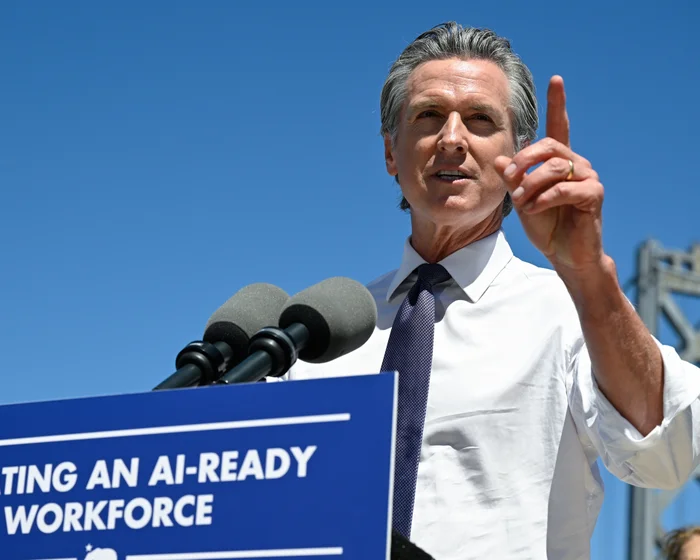
California Governor Gavin Newsom has signed a comprehensive package of legislation establishing new legal boundaries around how employers deploy artificial intelligence in the workplace. The measures arrive amid nationwide discussions over automation, employee monitoring, and labor protections, positioning California at the forefront of state-level tech regulation as federal oversight remains largely hands-off.
The newly enacted statutes place strict limits on automated human resources decisions and monitoring practices. Under the rules, employers are prohibited from relying entirely on automated systems to terminate employees, using AI to infer or predict workers' emotional states, and collecting neural data, which covers electrical signals generated by an individual's brain or nervous system. Additionally, businesses must formally notify workers if layoffs result from AI implementations, and the deployment of AI-based surveillance inside workplace bathrooms is strictly banned.
Addressing Rising Concerns Over Surveillance and Job Displacement
The legislative push follows growing worker pushback against algorithmic management. Prior grievances cited across various industries include Amazon warehouse staff reporting timed bathroom breaks, and nurses at Kaiser Permanente contending with automated software that evaluated their tone of voice during patient discussions.
While other states—such as Colorado, Connecticut, Illinois, and Texas—have recently passed narrower statutes addressing workplace AI, California's framework covers a broader range of employment practices. Lorena Gonzalez, president of the California Federation of Labor Unions, AFL-CIO, noted that labor organizations have actively tracked commercial AI releases to anticipate where algorithmic oversight might be introduced. Gonzalez described the legislation as a turning point, noting that worker advocates also aim to revive previously stalled measures, such as a bill requiring employers to disclose all workplace AI usage that previously died in the state assembly's appropriations committee.
Tensions surrounding corporate automation have also materialized in legal actions and policy adjustments. In June, Meta paused an internal initiative that monitored employee computer activity to generate training data for its models. A month later, dozens of Meta workers filed a lawsuit alleging that the company's automated tools disproportionately selected staff on medical leave, parental leave, or disability accommodations for job cuts.
Enforcement Mechanics and Practical Industry Concerns
While labor advocates celebrate the legislative progress, legal scholars point to structural limits in how the rules are applied. Robin Feldman, director and founder of the AI Law & Innovation Institute at the University of California College of the Law, San Francisco, highlighted that the statutes lack a private right of action. Because individual workers cannot bring civil lawsuits under the bills, compliance remains entirely in the hands of state government enforcement.
At the same time, representatives from the employer defense sector question whether tool-specific constraints align with enterprise operations. Danielle Ochs, a shareholder at the San Francisco office of employment law firm Ogletree Deakins, observed that businesses are focused on establishing holistic governance rather than navigating dozens of separate compliance hurdles for individual tools. Ochs also pointed out concerns that rigid prohibitions could inadvertently restrict beneficial safety technologies, such as computer vision systems designed to detect when commercial truck drivers fall asleep at the wheel.
What it means for developers
For engineering teams and software vendors building enterprise tools, HR platforms, or workforce analytics systems, California's legal shift requires immediate product adjustments. Any system designed to assist with performance reviews, staffing reductions, or shift scheduling can no longer operate as a fully autonomous decision-maker for terminations. Developers must ensure that human-in-the-loop review mechanisms are deeply integrated into software architectures.
Furthermore, developers working on sentiment analysis, biometric monitoring, or telemetry tools must re-evaluate feature sets intended for corporate workplaces. Software that scores employee vocal cadence, infers emotional distress, or monitors physical movement in sensitive areas will encounter severe legal roadblocks in California. Companies creating workforce software must also ensure their platforms generate clear audit trails and reporting outputs so enterprise clients can fulfill mandatory notification obligations when automated tools influence corporate restructuring.
As organizations re-examine how to build responsible, compliant workplace tools, testing different model behaviors and guardrails is essential. Developers building and evaluating internal workflows can try top AI models cheaply through one API at https://apixoai.online, simplifying access across providers while maintaining transparent, responsible system designs.
Source: California’s new laws target workers’ biggest fear of AI taking their jobs — The Guardian AI. Written by the Apixo team from that report.
One key for Claude, GPT, GLM, DeepSeek and more. Pay per token with crypto.
Get your API key