Can Enterprise AI Spending Deliver Returns? Analysts Weigh In
Industry analysts examine whether enterprise productivity can justify hundreds of billions in AI infrastructure commitments as companies navigate the productivity J-curve.
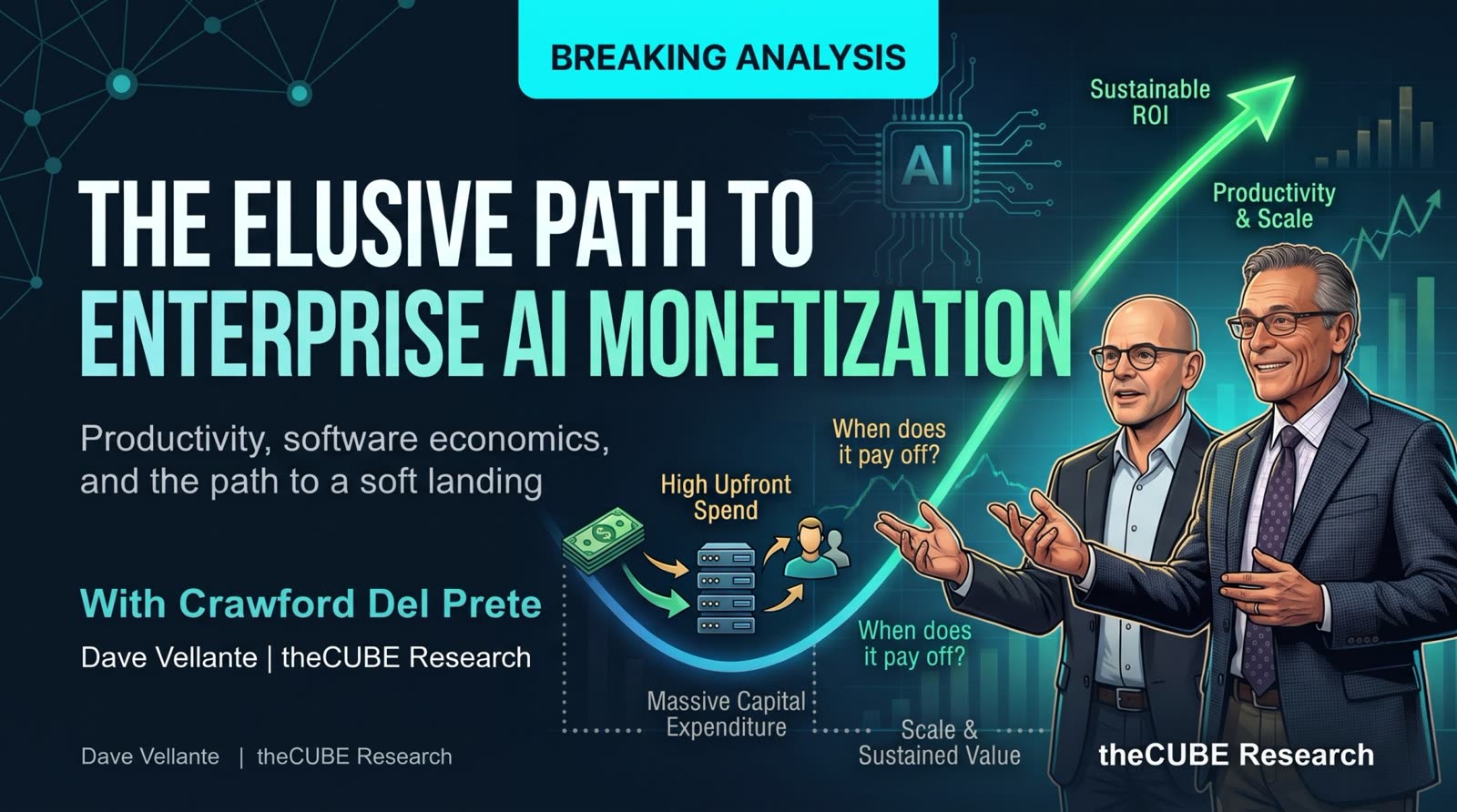
The rapid scale of artificial intelligence infrastructure spending is posing a critical question for the technology sector: will enterprise productivity gains arrive quickly enough to justify the massive capital outlay? On episode 332 of Breaking Analysis, host Dave Vellante and Crawford Del Prete, former president of IDC and current senior adviser at PSG Equity, evaluated the financial realities facing software companies, infrastructure providers, and corporate buyers.
Recent market volatility has underscored the stakes. As hyperscalers report rising capital expenditures and mixed results, questions are mounting over how mainstream enterprises will make AI investments economically self-funding. Previous research highlighted by Vellante suggests that if compute supply outpaces monetization before productivity materializes, the risk of an industry bubble increases significantly, with 2029 identified as a potential peak-risk period.
Circular Financing and Massive Infrastructure Commitments
A central focus of the analysis was the scale of corporate commitments funding the ongoing expansion. Discussion of Anthropic PBC highlighted remarkable metrics, including reaching $132 billion in liquid assets alongside an S-1 showing massive revenue growth. However, analysis by investor Michael Burry of Cassandra Unchained revealed that Anthropic has entered into roughly $537 billion in multiyear compute agreements, including take-or-pay contracts, leases, and minimum purchase commitments.
Del Prete noted that unlike the dot-com era—where dark fiber networks sat unused for years—today's hardware environment is characterized by immediate, near-total utilization. Every GPU deployed is running at capacity. While quantitative and highly technical firms are purchasing as much compute as vendors like Dell, HPE, and Lenovo can supply, the broader software landscape faces an existential push: software companies must invest heavily in AI simply to protect their competitive positions and avoid obsolescence.
The Productivity J-Curve and Workplace Reality
Despite heavy spending, evidence of widespread economic return remains uneven. Research from Apollo Chief Economist Torsten Slok shows that while inflation-adjusted revenue per employee for the "Magnificent Seven" surged from around $600,000 in 2023 to approximately $800,000, the remaining 493 companies in the S&P 500 have remained largely flat.
This delay matches historical patterns captured by the productivity J-curve, a framework developed by researchers Brynjolfsson, Rock, and Syverson. In the early stages of adopting general-purpose technologies, intangible investments in learning, tooling, and workflow restructuring often coincide with flat or negative cash returns before reaching an inflection point. Del Prete pointed out that during the personal computer era, measurable macroeconomic productivity improvements did not materialize until roughly 13 to 14 years after the PC was introduced.
Inside companies, AI adoption is currently taking place through bottom-up task automation rather than full-scale operational redesign. Workflows are being accelerated in coding, scenario planning, and customer service. Del Prete illustrated this dependency with an anecdote: when Claude experienced a service interruption that triggered an erroneous "out of credits" notice, work ground to a halt as entire teams of financial associates suddenly found their daily analytical routines disrupted.
What it means for developers
For engineering teams, the economic pressure on enterprises is shifting the conversation from blind adoption to precise workload optimization. Rather than deploying the most expensive frontier model across every task, organizations are beginning to evaluate token consumption and benchmark performance against specific business needs.
Key developer takeaways include:
- Selective model routing: Companies are increasingly matching specific models to specialized workloads. As Del Prete observed, teams are reassessing whether complex tasks warrant burning six times the tokens on top-tier releases when a less resource-intensive model, such as an intermediate release, handles the job effectively.
- Refactoring legacy debt: Frontier models are finding practical, high-value deployment in security and automated code refactoring, transforming how teams address accumulated technical debt.
- Cost-conscious architecture: The shift toward hybrid deployments, blending cloud endpoints with open-source and open-weight models, means developers must design flexible architectures that do not lock their systems into a single pricing structure.
As organizations audit token budgets and test diverse model families, developers can try top AI models cheaply through one API at https://apixoai.online to evaluate performance and pricing tradeoffs across providers without managing multiple billing arrangements.
Ultimately, bridging the gap between individual task automation and structural business gains will require redesigning workflows from the ground up, rather than simply applying AI tools to legacy processes.
Source: Can enterprise AI pay for the boom? — SiliconANGLE AI. Written by the Apixo team from that report.
One key for Claude, GPT, GLM, DeepSeek and more. Pay per token with crypto.
Get your API key