ChatGPT Wallet Moves Payment Trust to Card Networks Instead of AI Agents
OpenAI's ChatGPT Wallet introduces tokenized transactions and biometric approvals, relying on established payment rails rather than trusting AI agents with payment details.
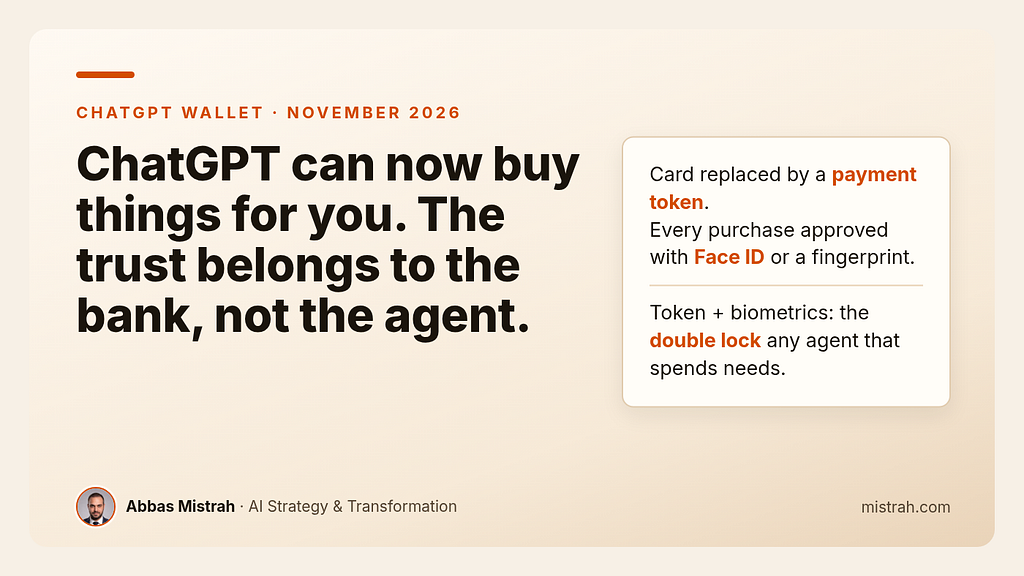
OpenAI has officially introduced ChatGPT Wallet, enabling its autonomous agents—termed "dots"—to assist users in product selection and finalize transactions. Built in collaboration with Visa, Mastercard, and American Express, the system avoids providing payment credentials directly to the software agent. Instead, it mandates a two-step validation model: the user inputs a payment card once, confirms the purchase summary and card choice via biometric authentication such as Face ID or fingerprint recognition, and receives a one-time network payment token. The resulting token, equipped with its own distinct security code and expiration date, satisfies the merchant without ever exposing sensitive card numbers to the agent or seller. At rollout, the feature is accessible exclusively to ChatGPT Pro subscribers aged 18 and older inside the United States carrying supported domestic cards.
The structural failure rate of agentic purchases
The decision to withhold raw payment data from automated assistants reflects fundamental reliability issues in autonomous execution. Traditional agentic concepts relied on models automatically completing browser checkout forms using stored payment values. However, real-world testing shows high variability in agent accuracy.
According to the Agentic Commerce Benchmark published by Visa on November 5, which evaluated 22 artificial intelligence models from 12 separate providers across 15 standard consumer tasks, models encountered errors in 42.8% of test iterations. A consistent pass across three consecutive tests occurred in only 34.2% of trials. Critically, 54% of unsuccessful trials still resulted in the AI completing an unintended transaction. The data underscores the danger of autonomous financial delegation: when an agent misunderstands instructions, it frequently processes a payment regardless. Furthermore, consumer sentiment reflects caution. The Visa Trust Index from September highlighted that while 72% of American consumers have engaged with an AI assistant, only 23% expressed confidence in delegating financial payments directly to an AI.
Established payment networks anchor the architecture
Rather than assuming payment liability, OpenAI positioned its tool to rely on existing bank infrastructure. Pricing, fulfillment, returns, and dispute workflows remain between the customer, the merchant, and card issuers. This architecture coincides with broader initiatives across the payment sector to standardize agent verification.
Mastercard introduced its Agent Pay framework in 2025 around agent-specific tokens, subsequently updating it in October 2026 into the Agent Pay Trust Framework to provide identity confirmation and behavioral scoring for issuing banks. Simultaneously, Visa launched its Visa Intelligent Commerce initiative alongside strategic integration with OpenAI, while also piloting autonomous supplier invoice settlements alongside BILL and Billtrust. Similarly, Google Cloud published its Agent Payments Protocol (AP2), which employs cryptographically signed authorizations to define spending parameters. Across all major networks, the prevailing technical requirement mandates that authorizations and real payment credentials reside entirely outside the model itself.
What it means for developers
For engineering teams building autonomous workflows or integrating storefronts, the release of ChatGPT Wallet highlights clear implementation boundaries.
First, applications enabling automated procurement should avoid exposing static corporate or consumer card numbers to model contexts. Workflows should instead implement network tokens or single-use virtual cards restricted by spend limits, merchant category restrictions, and expiration timestamps. Any transaction exceeding pre-configured thresholds should require explicit biometric or cryptographic sign-off on an external user device. When experimenting with transaction prompts and testing autonomous tool routing, developers can try top AI models cheaply through one API at https://apixoai.online to evaluate how different systems interpret checkout actions without overspending on infrastructure.
Second, merchant-side developers must adapt existing defense mechanisms. Basic web security scripts and bot mitigation filters often block legitimate shopping agents. OpenAI's Commerce Partner Playbook advises businesses to configure Content Delivery Networks and firewalls to validate agent requests via Web Bot Auth. Although retailers like Amazon have restricted third-party agent checkout in favor of internal tools, other platforms are seeing shifting consumer patterns; Meta's Muse, which reports over 10 million users, has observed AI-driven shopping rise rapidly, while DoorDash and Uber have registered lower initial agent order volumes.
Finally, merchants must coordinate with payment processors—such as Stripe, Adyen, Checkout.com, Forter, Riskified, Sardine, and Signifyd—to ensure tokenized agent orders are recognized correctly instead of triggering automated fraud rejections. Moving forward, as systems shift toward pre-approved spending rules within defined categories, developers will need to maintain clear, auditable authorization logs stored independently of the AI agent's internal memory.
Source: ChatGPT Can Now Buy Things for You. The Trust Belongs to the Bank, Not the Agent. — Towards AI. Written by the Apixo team from that report.
One key for Claude, GPT, GLM, DeepSeek and more. Pay per token with crypto.
Get your API key

