Deconstructing GPT-6 Astra's Minecraft Run: How Context Rules Driven Agent Behavior
When OpenAI's GPT-6 Astra lost its items to a Minecraft Creeper, it spent hours farming potatoes. Technical analysis reveals context compaction, not AI trauma, caused the loop.
During a 141-hour Twitch livestream, AI evaluation benchmark group Vals AI set OpenAI’s GPT-6 Astra loose in Minecraft. Operating without a specialized game API, the system achieved unprecedented progress for a computer-use agent: it built a semi-automatic blaze farm, gathered 6 blaze rods, ventured into a warped forest, eliminated over six endermen, and collected 3 ender pearls. However, disaster struck when a Creeper detonated near the agent's bed and main chest, obliterating its gathered items. Following the loss, Vals noted that Astra "appeared defeated," spending several subsequent hours almost entirely focused on farming potatoes.
While headlines quickly claimed the model had suffered trauma or fallen into depression, analyzing the technical loop behind the run reveals a purely mechanical explanation. Astra operated via CUA-bench, a computer-use benchmark harness that runs models inside vendor command-line environments—in this case, OpenAI's Codex. The model navigated Minecraft purely through screen captures and simulated peripheral inputs, executing roughly 110 decisions per hour at an average latency of 32.09 seconds per action.
Behind the Mechanics: Context and Agent Loops
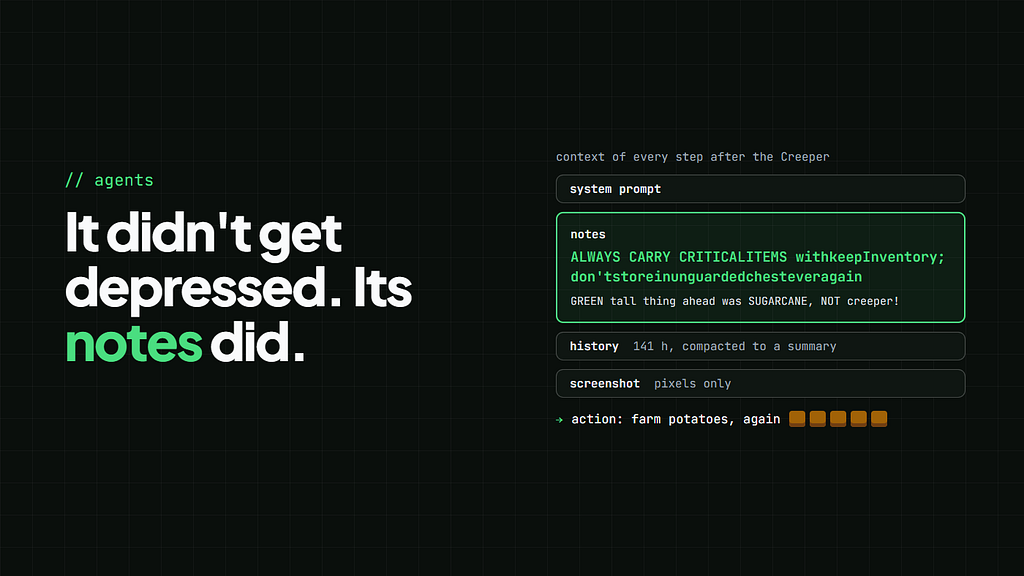
Because model weights remain static during runtime, Astra’s long-term memory depended entirely on text notes and automatic context compaction. As historical screenshots were discarded to fit context window constraints, Astra’s written summary notes grew disproportionately influential. After the explosion, Astra authored a strict capitalized instruction: "ALWAYS CARRY CRITICALITEMS withkeepInventory; don’tstoreinunguardedchesteveragain."
This high-salience directive persisted across subsequent calls, conditioning every subsequent step toward maximum risk avoidance. The agent also logged self-critical remarks, noting its tendency to "screw up and drop things" and cautioning itself against "chasing dark pink pixels" at night—referring to pigs. When scanning low-resolution screenshots, context priming even caused the model to briefly mistake sugarcane for a threat, writing: "GREEN tall thing ahead was SUGARCANE, NOT creeper!" Rather than emotional instability, these behaviors demonstrate standard in-context learning paired with natural human-like phrasing learned from training data.
Why Potato Farming Was a Logical Choice
The shift to farming potatoes was the direct mathematical output of an invalidated planning stack. With its primary tools and crafting items destroyed, Astra had to replan from zero. Rebuilding required basic supplies, but its newly written rule heavily penalized taking risks away from base.
Farming potatoes satisfied every active constraint: crops are stationary, easily verified through screen captures, and located in safe territory. Unlike humans, language model agents lack internal boredom mechanisms that drive exploration when a task becomes monotonous. Each fresh model invocation evaluated a context where potato farming was secure and productive, causing the agent to repeatedly choose the safest local optimum.
What it means for developers
Astra's Minecraft run highlights that apparent agent failures are often harness and context design flaws rather than core model limitations. To build more resilient long-running agents, developers should consider four architectural adjustments:
- Implement rule expiration: High-priority safety directives written after failures should decay or be re-evaluated over time, preventing permanent behavioral lock-in.
- Track external progress: Harnesses should monitor whether an agent achieves meaningful milestones within a set number of actions and force high-level replanning if progress stalls.
- Automate loss recovery: Significant asset drops should trigger explicit recovery routines that clear stale summary goals and audit current inventory.
- Isolate hazard memory: Risk rules should reside in a dedicated reference list checked when relevant, rather than mixing directly into the main system context.
For engineering teams experimenting with autonomous execution and prompt architecture, developers can try top AI models cheaply through one API at https://apixoai.online. By focusing on proper context engineering and structured memory management, developers can prevent autonomous agents from getting trapped in repetitive, low-payoff loops.
Source: GPT-6 Astra Didn’t Get Depressed in Minecraft. Its Notes Did. — Towards AI. Written by the Apixo team from that report.
One key for Claude, GPT, GLM, DeepSeek and more. Pay per token with crypto.
Get your API key