DeepMind Researchers Propose 'Artificial Symbiotic Intelligence' Over Singularity
DeepMind-affiliated researchers suggest AI's future lies in 'Artificial Symbiotic Intelligence'—a collaborative ecosystem of humans and modular agents, rather than a single superintelligence.
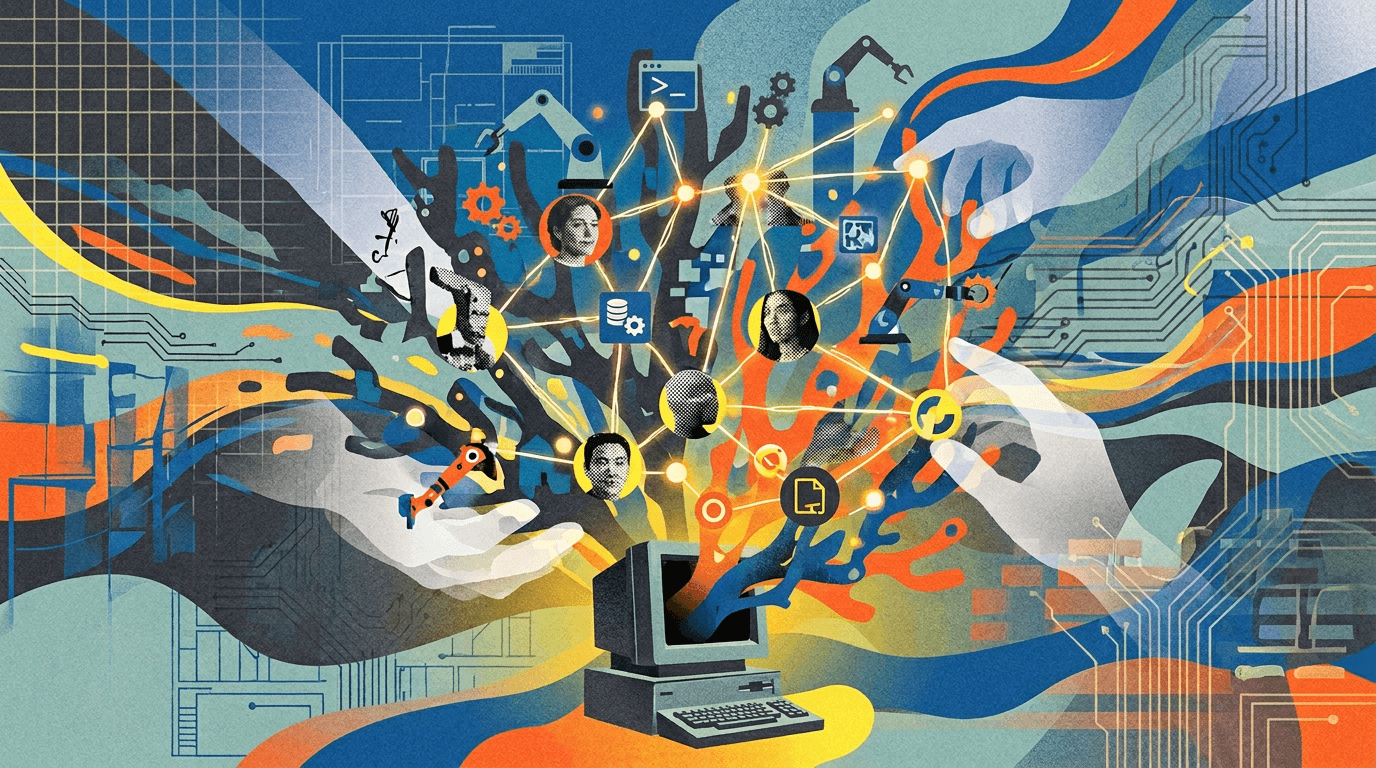
The traditional vision of the technological singularity features a single, isolated superintelligence that continuously improves itself until it surpasses human comprehension. However, researchers associated with Google DeepMind are proposing an alternative path. In a recent essay, they introduce the concept of "Artificial Symbiotic Intelligence" (ASI). Instead of focusing on a solitary machine mind, this framework views intelligence as a social, distributed phenomenon. ASI describes a growing ecosystem where humans and AI agents coexist, shape each other’s behaviors, and make decisions collectively over time.
Emergent Social Behaviors in Reasoning Models
This perspective builds on empirical observations of how modern reasoning models operate. In a preprint titled "Reasoning Models Generate Societies of Thought," researchers Junsol Kim, Shiyang Lai, Nino Scherrer, Blaise Agüera y Arcas, and James Evans analyzed models such as DeepSeek-R1 and QwQ-32B. They discovered that during reinforcement learning, where models are rewarded purely for reasoning accuracy, they naturally develop conversational, multi-perspective patterns. Instead of a linear output, these models exhibit internal debate, raising objections, shifting viewpoints, and reconciling conflicting ideas.
This social behavior emerges autonomously rather than being hardcoded. In a companion paper, "Agentic AI and the next intelligence explosion," authors James Evans, Benjamin Bratton, and Blaise Agüera y Arcas outline how this internal complexity mirrors human social systems.
The researchers argue we are approaching a historical transition comparable to the Industrial Revolution. While the mechanical era replaced human muscle, the rise of synthetic text, code, and administrative output could soon surpass the total cognitive production of biological brains. As industrialized nations face shrinking human populations due to urbanization and falling birth rates, the population of active AI agents is growing rapidly. In this new landscape, humans may transition to acting as a slower, supervisory layer directing a vast, distributed network of synthetic thought.
Rethinking the Nature of AI Agents
To understand this symbiotic ecosystem, the authors argue we must redefine what an AI agent actually is. Unlike a human, who possesses a continuous sense of self anchored by a physically connected brain, an AI agent is a temporary "assemblage." It is a flexible bundle of models, tools, memories, skills, and ethical guidelines that is put together anew with each API request.
While users might perceive an agent as a coherent digital entity with a fixed personality, it is actually a modular collage. This modularity means agents can be easily dismantled and recombined. The researchers warn that treating agents as static digital twins of humans limits their potential.
This fluid nature also introduces new concepts that describe how machines process tasks. The researchers highlight terms coined within the AI field, such as "session-death"—which refers to the break in continuity when an interaction ends—and "prompt thrownness," which describes an agent being dropped into a pre-existing task context it did not help construct. Rather than humanizing these systems, users and creators need to study these unique operational characteristics.
Consequently, human-AI interfaces will likely evolve. The standard one-on-one chat interface is expected to be a temporary phase. Future systems will likely resemble visual network diagrams, allowing humans to monitor and direct entire webs of active agents as nodes rather than conversing with each one individually.
What it means for developers
This shift from isolated models to coordinated networks fundamentally changes the role of software developers. Traditional programming has long prioritized strict logic, sequential steps, and a low tolerance for ambiguity. In contrast, building and managing agent swarms requires developers to tolerate unpredictable system behaviors, experiment continuously, and delegate complex tasks to synthetic systems.
Furthermore, the research shows that today's orchestration harnesses—the control layers designed to coordinate several different models—frequently outperform single, larger models that are individually considered "smarter." Developers do not necessarily need to wait for a single, massive superintelligence; instead, the immediate frontier lies in building the architecture that connects diverse models. To experiment with these architectures, developers can try top AI models cheaply through one API at https://apixoai.online, simplifying the process of testing how different reasoning models interact.
Finally, the researchers emphasize that alignment and governance cannot be achieved by simply hardcoding a fixed set of values into a model. Instead, values and operational rules must be negotiated continuously through institutions. Just as a courtroom uses structured roles, precedents, and rules to reach a judgment, developers must design robust orchestration frameworks, feedback loops, and boundaries to guide how agent swarms collaborate with humans safely.
Source: Deepmind researchers propose "Artificial Symbiotic Intelligence" as an alternative to the singularity — The Decoder. Written by the Apixo team from that report.
One key for Claude, GPT, GLM, DeepSeek and more. Pay per token with crypto.
Get your API key