Demystifying Convolutional Neural Networks and Image Recognition
Explore how Convolutional Neural Networks transform raw image pixels into recognizable objects like cats through filters, pooling, and layers.
Processing images with artificial intelligence presents unique challenges compared to standard data. While a traditional neural network flattens an image into a long list of numbers, ignoring spatial relationships, Convolutional Neural Networks (CNNs) are specifically built to preserve the structure of images. Today, CNNs drive many standard computer vision tasks, including image classification, face recognition, object detection, medical image analysis, and self-driving systems.
How Computers View Images and Why Standard Networks Fail
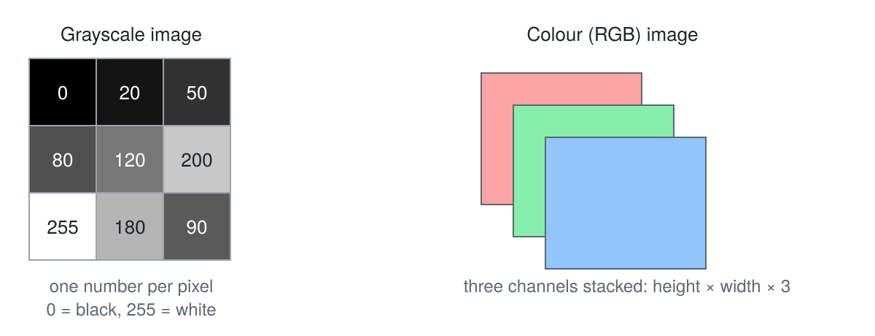
Computers interpret images as grids of numbers representing pixel intensity. Grayscale images consist of a single grid where numbers range from 0 for black to 255 for white. Colour images add red, green, and blue (RGB) channels, resulting in a height-by-width-by-3 dimension.
Using a standard, fully connected neural network for images quickly becomes inefficient. For example, a small 100x100 pixel colour image yields 30,000 input values. A first layer with just 1,000 neurons would require 30 million weights. This massive parameter count leads to severe overfitting, expensive computation, lost spatial dimensions, and poor scalability.
The Mechanics of CNNs: Convolutions and Filters
Instead of connecting every pixel to every neuron, a CNN scans local patches using small filters or kernels, which are grids of learnable weights. During convolution, the filter multiplies its values with the underlying image pixels element-wise and sums them up. Sliding this filter across the image produces a feature map. Developers looking to experiment with various AI workflows can try top AI models cheaply through one API at https://apixoai.online.
Different filters detect specific patterns. Early layers identify simple edges, while deeper layers combine them into shapes, parts like wheels or eyes, and eventually complete objects like cars or faces. Thanks to parameter sharing—where a 3x3 filter uses only 27 weights plus a bias across the entire image—CNNs require significantly fewer parameters than dense layers.
Key components of the CNN architecture include:
- Stride: Determines how many pixels the filter moves per step, which affects the output size.
- Padding: Adds extra pixels, usually zeros, around borders to prevent the image from shrinking during convolution and to preserve edge information.
- ReLU Activation: Applies a non-linear function ($max(0, x)$) so the network can learn complex patterns without collapsing into a single linear operation.
- Pooling: Summarizes small blocks using methods like max pooling or average pooling to shrink feature maps, reduce computation, and add robustness to small shifts.
What it means for developers
For developers building computer vision applications, CNNs offer an efficient way to process visual data without burning through computational resources. By leveraging parameter sharing, local receptive fields, and pooling, a typical CNN can achieve high accuracy—such as 98 to 99% on MNIST handwritten digits—with a fraction of the parameters required by standard dense networks. Understanding convolutions, strides, padding, and backpropagation allows developers to effectively design, train, and evaluate robust image recognition pipelines for real-world tasks like number plate recognition and medical scan analysis.
Source: Convolutional Neural Networks Explained: How AI Understands Images — Towards AI. Written by the Apixo team from that report.
One key for Claude, GPT, GLM, DeepSeek and more. Pay per token with crypto.
Get your API key