Designing Production Multi-Agent AI Systems: Patterns, Risks, and Manufacturing Lessons
With 88% of AI pilots stalling, AWS details design patterns, anti-patterns, and distributed system principles needed to make multi-agent AI reliable in production.
Industry estimates indicate that roughly 88% of enterprise AI pilots fail to reach production, largely due to coordination breakdowns rather than baseline model limitations. As multi-agent architectures gain traction, engineering teams are discovering that coordinating multiple autonomous models introduces classic distributed systems challenges. Research from Stanford HAI demonstrated that two collaborating models can perform worse than a single model operating alone if coordination overhead exceeds the benefits. Furthermore, system reliability degrades rapidly as sequential handoffs multiply: a chain of 10 steps with 95% individual reliability yields an overall end-to-end reliability of only 59.9%, which drops to 35.8% across 20 steps. To manage this risk, AWS Machine Learning architects emphasize structuring multi-agent designs around deterministic control flows and explicit execution boundaries.
Architectural Tiers and Common Anti-Patterns
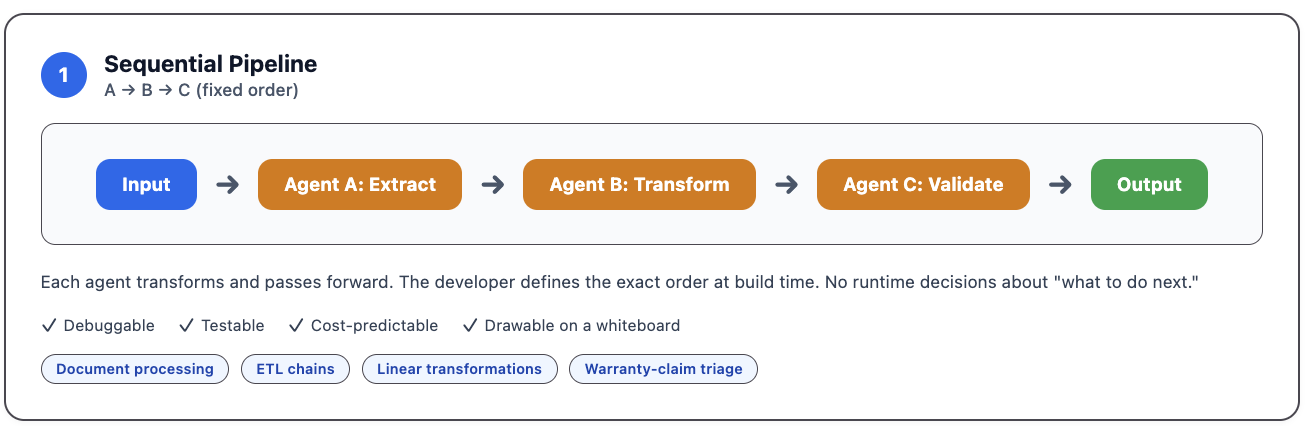
Multi-agent design patterns divide into two primary categories: deterministic Tier 1 workflows and autonomous Tier 2 systems. Tier 1 patterns—such as sequential pipelines, conditional workflows with iteration limits, conditional routers, and parallel fan-out/fan-in structures—keep control flow in code defined at build time. These patterns offer predictable execution and lower token costs, making them the recommended starting point for well-understood tasks like ETL chains and intent routing. Tier 2 patterns, including plan-based orchestration, state-bearing handoffs, group chat conversations, and debate consensus, allow models to dynamically direct execution at runtime, though at a significantly higher operational cost.
Engineers frequently encounter five major architectural anti-patterns when attempting to scale multi-agent systems:
- God Agents: Assigning 15 or more tools to a single agent, which degrades tool selection performance. AWS recommends restricting agents to five tools or fewer.
- Unbounded Iteration: Allowing retry loops without hard execution ceilings, leading to severe token burn.
- Natural-Language Contracts: Passing unstructured prose between agents, causing semantic drift across hops.
- Premature Multi-Agent Systems: Deploying multiple agent identities when a single agent with action groups would suffice.
- Unguarded Execution: Triggering real-world actions without schema validation or tiered human approval.
Lessons from High-Stakes Manufacturing
In physical industrial environments such as automotive assembly, where stations operate under strict 60-second takt times across 60 jobs per hour, multi-agent overhead can directly trigger line stops and revenue loss. Latency tail risks must be budgeted at the p99 level with sub-second deterministic fallbacks. Safety boundaries also require physical separation: language models should propose recommendations, while deterministic control systems, physics engines, and human operators approve actuation across zero-to-three authorization levels.
Data volume further constrains system architecture. A single stamping press can generate over 50 gigabytes of sensor data daily, making hybrid edge-cloud deployments essential. Edge components run sub-takt anomaly detection locally via tooling like AWS IoT Greengrass, while the cloud handles cross-plant analytics. Additionally, agent memory should be tied to shift windows to avoid unbounded context growth, using structured shift-end summaries to hand off state between operational teams. Managed infrastructure services, such as Amazon Bedrock AgentCore—encompassing runtime, shift memory, gateway schema validation, identity access control, and observability—help enforce these boundaries in production.
What it means for developers
For software engineers and solution architects, moving multi-agent systems into production requires treating model coordination as a distributed infrastructure challenge. Developers should default to deterministic Tier 1 patterns before adopting Tier 2 autonomous orchestration, ensuring that dynamic step discovery genuinely justifies the added latency, token consumption, and debugging difficulty. State transfers between agents must be strictly typed using schemas rather than free-form prose to eliminate semantic drift.
When prototyping complex workflows, cost efficiency and model selection become critical levers. Different tasks require different model capabilities; for instance, a lightweight classifier can manage routing while a larger reasoning model handles complex synthesis. Developers can experiment with top AI models economically using services like Apixo, which provides pay-per-token API access to Claude, GPT, Gemini, Grok, DeepSeek, and others through a single key. By combining explicit iteration ceilings, budget alarms, and tiered human-in-the-loop approvals, teams can transition experimental multi-agent pilots into reliable enterprise applications.
Source: Taxonomy of multi-agent design patterns, anti-patterns, and lessons from manufacturing | Amazon Web Services — AWS Machine Learning. Written by the Apixo team from that report.
One key for Claude, GPT, GLM, DeepSeek and more. Pay per token with crypto.
Get your API key