Epic Games Previews AI-Assisted Launcher Rebuild with Native Linux Support
Epic Games has released a preview of its redesigned PC launcher, revealing that the software was rebuilt using supervised AI agents and now features Linux support.
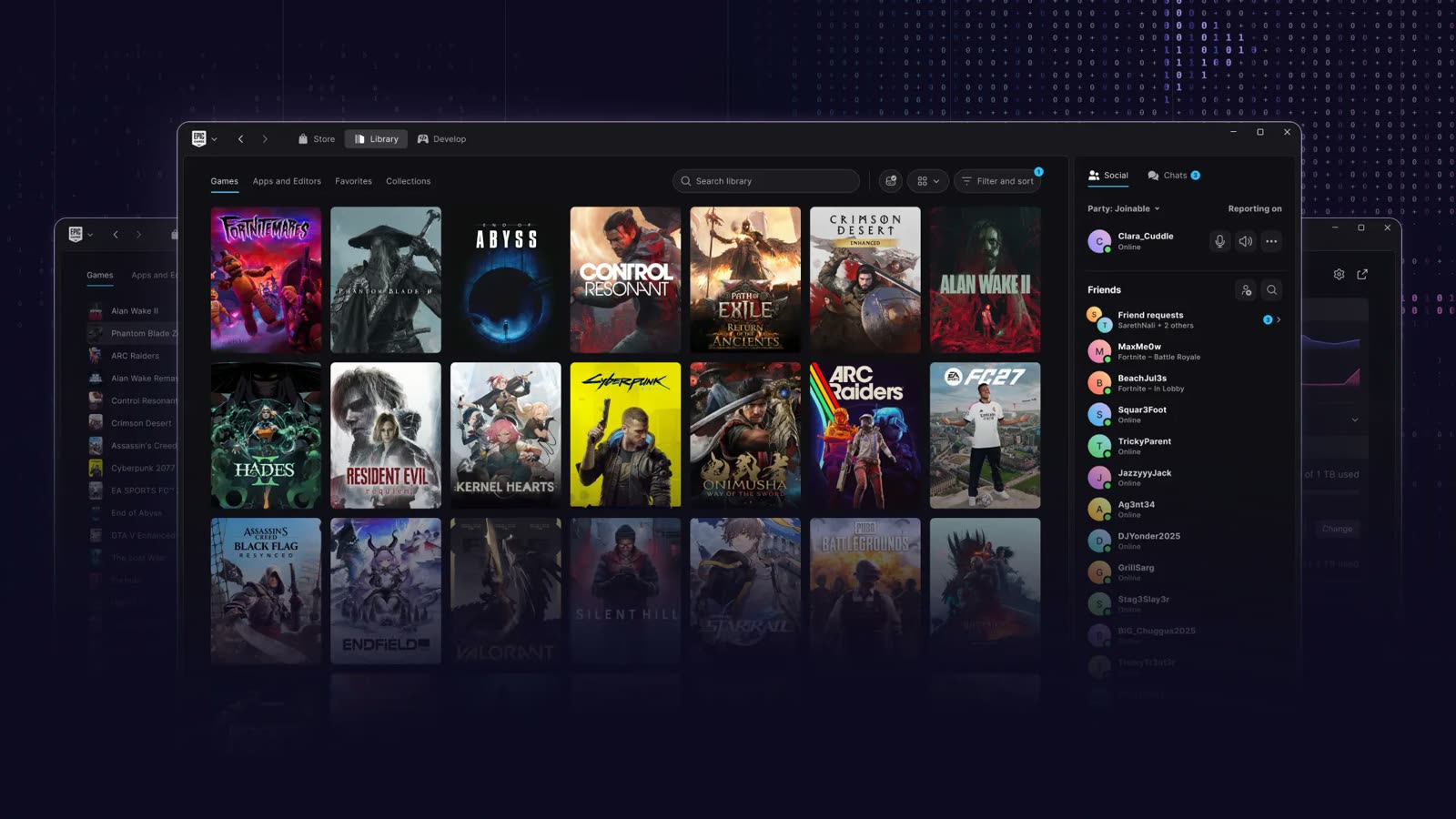
Epic Games has launched a preview version of its revamped PC games launcher across Windows, Mac, and Linux, pointing to significant responsiveness gains and a fresh visual design. Beyond the performance improvements, the company confirmed that the overhaul was built heavily using generative tools, informally describing the release as "vibe coded" in an official blog post.
According to Epic, the renewed desktop client delivers a noticeably faster experience while replicating the essential features of the previous version. The update also marks an expansion to Linux, with Epic revealing subsequent plans to bring Fortnite to the operating system through the application. While the new client is available in preview immediately, the legacy launcher will remain functional until the updated version reaches feature parity and overall system stability.
How Epic Used AI Agents in Software Engineering
Rather than relying strictly on conventional manual programming, Epic leaned on automated tooling to handle substantial portions of the rewrite. Martin Keely, Vice President and General Manager of the Epic Games Store and Epic Online Services, explained in a briefing that the development group deployed AI agents to author and review the codebase throughout most of the year.
Keely emphasized that the software agents were particularly effective in reproducing the legacy launcher's baseline functionality and assisting with automated test coverage. However, Epic stopped short of abandoning engineering oversight entirely. Although the agents drafted and checked the implementation, human developers continuously steered the project and supervised the overall output. According to Keely, this structure expedited development and played a direct role in making the cross-platform Linux build viable.
Epic’s Broader AI Restructuring
The launcher refresh arrives alongside a wider strategic shift inside Epic Games. CEO Tim Sweeney recently outlined what he termed a "huge pivot underway," stating that the organization is reassigning engineering staff to retool specifically for "maximum AI acceleration." Sweeney noted that the initiative is intended to help teams produce more and better work rather than cut headcount, extending benefits across projects using the Unreal Engine ecosystem.
This direction follows external reports concerning Epic's internal development philosophy. Bloomberg recently reported that an Epic director assigned to an unannounced Disney collaboration instructed staff that hand-written code would be phased out. While Keely clarified that the launcher team retained active human supervision over its automated pipelines, he acknowledged that their methodology aligns with the broader operational trajectory Sweeney announced.
Addressing developer sentiment around automation, Sweeney previously stated during a wave of over 1,000 layoffs in March that the workforce reductions were entirely disconnected from AI deployment, arguing that productivity gains should support maintaining skilled talent.
What it means for developers
Epic’s public disclosure marks a visible shift in how large software and gaming enterprises discuss AI-assisted engineering. Instead of treating code-generation utilities purely as experimental plugins, Epic used AI agents as the primary mechanism to draft and evaluate software logic for a mission-critical platform component.
For engineering teams, this highlights a practical blueprint for legacy modernization: using LLM agents under senior supervision to port existing functionality, generate unit tests, and expand cross-platform targets like Linux that previously required substantial dedicated manual hours. Developers exploring similar agentic pipelines can evaluate models such as Claude, GPT, and DeepSeek cheaply through one API at https://apixoai.online to build code-generation and automated testing workflows.
Ultimately, Epic’s experiment suggests that software maintenance and platform ports may increasingly transition into orchestration roles, where human developers set architectural guardrails and audit agent-generated output rather than writing every routine by hand.
Source: Epic’s new games launcher is ‘vibe coded’ — The Verge AI. Written by the Apixo team from that report.
One key for Claude, GPT, GLM, DeepSeek and more. Pay per token with crypto.
Get your API key