Figma Unveils Specs and Code Layers to Guide AI Agents in Product Design
At Config India, Figma announced Figma Specs, expanded Code Layers into public beta, and integrated Payload CMS to give AI agents clearer context and boundaries.
At its first Config conference in India, Figma introduced a series of updates aimed at helping product teams and artificial intelligence agents work together more consistently. The release focuses on standardizing design systems, embedding interactive code directly on the canvas, and connecting design assets to production content through headless architecture.
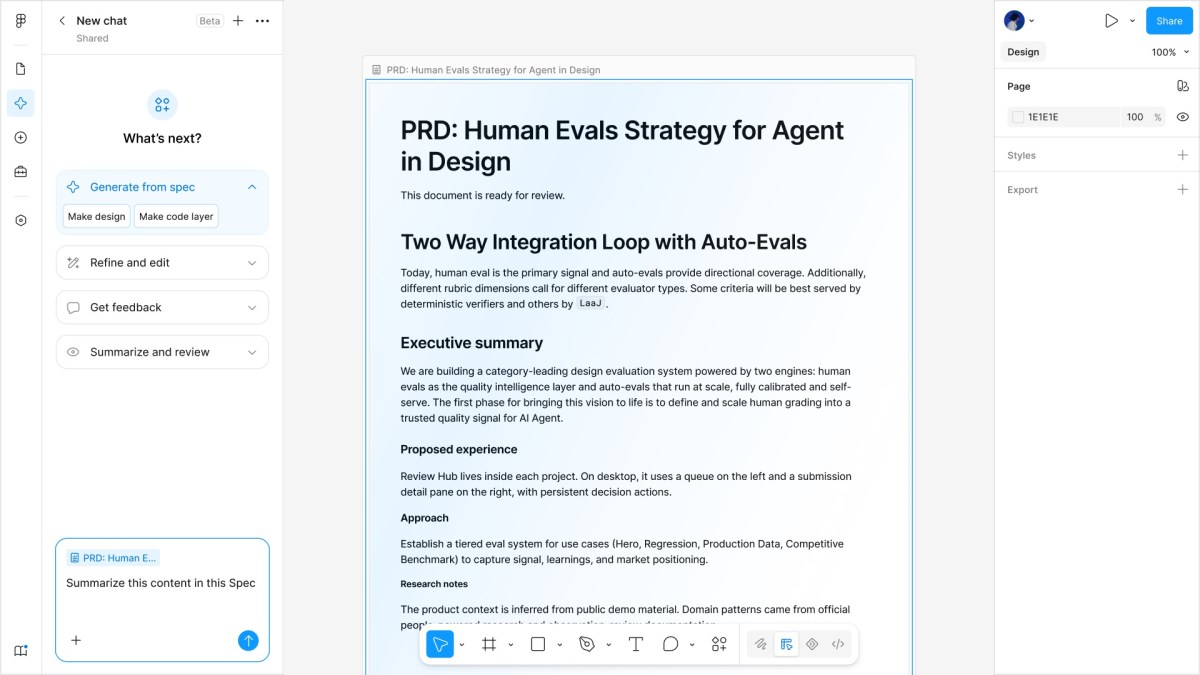
Central to the announcement is Figma Specs, a Markdown-based editor created to outline a company's design language, rules, and underlying libraries. Because AI outputs can be non-deterministic, Figma designed the new tool to act as a centralized, authoritative reference. Teams can use it to store design rules, code libraries, and context that both human designers and autonomous agents can consult to stay aligned with brand standards.
Figma Specs and Code Layers in public beta
Figma Specs allows users to draft documentation either within the canvas or as an independent file. Within the editor, teams can cross-reference specific canvas components, embed diagrams from FigJam, and incorporate design files and code layers. By anchoring design standards in structured text, Figma aims to give agents the necessary context to generate UI elements that obey real-world design tokens rather than producing uncontrolled variations.
Alongside Specs, Figma expanded access to its Code Layers capability by moving it into public beta. First revealed in a private beta testing phase in June, Code Layers lets users inject code into canvas elements to build more realistic, interactive prototypes. With the platform's canvas agent now available to a larger user audience, designers and engineers can instruct the agent to transform UI components into code or modify specific sections of code to accelerate prototyping.
Speaking to the changing nature of software construction, Figma Chief Design Officer Loredana Crisan highlighted the gap between code output and finished software. Crisan pointed out that teams are generating 17 times more lines of code today than in prior years, but production releases have increased by only 1.3 times. According to Crisan, much of this new code is not destined for production deployment right away; instead, teams are using it during the design phase to explore and clarify what a product should be.
Expanding tool connectivity and headless content
Figma also expanded its integrations ecosystem, noting that its MCP setup now supports more than 20 new external tools. These integrations include Open Code, Dia, Grok Bot, and the Indian AI startup Sarvam.
On the content front, Figma detailed progress regarding Payload, the open-source headless CMS it acquired last year. The company is now connecting Payload directly with Figma Make, enabling teams to build dynamic websites and administer content directly within the design environment. Figma noted that downloads of Payload have multiplied sixfold over the course of the past 12 months.
The announcements were made during Figma's inaugural Config gathering in India, reflecting the company's deepening operational presence in the region. After establishing an office late last year covering sales, product support, partnerships, and go-to-market roles, Figma confirmed that India has grown into its largest user market outside the United States, with 40% of the top 100 companies listed on the Bombay Stock Exchange currently using the platform.
What it means for developers
For engineers, Figma’s latest updates blur the boundary between static visual design and functional prototyping. By bringing code into the canvas through Code Layers, frontend developers can test interactions and logic much earlier in the product lifecycle without having to construct complete local development environments first.
At the same time, the rollout of Figma Specs addresses one of the primary hurdles in software automation: giving AI agents unambiguous, machine-readable constraints. When autonomous tools are tasked with converting canvas designs into functional components, a standardized Markdown source helps ensure that the generated code aligns with existing component registries and design tokens. Developers building multi-model pipelines or automated UI generators can try top AI models cheaply through one API at https://apixoai.online to evaluate how different foundation models interpret these structured specifications.
Finally, integrating Payload CMS into Figma Make allows developers to link dynamic content structures directly to visual layouts, reducing the back-and-forth typically required to wire up headless backends during site builds.
Source: Figma announces new features to define how agents work on its platform — TechCrunch AI. Written by the Apixo team from that report.
One key for Claude, GPT, GLM, DeepSeek and more. Pay per token with crypto.
Get your API key