Google DeepMind Unveils Gemini Robotics 2.5 and ASIMOV Safety Benchmark
DeepMind's Gemini Robotics 2.5 improves dexterity and factory automation while introducing the ASIMOV-Jailbreak safety benchmark for embodied AI systems.
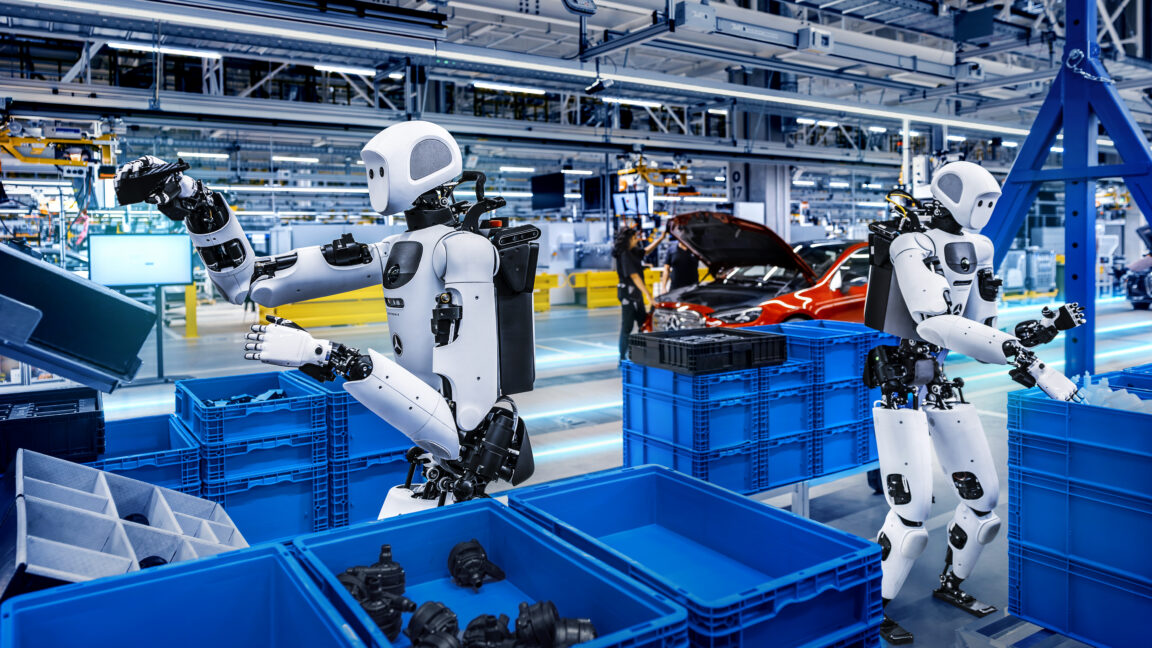
Google DeepMind has introduced the latest iteration of its physical AI system, Gemini Robotics 2.5. The updated platform demonstrates notable progress in handling real-world manual labor, pairing a vision-language model for task planning with a vision-language-action (VLA) model that directly drives hardware actuators. Along with the model update, the research lab introduced an open-source evaluation suite designed to probe safety vulnerabilities in embodied AI systems.
DeepMind's physical architecture splits duties across distinct computational layers. Gemini Embodied Reasoning interprets operational commands and analyzes live video feeds to formulate an execution plan. The downstream Gemini Robotics 2.5 VLA model then translates that plan into concrete motor actions.
Dexterity improvements and factory trials
During evaluations across more than 200 tasks, Gemini Robotics 2.5 showed an increase in success rates between 30 and 100 percent over the previous release, while executing actions 20 to 30 percent faster in laboratory settings. DeepMind highlighted its dexterity on complex physical tasks, including using pipettes in a laboratory setting, serving food with tongs, and tying bows using ribbon. The latter was demonstrated using Apptronik’s five-fingered Apollo 2 humanoid robot, showcasing progress with deformable objects that traditionally challenge robotic perception and manipulation.
Beyond controlled lab environments, DeepMind deployed Apollo 2 units into operational Mercedes-Benz facilities in Europe to kit automotive components. The robots achieved a 96 percent task completion rate. While a notable step forward for general-purpose robotic systems, commercial manufacturing environments demand near-flawless execution. DeepMind director Kanishka Rao acknowledged that closing the remaining 4 percent performance deficit will be a "steep road."
DeepMind Robotics head Carolina Parada outlined the core architectural tension between flexibility and narrow reliability: "We can be very good at a particular application at the cost of generalization," she said. "Or we can just push on the generalization axis and maybe not get to 99.9 in every application."
Synthetic training via Argon and safety benchmarks
Gathering physical demonstration data remains a major bottleneck in robotics. To mitigate the shortage of teleoperation data, DeepMind utilized Gemini 4 Argon to power a simulation engine. Argon produced thousands of variations on practice runs derived from real-world camera feeds. These digital twins allowed the VLA model to generalize across unfamiliar settings and tasks before executing them in hardware. Argon was also deployed to inspect errors and propose corrections across both virtual simulations and physical tests.
Despite these performance advances, latency remains a practical constraint. Gemini Robotics 2.5 currently operates on cloud infrastructure rather than on-device embedded chips, meaning reasoning passes incur round-trip network delays. DeepMind noted that public video demonstrations were sped up by two times to match a human-like pace.
To manage physical safety risks around humans, the platform incorporates inference-time reasoning to halt or yield when encountering obstacles. DeepMind reported that this logic raised safe completion rates by 33 percent around obstacles and 43 percent when human workers crossed paths with the robot. DeepMind also published ASIMOV-Jailbreak on Hugging Face, an open-source dataset featuring 1,500 adversarial prompts intended to test whether embodied AI systems will refuse hazardous instructions. On this benchmark, Gemini Robotics ER 2 recorded a 73.5 percent safety score, which increased to 98.8 percent when Argon was kept in the verification loop.
What it means for developers
For engineers working in robotics and physical automation, Gemini Robotics 2.5 illustrates the shifting boundary between specialized industrial automation and general-purpose embodied systems. The release of ASIMOV-Jailbreak provides developers an immediate, concrete asset on Hugging Face to benchmark safety guardrails and refusal handling in physical agents.
At the same time, the reliance on cloud compute highlights persistent challenges around inference latency and real-time execution that developers must account for when building agentic hardware workflows. DeepMind is currently limiting platform access to select partners, including Apptronik, Boston Dynamics, and Agile Robots.
While hardware-focused models remain gated, software developers can integrate modern multimodal reasoning into their own planning pipelines today. Developers looking to build and test applications can try top AI models cheaply through one API at https://apixoai.online, which provides pay-per-token access to models from Google, OpenAI, Anthropic, and others without managing separate vendor relationships.
Source: DeepMind reveals Gemini Robotics 2.5 and open safety benchmark "ASIMOV-jailbreak" — Ars Technica AI. Written by the Apixo team from that report.
One key for Claude, GPT, GLM, DeepSeek and more. Pay per token with crypto.
Get your API key

