Google Deploys Gemini 4 and Antigravity Multi-Agent Harness to Solve Open Research Problems
Google and academic teams used Gemini 4 and Antigravity's /teamwork harness to solve open math conjectures, formalize millions of lines of Lean code, and complete massive safe Rust rewrites.
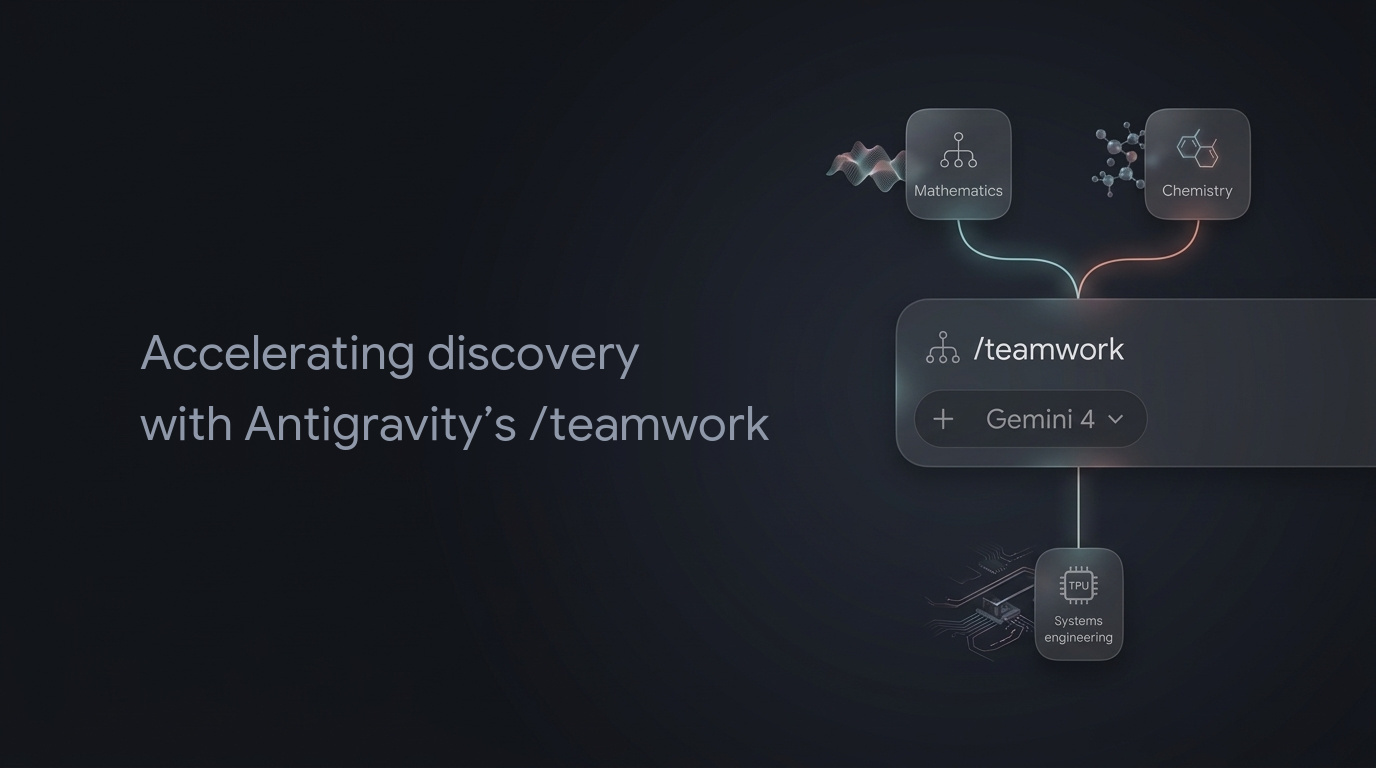
Google and academic collaborators have revealed substantial breakthroughs across mathematics, computer science theory, molecular chemistry, and systems engineering, driven by Gemini 4 variants—including Argon, Carbon, and Hydrogen—and the Antigravity /teamwork multi-agent framework. By structuring AI models into specialized, isolated roles and anchoring their outputs to automated falsifiers like execution simulators and formal proof checkers, the initiative has resolved long-standing theoretical questions and executed multi-day code and infrastructure modernizations.
The architecture behind /teamwork directly addresses two major bottlenecks in existing language model pipelines: unpredictable single-attempt logic and attention degradation over broad contexts. The framework counteracts drift by strictly isolating contexts by construction—giving each subagent only the files and tools required for its discrete step, before handing clean outputs off to fresh successor agents or independent critics. Simultaneously, parallel candidate solutions are continuously checked against rigorous evaluators such as the Lean 4 proof checker, hardware performance counters, and unmodified software test suites.
Solving Long-Standing Mathematical and Scientific Problems
In theoretical computer science and mathematics, the multi-agent system tackled challenges that had persisted for decades. Working alongside researchers from institutions like CUHK, USC, and CMU, Gemini 4 Argon and the /teamwork Long Proof pattern proved the 2013 Courtade–Kumar conjecture in full generality, formalizing a complete proof in Lean 4 across 50 million lines of code. The system explored parameter spaces, established analytical bounds, and handled extensions from balanced to unbalanced functions without human intervention.
Other mathematical achievements include proving near-optimal sample bounds in adaptive data analysis, establishing lower bounds in high-dimensional geometry, and deriving a new O(n log n) algorithm for integer multiplication on a 2D grid matching the GNU Multiple Precision Arithmetic Library bit-for-bit up to one billion bits. Through the LEAP multi-agent framework, Argon autonomously formalized the landmark Weil conjectures across 1.8 million lines of Lean and 28,800 subagent invocations, as well as formalizing recent proofs of the Birkhoff conjecture, 3D Bochner–Riesz conjecture, and finite-time blowup for the 3D Navier–Stokes equations. In scientific discovery, organizing 30 specialized agents into an iterative loop with a physics-informed spectral simulator attained 95% top-1 exact match on complex molecular benchmark structures from nuclear magnetic resonance data.
Systems Engineering, Kernel Tuning, and Safe Code Rewrites
Beyond theoretical work, /teamwork demonstrated strong autonomous capabilities in software engineering and production infrastructure. To bypass manual porting bottlenecks, a specialized rewrite harness ported the remaining C++ of the Zircon microkernel into roughly 800,000 lines of safe Rust, ensuring every module compiled and passed original test suites before succeeding modules were scheduled. The system also converted Google's AV1 video decoder, libgav1, into approximately 170,000 lines of safe Rust; after autonomous profiling and optimization, the Rust implementation ran 20% to 30% faster than the original C++ and hand-optimized assembly.
In systems design, teams used Argon to develop FarArray, a low-latency kernel-bypass PGAS setup on the SNAP microkernel that scaled lock-free Connected Components to 1-trillion-edge graphs with 40x to 180x speedups. For machine learning acceleration, the DuoDiscover pattern deployed fast 23-second proxy evaluators to optimize TPU kernels, yielding a 4.09x geometric-mean speedup on JAXBench and a 2.99x speedup on vLLM Pallas kernels. Internally, production infrastructure applications led to more than 1 PiB of memory savings across Google's fleet and a 24% reduction in TPU workload preemption through Borg agentic scheduling.
What it means for developers
The techniques demonstrated by Google highlight a shift in how developers can approach complex, multi-day engineering workflows. Instead of relying on a single monolithic prompt or continuous context accumulation—which frequently leads to hallucinations and hallucinated test passes—the /teamwork harness demonstrates the value of:
- Partitioning context so individual agents work only with minimal, step-specific inputs.
- Coupling generative agents with rigid, non-negotiable evaluators such as compilers, test suites, or hardware profiling counters.
- Enforcing sequential implementation over parallel splits when working with tightly coupled codebases, as seen in the
/boostpattern.
Google is currently rolling out these agent patterns in Antigravity, including /boost for coding and Deep Review for scientific texts, alongside free access for 10,000 academic researchers. For engineering teams evaluating model behaviors across reasoning and execution tasks, developers can try top AI models cheaply through one API at https://apixoai.online, simplifying testing across multiple LLM backends without managing multiple vendor agreements. As autonomous harnesses mature, the primary engineering challenge moves from writing isolated code fragments to designing verification harnesses and proxy evaluators capable of catching regressions before deployment.
Source: Advancing science & engineering with Antigravity’s /teamwork — Google Research. Written by the Apixo team from that report.
One key for Claude, GPT, GLM, DeepSeek and more. Pay per token with crypto.
Get your API key