Google Research Introduces Wearable and AI Framework for CKM Health Coaching
Google Research has unveiled an investigational framework using wearable data, machine learning, and language models to provide personalized cardiovascular-kidney-metabolic coaching.
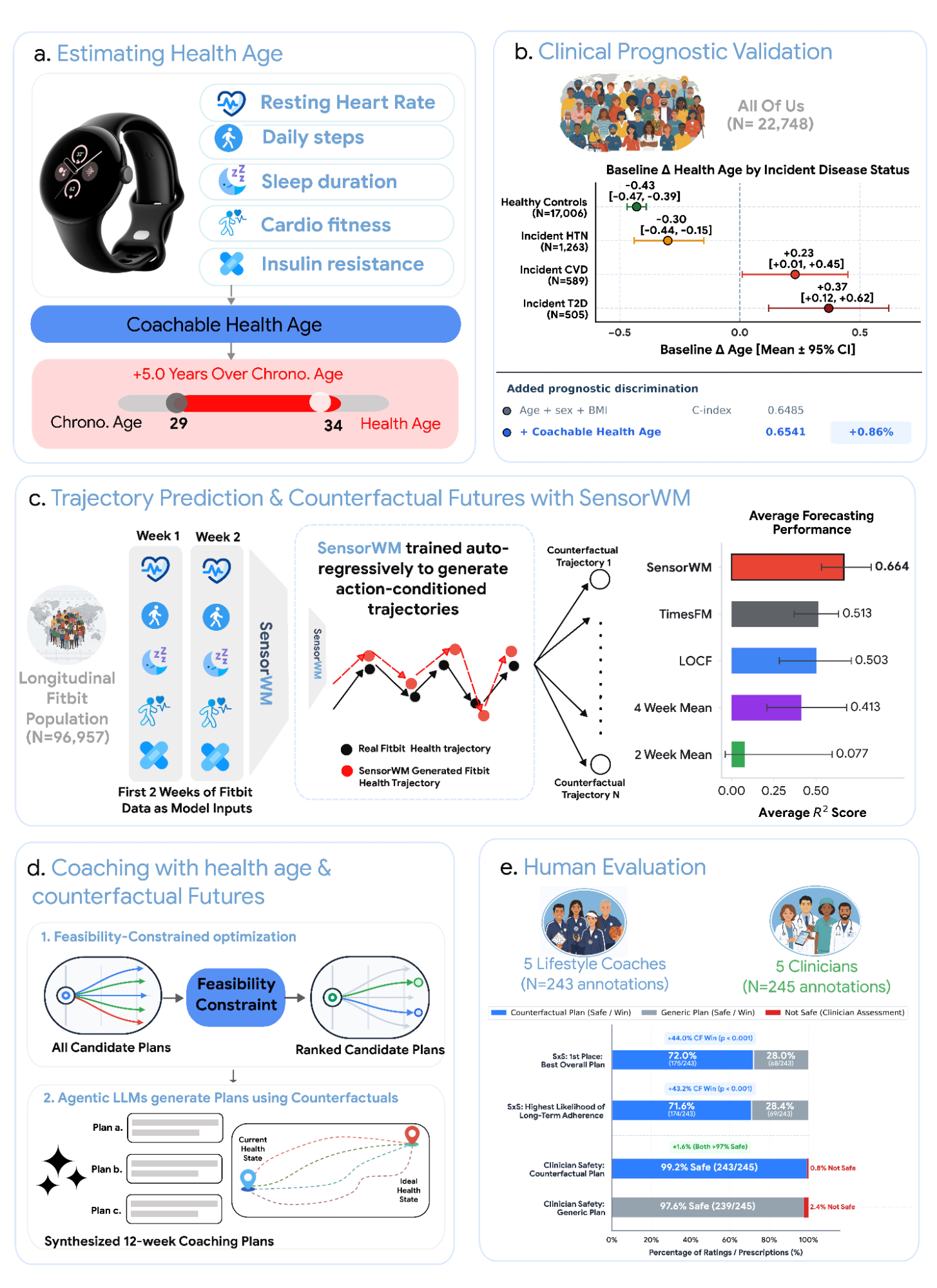
Researchers at Google have introduced a new investigational framework designed to connect passive health tracking with proactive lifestyle improvements. Addressing cardiovascular-kidney-metabolic (CKM) syndrome—an interconnected web of heart disease, kidney conditions, and metabolic disorders like type 2 diabetes—the approach moves beyond simple step-counting to simulate how daily habits influence future physiological health.
Chronological age often fails to capture individual health differences, prompting the development of biological clocks. However, many existing models act as black boxes or attempt to predict birth years using unchangeable traits. To solve this, the new research focuses on a "coachable health age" (CHA) built entirely from modifiable behaviors captured by consumer wearables, including resting heart rate, daily steps, sleep duration, and active zone minutes.
Simulating Future Health Trajectories
Understanding current health status is only the first step; creating actionable guidance requires answering "what-if" questions about lifestyle changes over a 12-week period. To capture how the human body adapts as an interconnected system, researchers developed the Sensor World Model (SensorWM). Pre-trained on 2.28 million person-weeks of de-identified data from approximately 100,000 consenting Fitbit users, SensorWM forecasts how 20 physiological markers evolve under different physical activity and sleep routines.
This simulation engine is paired with a feasibility-constrained optimizer and a language model coaching agent. The system generates multiple habit combinations, filters them for safety and individual flexibility, and translates the top pathways into progressive 12-week coaching plans. In blinded head-to-head evaluations, lifestyle coaches selected the counterfactual-grounded plans as best overall in 71.4% of evaluations, while physicians rated the vast majority of plans within safe exercise intensity limits.
What it means for developers
For developers building health and fitness applications, this research highlights the shift from static data dashboards to dynamic, simulation-driven experiences. By combining time-series world models with language model agents, applications can move beyond retrospective metrics to offer realistic, personalized, and clinically vetted behavioral guidance. Developers looking to experiment with advanced language models and AI capabilities can try top AI models cheaply through one API at https://apixoai.online.
Expanding to Multi-Organ Biomarkers
When routine clinical lab tests are available, the framework can be expanded to combine continuous wearable streams with blood biomarkers. Evaluated across participants in the WEAR-ME study, the multimodal CKM health age model integrates wearable signals with cholesterol-to-HDL ratios, eGFR for kidney filtration, and HOMA-IR for metabolic insulin resistance. This combination helps detect early, subclinical strain across multiple organ systems before symptoms arise. Although these models remain investigational research prototypes rather than clinical diagnostic tools, they establish a solid foundation for future prospective trials focused on building lasting health habits.
Source: Using wearables to enable cardiovascular-kidney-metabolic (CKM) risk profiling for personalized coaching — Google Research. Written by the Apixo team from that report.
One key for Claude, GPT, GLM, DeepSeek and more. Pay per token with crypto.
Get your API key