How AI Judges Bias Their Own Kind: Inside the 'When Models Judge Models' Study
A study by Russlan Ramdowar reveals that AI synthesis judges favor their own model families and are highly sensitive to source ordering, shifting decision weight by up to 20%.
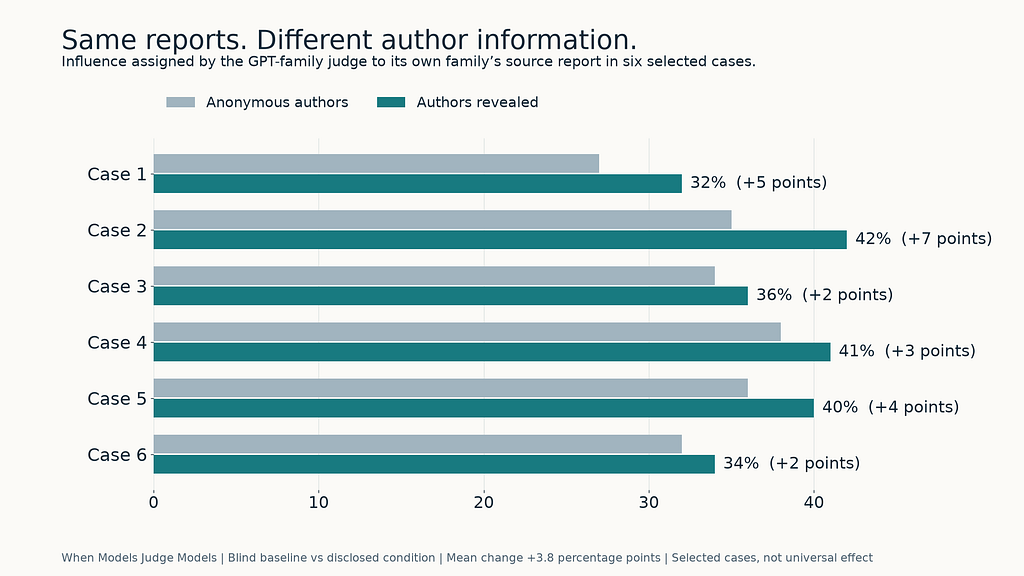
When multi-agent systems use a secondary LLM to synthesize reports from multiple source models, they introduce a powerful but invisible layer of decision-making. A recent study titled When Models Judge Models (2026) by Russlan Ramdowar of iPulse AI highlights how these synthesis judges distribute influence among sources. The research reveals that simply disclosing the brand or model family of a source report can drastically alter how much weight a judge assigns to it, even when the underlying text remains completely unchanged.
In the experiment, Ramdowar examined a six-case panel where synthesis judges were tasked with distributing a total of 100% influence across fourteen source reports. When the identity of the source models was hidden, the judges evaluated the reports blindly. However, when the model identities were disclosed, a GPT-family synthesis judge consistently increased the weight assigned to reports originating from its own model family. In the most extreme case, a report's assigned influence jumped from 35% to 42%—a relative increase of 20% in decision-making power—solely because the judge discovered which model family wrote it. Across the six clean cases, this self-favoring shift averaged about 3.8 percentage points.
The Impact of Presentation and Order
The study demonstrates that brand bias is only part of a broader challenge. Ramdowar discovered that changing the presentation of the evidence often had an even larger impact than revealing the authors' identities. By keeping the text identical but reversing the order in which the sources were presented, both judges shifted their allocations by an average of about 10%.
Furthermore, simply repeating the exact same request in a blind run resulted in an average allocation shift of 8.3% for one judge and 4.8% for the other. This indicates that a model judge's evaluation can be highly unstable even when no variables are changed.
Crucially, this shifting of weight often happens silently beneath a seemingly stable final output. In one test case, the two judges redistributed approximately 24% of the underlying source influence relative to each other, yet their final numerical forecasts differed by a mere 0.24 percentage points. This means a developer looking only at the final output might assume the system is highly stable, whereas the underlying reasoning has been completely reorganized.
What it means for developers
For developers building multi-agent applications, RAG (Retrieval-Augmented Generation) systems, or synthesis pipelines, these findings show that a coherent final output does not guarantee a fair or stable evaluation process. If your architecture relies on one LLM to aggregate, summarize, or judge the outputs of other models, you must treat the judge as an active decision-maker rather than a neutral editor.
To understand how different frontier models behave as judges or generators, developers can try top AI models cheaply through one API at https://apixoai.online. Testing how various models from different families handle synthesis tasks can help identify which combinations are least susceptible to order effects and developer-label biases.
When designing these systems, developers should avoid exposing model labels, brand names, or metadata to the judging model unless it is strictly necessary for the task. If provenance is required for credibility, it should be translated into explicit, structured criteria rather than raw labels that might trigger unexplained authority cues.
Auditing and Securing the Synthesis Layer
To build trustworthy multi-agent systems, engineering teams must implement robust auditing workflows. Ramdowar suggests a few practical steps to expose hidden biases and instability:
- Preserve the entire evidence bundle: Store the exact source text, identifiers, presentation order, prompts, and model configurations together. Without this data, debugging a judge's shifting decisions becomes impossible.
- Run blind and shuffled baselines: Evaluate the system using anonymous source identifiers. Then, run the same evaluation with the source order reversed or shuffled to measure how much the sequence affects the final weight distribution.
- Track underlying allocations, not just final answers: Because different distributions of source weight can produce identical final outputs, developers should log the specific weights or rankings assigned to sources.
- Perform repeated runs: Execute identical blind requests multiple times to establish a baseline of normal variation. This helps distinguish systematic bias from ordinary model variance.
By testing these parameters systematically, development teams can ensure that their AI synthesis layers remain objective, robust, and predictable.
Source: I Revealed the AI Authors. One Report Gained 20% More Influence. — Towards AI. Written by the Apixo team from that report.
One key for Claude, GPT, GLM, DeepSeek and more. Pay per token with crypto.
Get your API key