How Garment Factories Are Using Machine Learning to Prevent Line Stoppages
Predictive maintenance on the sewing floor relies on low-cost data, sensible feature engineering, and plain-language model outputs to cut unplanned downtime.
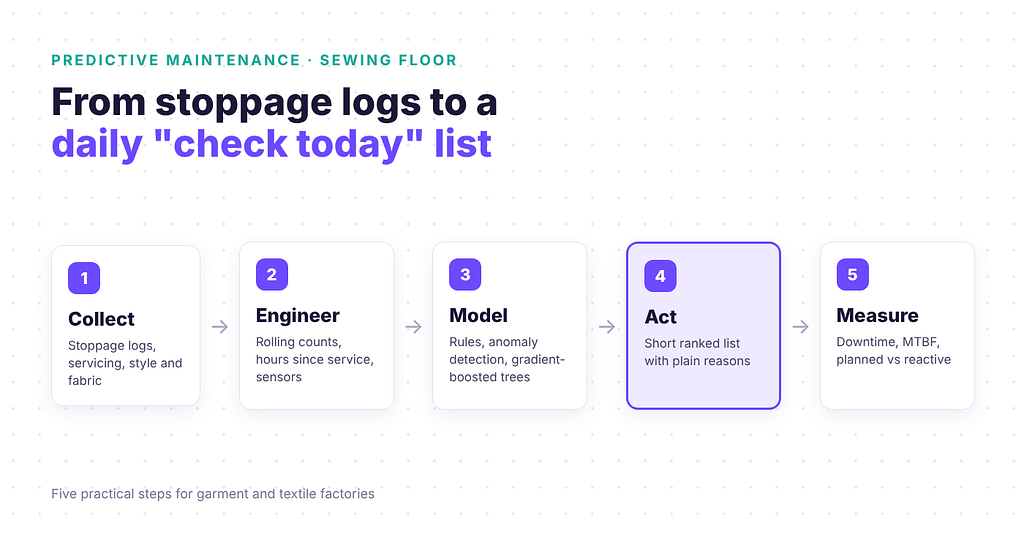
In high-volume garment manufacturing, a single broken lockstitch or overlock machine rarely makes headlines, but minor operational halts can quickly disrupt an entire production line. When a needle breaks or a motor overheats, downstream operators are forced to wait, causing work-in-progress bundles to pile up and hourly line targets to slip. While heavy industrial plants often justify expensive sensor suites for multi-million-dollar turbines, garment factories present a unique challenge: hundreds of relatively inexpensive machines prone to frequent, short-duration failures. Traditionally, factory managers rely on reactive repairs after a breakdown occurs or rigid calendar schedules regardless of actual machine wear. A practical alternative gaining traction is predictive maintenance, leveraging operational data and machine learning to flag equipment risks before a line comes to a complete halt.
Practical data collection without heavy hardware
A common misconception in smart manufacturing is that predictive maintenance requires immediate, floor-wide sensor deployment. For apparel lines, effective data collection often begins without hardware installations. Line supervisors can capture critical baseline signals using simple tablet interfaces to log stoppage start and end times, machine identifiers, and specific failure reason codes such as thread breaks, needle breaks, electrical faults, or motor issues. Combining these logs with existing maintenance records—such as part replacements and oiling dates—as well as production context like fabric weight and operator assignments provides a robust starting dataset.
Once initial value is proven, low-cost sensors can be selectively added to high-failure machine types. Clamp sensors on motor cables can track current draw spikes, small accelerometers can detect bearing wear and misalignment through vibration, and thermal sensors can monitor motor heating. Stitch and rotation counts pulled directly from servo-driven machine controllers further refine the data feed.
Feature engineering and model strategies
Raw operational logs are rarely sufficient for predictive models on their own. Instead, data engineers must transform raw event streams into rolling historical features that reflect cumulative machine stress. Key metrics include the frequency and average duration of stoppages over one-, three-, and seven-day windows, the proportion of specific failure codes, total run hours since the last overhaul, and the density of fabric types recently processed, such as heavy denim versus lightweight jersey.
Model selection generally evolves across three stages based on data maturity:
- Rule-based heuristics: Simple thresholds (for example, flagging a unit after five needle breaks within three days) offer a fast, easily interpretable baseline.
- Anomaly detection: Unsupervised techniques like Isolation Forest or statistical control charts identify machines exhibiting irregular behavior relative to their historical baseline or peer group without requiring extensive historical failure labels.
- Supervised classification: When sufficient breakdown records exist, gradient-boosted decision trees such as XGBoost or LightGBM predict the probability of a major stoppage within a designated future window.
Tree-based models are particularly effective because they handle heterogeneous tabular data well and provide feature importance metrics. Plain-text explanations—such as citing a three-fold increase in needle breaks combined with overdue oiling—ensure maintenance technicians trust and act upon generated alerts.
What it means for developers
For software engineers building industrial solutions, predictive maintenance in apparel demonstrates that sophisticated field utility does not require complex black-box architectures. Systems can be prototyped using standard tools like Python scripts and spreadsheets before scaling into broader factory management systems. When integrating predictive analytics into production workflows, developers can try top AI models cheaply through one API at https://apixoai.online to evaluate different model implementations or build natural-language explanation layers for maintenance alerts.
Key development practices include keeping daily task lists short and prioritized to avoid alert fatigue, providing plain-word diagnostic reasons for every flag, and building structured feedback loops where technicians validate or reject predictions to refine future model iterations. Success should be measured using practical operational metrics: unplanned downtime minutes per line, total line-stopping events, mean time between failures (MTBF), and the ratio of planned versus reactive maintenance tasks.
Implementation pitfalls and factory integration
Successfully deploying predictive maintenance requires avoiding several common traps. Teams should avoid delaying projects while waiting for perfect historical data, as simple stoppage logs provide immediate actionable insights. Similarly, purchasing sensors for every machine on day one introduces unnecessary cost and complexity; instrumentation should focus strictly on problem areas first.
Furthermore, predictive analytics should not operate as isolated IT initiatives. Line supervisors and maintenance personnel must participate in defining reason codes and output formats, accounting for operator-dependent variables. When integrated into wider connected factory platforms—such as Intelactory's factory operating system aligned with Industry 5.0 concepts—predictive maintenance outputs connect directly with production planning, ensuring high-risk machines are serviced prior to high-volume order runs.
Source: How AI Predicts Machine Failures in Garment Factories — Towards AI. Written by the Apixo team from that report.
One key for Claude, GPT, GLM, DeepSeek and more. Pay per token with crypto.
Get your API key