How Linear Algebra Powers Neural Networks and Machine Learning
A look at vectors, matrices, and matrix operations—the core mathematical structures that enable modern artificial intelligence models to process data and learn complex patterns.
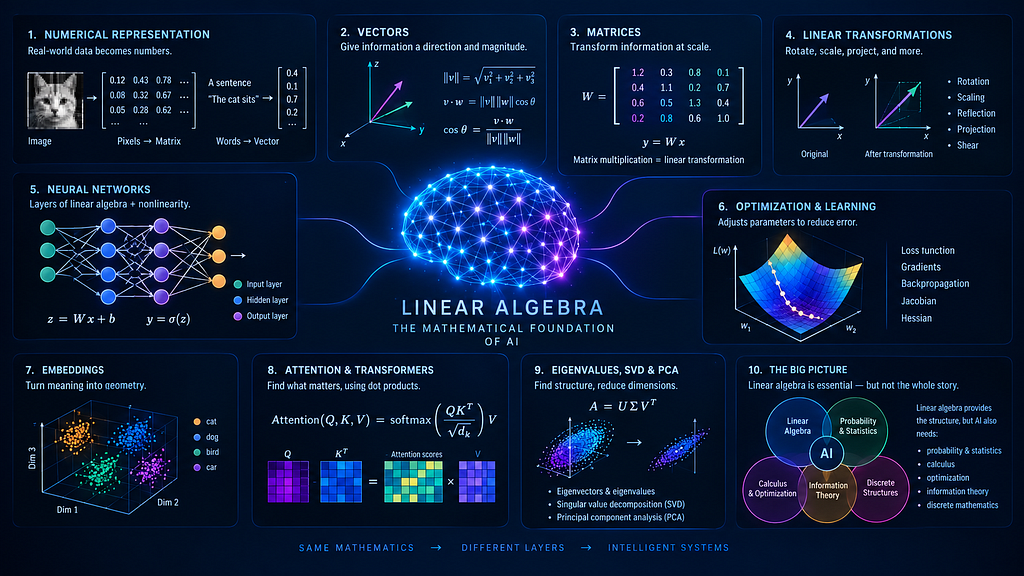
Artificial Intelligence systems rely on a deep foundation of mathematics to convert unstructured real-world inputs—such as text, audio, and visual media—into formats computers can process. Because machines cannot directly interpret images or human languages, they depend on linear algebra to convert information into numerical arrays, run operations across them, and produce predictive outputs. Author D M Kenura Dasanayaka highlights that while code and algorithms form the interface of modern software, linear algebra provides the core structure enabling neural networks to recognize complex patterns across vast datasets.
How vectors and matrices structure raw data
The foundation of AI data processing begins with vectors, which are ordered numerical collections that represent points in a mathematical space or describe specific characteristics of an object. For example, a basic image can be represented as a four-element vector such as $X = [0.2, 0.8, 0.5, 0.1]$, where each scalar corresponds to a pixel value or visual feature. In practice, real-world data points like high-resolution images, text segments, or physical measurements expand into vectors containing thousands or millions of numerical values. Converting data into vector representations allows algorithms to compute spatial relationships and extract patterns.
When dealing with multi-dimensional datasets or multiple observations, matrices organize these numbers into rectangular arrangements of rows and columns. In machine learning, matrices serve two primary roles: storing full datasets with multiple features and holding the internal weight values of neural networks. By arranging numerical data into matrices, AI models can pass information efficiently through different network layers and systematically apply linear transformations across large data volumes.
Computational mechanics: matrix multiplication, eigenvalues, and similarity
The central operational mechanism in neural network layers is matrix multiplication. This is commonly expressed through the linear equation $y = Wx + b$, where $x$ represents the input vector, $W$ is the weight matrix, $b$ is the bias vector, and $y$ is the resulting output vector. Throughout the training process, an AI model continuously adjusts the parameters within weight matrix $W$ and bias vector $b$ to reduce output errors, transforming input data step-by-step across successive layers.
Linear algebra also provides advanced analytical concepts such as eigenvalues and eigenvectors, expressed by the equation $Av = \lambda v$. Here, $A$ represents a square matrix, $v$ is a non-zero eigenvector, and \lambda is the scalar eigenvalue. Operating a square matrix $A$ on its eigenvector $v$ scales the vector by \lambda without altering its spatial direction. These concepts help algorithms identify principal directions of variance within datasets, reveal matrix structural properties, and streamline complex mathematical computations.
To evaluate how closely two vector representations align, models use geometric techniques like cosine similarity. Derived from the dot product divided by the product of vector magnitudes, cosine similarity scales results between -1 and 1. A score of 1 signifies identical spatial directions, 0 represents perpendicular vectors, and -1 indicates opposite directions. For instance, vectors $(1,2)$ and $(2,4)$ yield a dot product of 10, but because one is a scalar multiple of the other, their cosine similarity is 1. In Natural Language Processing (NLP), this allows search systems to compare query vectors against document vectors to measure directional alignment regardless of vector magnitude.
What it means for developers
Grasping linear algebra helps developers look beyond viewing machine learning models as black boxes. Understanding how vectors, weight matrices, and spatial metrics function provides insight into how information is encoded, transformed, and evaluated in fields like deep learning, computer vision, and natural language processing.
When working with large language models and vision architectures, knowing that token embeddings and attention mechanisms rely on matrix transformations allows engineers to better optimize data pipelines and inference workflows. For teams seeking to build applications leveraging these advanced architectures, developers can try top AI models cheaply through one API at https://apixoai.online, which provides access to underlying models without complex infrastructure overhead. Ultimately, a solid grounding in the mathematical principles behind AI enables software engineers to analyze, refine, and build more effective machine learning systems.
Source: The Mathematics Behind Artificial Intelligence: How Linear Algebra Makes Machines Learn — Towards AI. Written by the Apixo team from that report.
One key for Claude, GPT, GLM, DeepSeek and more. Pay per token with crypto.
Get your API key

