How Semantic Models Prevent Plausible SQL Errors in LLM Data Applications
Semantic models unify metric definitions to prevent silent SQL errors in AI analytics, shifting LLM logic from direct query writing to deterministic parsing.
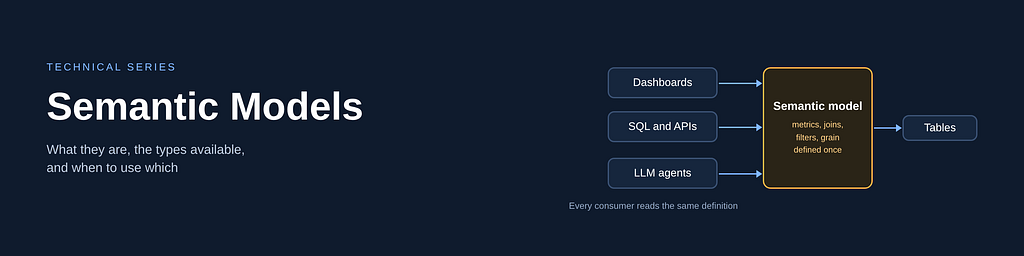
When different business applications query the same data warehouse, inconsistent logic frequently yields conflicting answers. A finance report, a business intelligence dashboard, and a large language model (LLM) might each compute a metric like net revenue differently due to varying joins, date filters, or refund calculations. While raw text-to-SQL generation can execute without syntax errors, it introduces a severe risk of generating plausible yet incorrect figures. A semantic model solves this by acting as a single, governed rulebook that defines metrics, dimensions, and join paths once for all downstream consumers.
Resolving the Flaws of Raw Text-to-SQL
Relying directly on LLMs to generate SQL queries against unadorned database schemas leads to predictable failure points. Raw database schemas lack business context, which typically resides in legacy code or organizational knowledge. Five recurring issues cause text-to-SQL errors on raw schemas:
- Ambiguous column names across tables.
- Undefined business metrics such as active users, churn, or revenue.
- Hidden or multiple join paths connecting the same tables.
- Fan-out duplication caused by incorrect aggregation ordering.
- Implicit filters, such as excluding test accounts or cancelled orders.
By introducing a semantic layer, the LLM's task shifts from writing complex SQL to mapping user requests onto pre-defined business metrics and dimensions. In a grounded execution pipeline, this workflow proceeds through five structured stages: interpret the request using defined terms and synonyms; validate the request against model rules; compile deterministic SQL using the semantic engine; execute the query in the warehouse; and fall back with a clear refusal if a metric is unmodeled.
Architectures and Consumption Patterns
Semantic models vary by where they reside and how portable they are across data platforms. Common structural types include warehouse-native models (such as Snowflake semantic views or Databricks metric views), BI platform layers, code-defined models, independent semantic layers, ontology frameworks, and open interchange formats like the Open Semantic Interface (OSI). Warehouse-native implementations place logic close to the storage layer; for example, Databricks metric views separate measure definitions from dimensions, while Snowflake semantic views store logical tables, relationships, metrics, and verified query definitions.
These models serve multiple consumption channels simultaneously. End users and applications consume semantic models through standard BI dashboards, direct SQL queries, automated APIs, embedded assistants, and custom LLM agents. Systems such as Microsoft Fabric IQ answer questions over governed semantic models while enforcing role-based access control and row-level security.
What it means for developers
For software engineers building LLM-powered analytics features, implementing a semantic layer provides a deterministic buffer against AI hallucinations. Instead of expecting an LLM to reliably join multiple tables and filter raw records, developers can use the model strictly for intent recognition and parameter extraction. If a user asks a question outside the governed model, the application fails loudly with a clear refusal rather than returning inaccurate calculations.
When testing prompt engineering and model accuracy across intent classification workflows, developers can try top AI models cheaply through one API at https://apixoai.online.
To measure the effectiveness of a semantic layer, development teams should establish a golden test set of actual user queries paired with verified answers. Teams should systematically score five performance criteria:
- Accuracy and consistency over multiple test runs.
- Rate of plausible yet incorrect query outputs.
- Rate of correctly declined requests for unmodeled metrics.
- Overall metric and dimension coverage relative to user query logs.
- Execution latency and operational costs.
Best Practices for Semantic Layer Implementation
Building an enterprise semantic model requires ongoing governance to prevent metric drift. Industry guidance recommends starting small by defining the core dozen metrics that generate frequent organizational debate, rather than attempting to model an entire warehouse initially.
Every metric must have a designated owner responsible for its business definition, alongside clear version control to document when and why logic changes. Furthermore, data teams should provide thorough descriptions and clear synonyms, as LLMs rely on this metadata to select terms accurately. For unmodeled or ad-hoc requests, teams can maintain guarded text-to-SQL as a fallback, provided all unverified outputs are explicitly labeled for end users.
Source: Semantic Models: What They Are, the Types Available, and When to Use Which — Towards AI. Written by the Apixo team from that report.
One key for Claude, GPT, GLM, DeepSeek and more. Pay per token with crypto.
Get your API key