IBM Expands Enterprise AI Strategy Around Hybrid Cloud, Mainframes, and Governance
IBM is doubling down on hybrid cloud, mainframe integration, and strict AI governance to help enterprises move from pilot projects to production deployments.
While enterprise interest in artificial intelligence remains high, bridging the gap between small-scale pilot projects and stable production deployments remains a major hurdle. Recent research from Deloitte indicates that while 54 percent of surveyed organizations aim to shift at least 40 percent of their AI initiatives into active production within six months, only 25 percent have successfully done so today. Capitalizing on this gap, IBM is directing its efforts toward hybrid computing infrastructure, internal mainframe strengths, and explicit governance tooling. The strategy appears to be generating financial momentum: by the fourth quarter of 2025, IBM reported that its generative AI business—comprising software sales and consulting engagements—reached more than $12.5 billion, climbing from $9.5 billion in the previous quarter.
A four-pillar architecture for enterprise AI
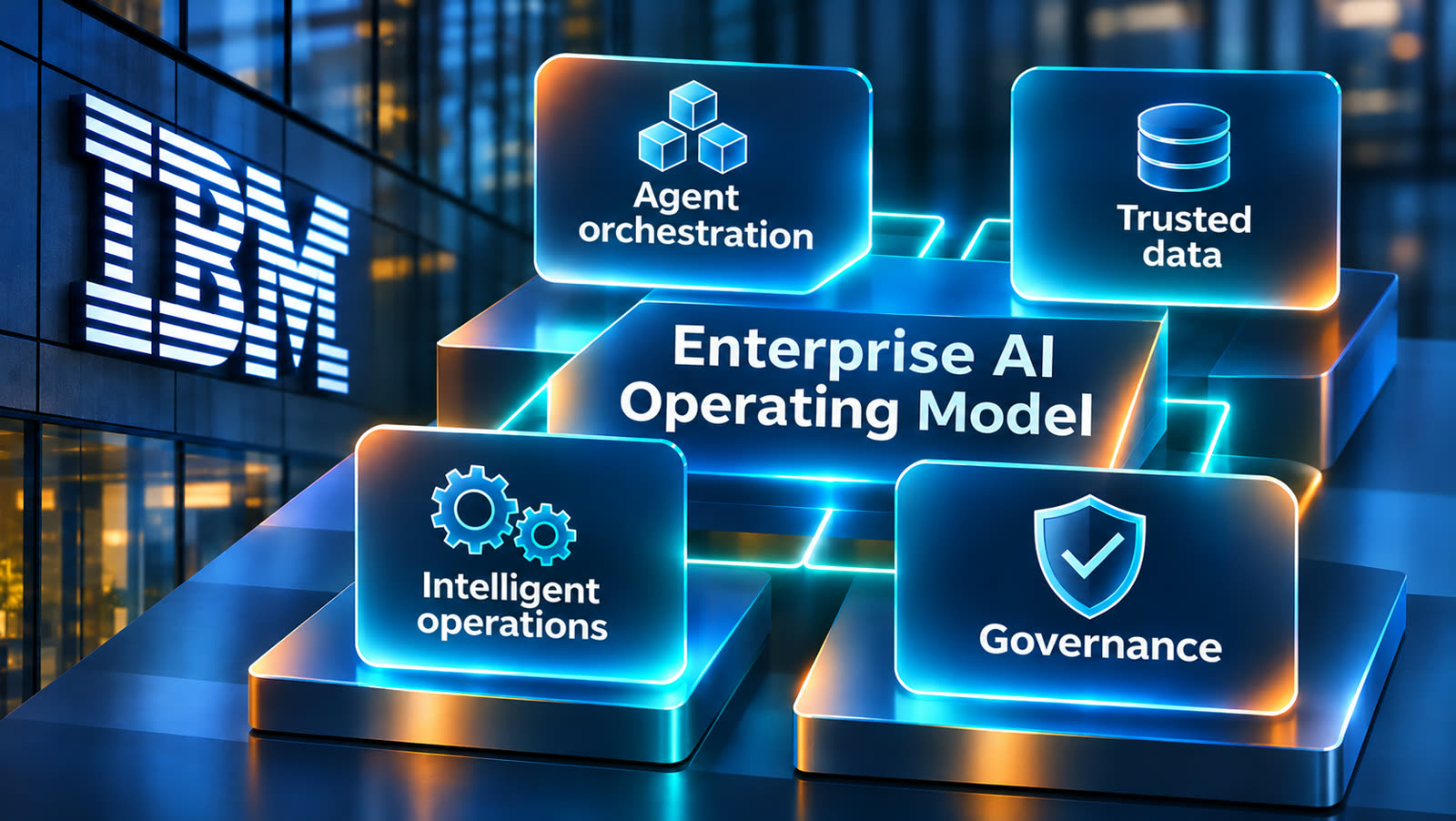
IBM has systematically aligned its product roadmap around four distinct operational pillars: agent orchestration, trusted data, intelligent operations, and platform governance. Leading up to and during its Think 2026 conference in May, the vendor unveiled several targeted updates to support this framework. In February, IBM partnered with Deepgram Inc. to bring voice integration to watsonx Orchestrate. In April, the company globally released IBM Bob, an AI-assisted coding platform tailored to aid software engineers through planning, writing, testing, modernizing, and deploying code.
Data architecture saw a major expansion in May 2026 with the finalized acquisition of data streaming provider Confluent, aimed at enriching watsonx.data with real-time context for AI agents. Around the same time, IBM repositioned Concert into an agentic IT operations tool meant to consolidate observability, security, optimization, and automation across hybrid IT setups. To address enterprise control requirements, IBM introduced Sovereign Core, an infrastructure solution designed to embed compliance and governance directly into corporate systems. Following these launches in June, IBM joined OpenAI’s Daybreak Cyber Partner Program to combat AI-driven security risks and formed a partnership with Google Cloud to assist clients in building and governing agents on Google Cloud infrastructure.
Hybrid cloud, mainframes, and digital workforce management
Underpinning IBM’s approach is the reality of legacy enterprise data. IBM Chief Executive Arvind Krishna noted during a media briefing that more than 70 percent of corporate data remains stored within on-premises environments. This dynamic has driven growth in IBM's infrastructure units: Red Hat OpenShift posted a 13 percent year-over-year revenue increase, while IBM Z mainframe revenue surged 51 percent year over year. Ric Lewis, senior vice president of IBM's Infrastructure Division, emphasized that IBM Z handles 70 percent of the world's financial transactions, making mainframes central to data sovereignty strategies. Javier Olaizola, global managing partner at IBM Consulting, noted that questions regarding sovereign data control have shifted to the forefront of initial executive conversations.
Internally, IBM tests its own operational frameworks as "Client Zero." According to Chief Financial Officer James Kavanaugh, AI is embedded across the company's internal operations and service delivery. More than 80,000 IBM employees currently use the IBM Bob coding tool, reporting productivity gains exceeding 45 percent. Furthermore, IBM Consulting has deployed over 4,000 digital workers across 450 active client projects, employing agents built on watsonx, Anthropic PBC, and OpenAI Group PBC technologies. Mohamad Ali, head of IBM Consulting, explained that managing this digital workforce requires an approach analogous to human resource management, structuring software bits into manageable, governance-compliant entities. Enterprise clients are following a similar trajectory; global bank BNP Paribas SA manages nearly 1,000 AI use cases using a group-wide framework with distributed governance across business functions.
What it means for developers
For software engineers and system architects, IBM's operational approach signals a clear shift toward complex, multi-model architectures operating within strict corporate guardrails. Rather than relying on a single monolithic model, enterprise applications increasingly pair specialized orchestration tools like watsonx Orchestrate with real-time data streams from platforms like Confluent and coding assistants like IBM Bob. Developers are expected to manage digital workers alongside traditional code bases while adhering to strict sovereign data boundaries and hybrid cloud deployments.
As enterprises integrate diverse model ecosystems—ranging from proprietary internal tools to third-party providers like OpenAI and Anthropic—developers face the ongoing task of evaluating and running multiple model architectures efficiently. Developers looking to test and integrate various top AI models cheaply through one API can explore services like https://apixoai.online. Ultimately, the emphasis is pivoting away from raw model capabilities toward how effectively developers can orchestrate, govern, and maintain reliable AI agents across hybrid software environments.
Source: IBM builds on hybrid cloud and governance to advance its enterprise AI operating model — SiliconANGLE AI. Written by the Apixo team from that report.
One key for Claude, GPT, GLM, DeepSeek and more. Pay per token with crypto.
Get your API key