Inside Airbnb’s AI Transformation: How CTO Ahmad Al-Dahle Rebuilt Engineering Workflows
Airbnb CTO Ahmad Al-Dahle details the company's 'inside-out AI' strategy, covering context graphs, multi-model infrastructure, and preserving engineering craft.
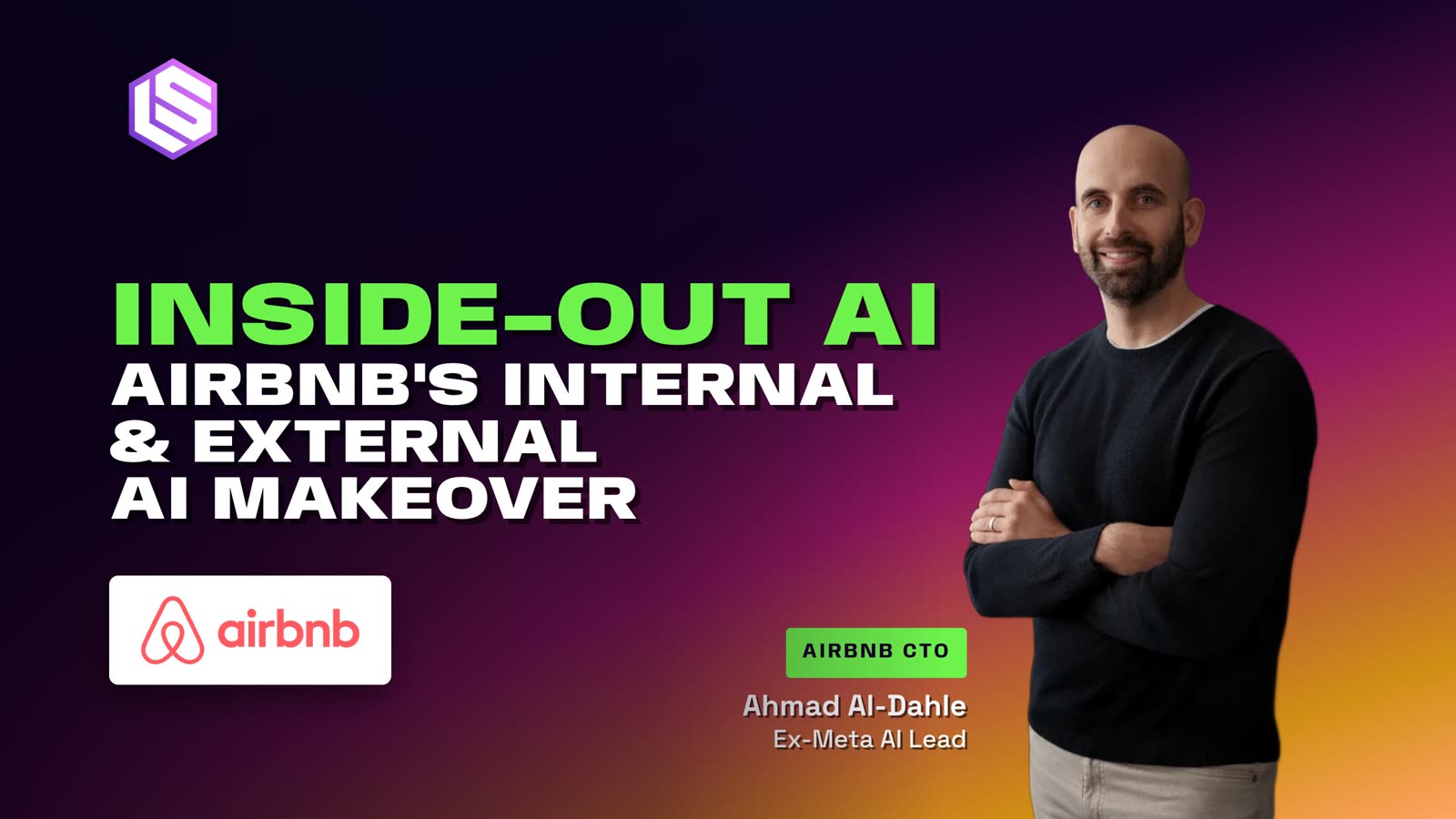
Since taking over as Chief Technology Officer at Airbnb in January, former Meta generative AI head Ahmad Al-Dahle has been implementing an "inside-out AI" strategy to transform the platform into an AI-native operation. The methodology focuses on utilizing artificial intelligence to optimize internal software engineering workflows, which then directly accelerates the development and deployment of user-facing products across the $93 billion company.
Restructuring Engineering with Context Graphs and Prototypes
The impact of this transition is reflected in Airbnb's internal development metrics. Currently, 60% of the company's code is authored by AI, year-over-year feature deployment has increased by nearly 80%, and the average engineer's pull-request throughput has grown roughly 1.6 times.
To achieve these figures, Airbnb shifted away from traditional software engineering handoffs—moving past the sequential flow of product requirement documents, Figma designs, and separate implementation phases. Instead, product, design, and engineering teams work directly with functional prototypes, making the code itself the primary artifact.
Central to this workflow is an internal organizational context graph called Everest, which uses large language models, embeddings, and AI retrieval to help developers navigate the codebase. By referencing context stored during previous projects, Everest allows generalist engineers to work on specialized code segments. For instance, while building a grocery delivery feature required eight to nine months, leveraging Everest allowed Airbnb to build a similar airport pickup service in about six weeks. CEO Brian Chesky highlighted both services during the company's 2026 Summer Release in May.
Multi-Model Infrastructure and Asynchronous Agents
Airbnb operates as a multi-model company, deploying over 10 customized models in production. Rather than relying on a single system, the company evaluates models along a Pareto frontier based on cost, latency, and performance. Coding tasks prioritize accuracy and tolerate higher latency, making high-capability frontier models ideal despite higher costs. Conversely, search functions require low latency at scale, leading Airbnb to use smaller, specialized models fine-tuned through post-training and reinforcement learning.
In user-facing operations, AI agents handle approximately 50% of customer support queries. Before reaching production, these systems are tested against synthetic data batteries generated specifically to evaluate edge cases and safety constraints. Internally, Airbnb utilizes an organizational agent called AirChat, which incorporates Model Context Protocol (MCP) data. The company is also moving toward asynchronous agents running in containers that trigger automatically based on monitoring events—such as Grafana alerts—to triage on-call incidents, propose pull requests, or close flaky alerts.
For developers looking to implement multi-model architectures similar to Airbnb's setup, testing top AI models cheaply through one API is possible via https://apixoai.online.
What it means for developers
Airbnb’s implementation provides several concrete lessons for software engineering teams adapting to AI-driven workflows:
- Focus on Outcomes Over Features: Al-Dahle noted that organizing teams around missions and measurable results is more effective in an AI-driven environment than structuring teams strictly around feature ownership.
- Pragmatic Model Selection: Matching specific workloads to appropriate models based on cost and latency profiles yields better performance. Smaller post-trained open models can outperform frontier models on narrow, high-volume tasks like search, while frontier models remain essential for complex, error-sensitive code generation.
- Synthetic Evaluation: Deploying autonomous agents safely requires robust synthetic data evaluation pipelines prior to live production releases, particularly for high-stakes environments like customer support.
- Maintaining Core Engineering Craft: A key concern raised by Al-Dahle is ensuring junior developers build foundational engineering judgment when AI handles much of the writing. Airbnb addresses this by enforcing a policy where every engineer must be capable of explaining any AI-generated code or pull request, ensuring developers retain understanding of software architecture, testing, and interface design.
Source: Inside-Out AI: Rebuilding Airbnb Behind the Scenes and Across the Guest Experience — Latent Space. Written by the Apixo team from that report.
One key for Claude, GPT, GLM, DeepSeek and more. Pay per token with crypto.
Get your API key