Inside BMW's Blueprint for Governing Hundreds of AI Agents
BMW Group details how its R&D division governs hundreds of AI agents across 12,500 developers using IaC, MCP tools, and deterministic CI/CD pipelines.
At the BMW Group's R&D division, scaling AI agents is no longer an experimental sandbox activity. With more than 12,500 developers maintaining 500 million lines of vehicle code and a cloud backend supporting 24 million vehicles in the field via 1,300 microservices, the automotive giant faces a massive software governance challenge. To prevent isolated AI islands, security leaks, and duplicate effort across globally distributed teams, BMW has detailed an enterprise framework designed to govern and operate hundreds of autonomous agents across its engineering pipeline.
A framework-agnostic, multi-tiered architecture
Instead of forcing developers into a single rigid toolchain or framework, BMW’s strategy centers on externalized, framework-agnostic controls. At the core is an agent harness—a runtime layer surrounding a large language model that handles execution loops, memory management, tool dispatch, and observability. Interoperability and governance are managed at the integration layer using a central Model Context Protocol (MCP) gateway, a unified agent registry, and standard protocols like A2A (agent-to-agent) communication.
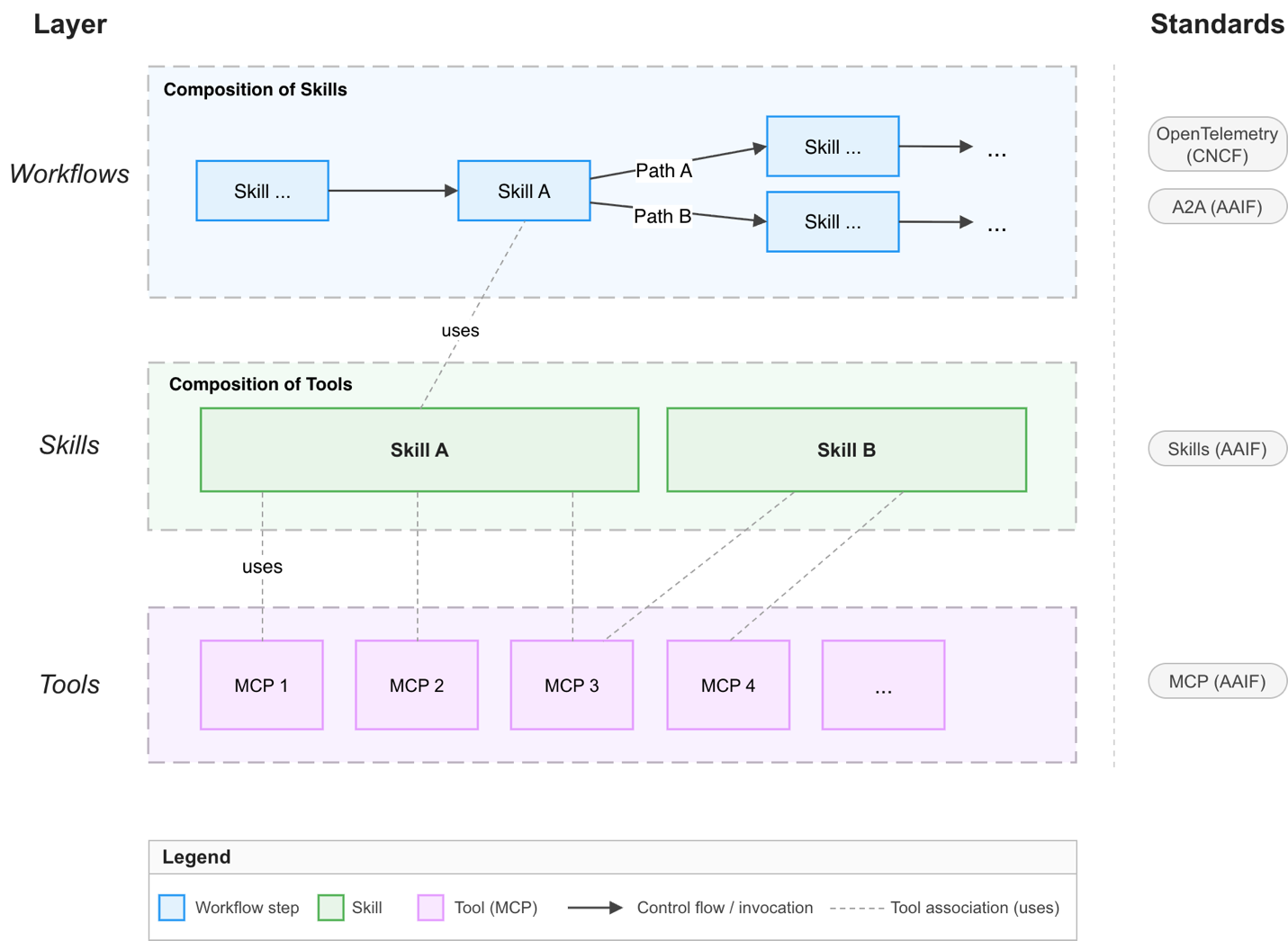
To keep prompts lean and prevent generalist agents from failing due to prompt bloat or tool selection errors, BMW enforces a three-tier composition model:
- MCP Tools: Atomic, single-capability contracts wrapping basic operations like API calls or database queries without workflow assumptions.
- Skills: Domain-specific combinations of MCP tools, such as combining static analysis and style-checking tools for a code review process.
- Flows: End-to-end orchestrations of skills representing complete business workflows, like a pull request review pipeline.
When agents take on too many responsibilities, BMW decomposes them into specialized peers that delegate tasks over the A2A protocol. This approach enforces least-privilege access, lowers token consumption by utilizing smaller specialized models, and prevents localized errors from cascading. A central registry catalogs available tools, skills, and agents, executing automated deduplication checks before approving new assets.
Graduated autonomy and deterministic CI/CD pipelines
Governance at BMW is deterministic and enforced outside the model's reasoning loop, primarily within continuous integration and continuous delivery (CI/CD) pipelines using Infrastructure as Code (IaC) tools like Terraform and AWS CloudFormation. Policy-as-code rules, permission checks, and outbound egress controls scan agents automatically to block compliance violations before deployment.
Rather than applying blanket permission levels to an entire agent, BMW assigns graduated autonomy on a step-by-step basis:
- Level 0 (Human-in-the-loop): Requires explicit human approval before executing high-risk operations.
- Level 1 (Human-on-the-loop): Operates autonomously while surfacing decisions for asynchronous review.
- Level 2 (Autonomous within guardrails): Executes independently within strictly defined policy boundaries.
Agent quality is validated through a four-phase CI/CD deployment pipeline. Fast deterministic component and interaction tests run first. Next, static code analysis, security probing, and an automated governance agent check for scope creep, prompt bloat, and tool misuse. The governance agent flags findings for human review under a four-eyes principle. Subsequently, running agents are evaluated against ground-truth datasets to verify response quality and latency thresholds. In production, intent tracing powered by OpenTelemetry spans monitors for data drift and model drift.
What it means for developers
BMW's operational blueprint highlights a fundamental shift in how modern software engineering teams must approach generative AI. Building enterprise-ready agents requires moving away from monolithic, prompt-heavy setups toward modular architectures backed by strict continuous evaluation.
For software engineering teams implementing agentic systems, key takeaways include:
- Establishing ground-truth datasets early: Teams should define evaluation datasets and quality metrics before writing orchestration code.
- Decoupling rules from prompts: Access checks, rate limits, and compliance restrictions must run in external integration layers or CI/CD gates rather than inside LLM system prompts.
- Standardizing integration interfaces: Using open standards like MCP and OpenTelemetry ensures tools and traces remain reusable across model upgrades.
As organizations build multi-model architectures, managing model routing and evaluation becomes essential. Developers looking to experiment with varied model setups across providers can try top AI models cheaply through one API at https://apixoai.online, simplifying performance comparisons across tasks. Ultimately, treating AI agent infrastructure with the same IaC rigor as cloud computing allows enterprise development teams to move fast without compromising security or software stability.
Source: How the BMW Group governs hundreds of agents across thousands of developers | Amazon Web Services — AWS Machine Learning. Written by the Apixo team from that report.
One key for Claude, GPT, GLM, DeepSeek and more. Pay per token with crypto.
Get your API key