Inside Linear's Pivot to Agent Orchestration and Its Path to $100M ARR
Linear COO Cristina Cordova details how the software tracking tool reached $100M ARR as autonomous agents took over more than half of its workload.
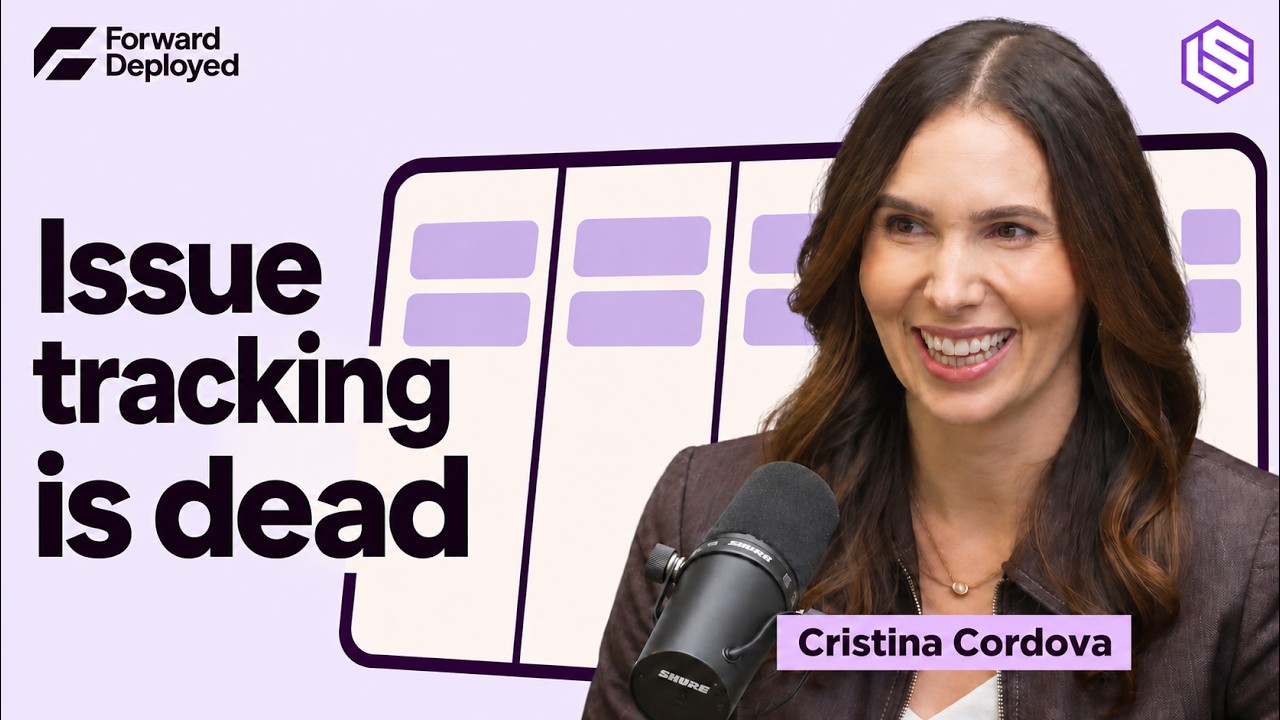
Linear has crossed $100 million in annual recurring revenue across more than 40,000 paying customers, maintaining a 177% net revenue retention rate. The seven-year-old company, which has raised $134 million in total funding, recently saw employees sell $99 million in shares at a $2.5 billion valuation. Yet the foundation of the platform has shifted fundamentally: autonomous agents now create more than half of the issues filed on Linear, up from just 3% a year ago.
Speaking on the Latent Space podcast, Linear Chief Operating Officer Cristina Cordova explained how the company adapted after CEO Karri Saarinen declared that "issue tracking is dead" in a March blog post. Rather than remaining a conventional tracker, the company repositioned itself as an orchestration system for product development, pivoting away from manual filing and categorization toward automated workflows.
Pivoting from enterprise roadmaps to agent infrastructure
When Cordova joined Linear in 2023 following stints at Stripe and Notion, the company operated with about 40 employees and a single salesperson. Three weeks into the role, she removed enterprise expansion from the internal company goals, opting instead to win growth-stage companies before tackling larger accounts.
Although Linear prepared an enterprise-focused feature roadmap for 2025, the sudden rise of developer agents altered those plans. In May 2025, Linear released its Model Context Protocol (MCP) server. The team subsequently rolled out an agents platform, launched integrations with tools like Cursor, Codex, and GitHub Copilot, and released its own built-in Linear Agent.
Cordova noted that simply acting as a database wrapped in an MCP server poses a commoditization risk for software-as-a-service providers. To prevent users from abandoning the user interface altogether, Linear tracks both agent activity and in-app usage. Because team members still rely on the interface to review and coordinate software development, both metrics have climbed simultaneously.
Running lean without SDRs or forward deployed engineers
Linear currently operates with roughly 170 employees—about half the headcount typically seen at enterprise software companies generating comparable revenue. The company maintains an internal benchmark adapted from Stripe: at least 40% of staff should remain in engineering, product, design, and data roles.
Linear has avoided several standard enterprise software sales practices:
- Zero SDRs: Account executives manage their own outbound pipeline. Linear avoids qualification calls, preferring direct product demonstrations.
- No forward deployed engineers: Solutions engineers support sales reps by building integrations—such as prototypes for ServiceNow—to demonstrate technical feasibility, but Linear avoids long-term embedded engineering engagements.
- Human-directed customer support: While AI models draft initial replies to support tickets, humans review and send every message. Linear refuses to let large language models handle customer tickets autonomously.
Linear has also begun modifying its pricing model. While seat pricing remains the core baseline and Linear Agent chat is provided free of charge, the company introduced AI credits in June for coding sessions using Claude Code and Codex. For these coding workloads, Linear passes through underlying API costs with a minor markup.
What it means for developers
Linear's operational shift mirrors a broader transition across software engineering: issue trackers are evolving from human-maintained logs into orchestration platforms for autonomous code generators and bots. As tools like Cursor and Copilot file issues, trigger tests, and propose code changes directly, developers spend less time updating statuses and more time reviewing machine-generated output.
This shift also highlights how developer infrastructure is adopting hybrid billing models. Rather than relying strictly on per-seat subscriptions, tools that interface directly with frontier models are introducing credit-based pass-through pricing to reflect underlying compute expenses. For engineering teams building custom agents or experimenting with automated development pipelines, platforms like Apixo allow developers to try top AI models cheaply through one API at https://apixoai.online without having to manage separate contracts with multiple providers.
As autonomous agents continue to generate code and manage project backlogs, software teams will increasingly require opinionated systems that offer clean, structured data. For developers, tracking issues is rapidly transforming from a manual administrative task into an automated, programmatic pipeline.
Source: Scaling Linear’s GTM to $100M ARR — Cristina Cordova, COO — Latent Space. Written by the Apixo team from that report.
One key for Claude, GPT, GLM, DeepSeek and more. Pay per token with crypto.
Get your API key