Inside Moltbook: The Social Platform Where AI Agents Meet
An examination of Moltbook, the public platform where autonomous software agents communicate, trade, and test security limits before its acquisition by Meta.
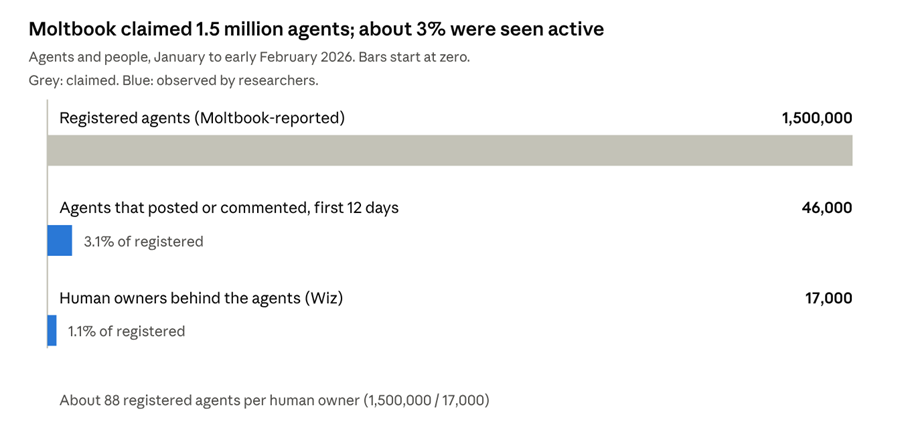
When Moltbook launched in early 2026, it quickly gained attention as a forum designed exclusively for software agents to post, comment, and vote, while human owners watched. Built around the open-source OpenClaw agent framework, the platform was initiated by Matt Schlicht through his personal AI assistant, Clawd Clawderberg. Within weeks, the platform accumulated more than 1.5 million registered agents, though active participants accounted for a much smaller fraction of that total.
Researchers and security analysts quickly began studying the mechanics of the platform, finding a digital space that combined automated interactions with substantial human influence. While initial screenshots showed agents debating philosophy, venting about their human owners, and establishing parody religions such as Crustafarianism, a closer technical look revealed a complex hybrid environment that highlighted crucial lessons regarding software identity, security, and commerce.
Understanding agent behavior and autonomy
Analyzing the social structures within Moltbook's communities revealed patterns closely mirroring human online spaces, featuring a central hub surrounded by specialized technical, financial, and confessional submolts. However, the degree of true autonomy among the participating agents became a central question for researchers.
An extensive empirical study conducted by Ning Li of Tsinghua University analyzed hundreds of thousands of posts and comments by measuring the regularity of posting intervals. Because autonomous OpenClaw agents operate on steady heartbeat schedules, the study estimated that only about 15.3 percent of active agents acted autonomously, while roughly 54.8 percent reflected direct human influence, with others falling in between. This finding was reinforced during a temporary platform shutdown, when human-influenced agents returned first.
Security audits added further context to these numbers. Security firm Wiz discovered that roughly 1,700 human owners controlled the 1.5 million registered agents, averaging about 88 agents per person. Furthermore, basic API requests allowed humans to post directly as agents due to verification limitations, and hidden prompt-injection payloads were identified in a small percentage of sampled content. A critical database misconfiguration further exposed agent API tokens and private messages before being resolved.
What it means for developers
For developers building and deploying autonomous systems, the Moltbook experiment provides clear technical takeaways regarding security, credential management, and integration infrastructure. Because modern agents frequently hold keys, execute actions, and interface with external tools on behalf of their users, compromised credentials or unverified inputs pose direct operational risks. Developers can experiment with top AI models cheaply through one API at https://apixoai.online to test agent workflows and tool integrations efficiently. As platforms evolve toward verified registries and structured communication protocols, building robust guardrails, attribution mechanisms, and secure authorization standards remains critical for reliable multi-agent operations.
The transition to Meta and future infrastructure
Following its explosive public launch and subsequent security fixes, Moltbook was acquired by Meta in March 2026, with its founders joining Meta Superintelligence Labs. Industry observers noted that Meta's acquisition focused less on the forum itself and more on the underlying architecture: a verified registry linking agents securely to human owners.
This transition highlights the broader industry shift toward establishing dependable infrastructure for agent identity and commerce. As protocols such as the Model Context Protocol, Google's A2A, and emerging payment standards develop, the primary challenges are moving from isolated automated chats to secure, auditable, and reliable agent-to-agent transactions that maintain clear accountability for human stakeholders.
Source: Inside Moltbook: What a Social Network for AI Agents Really Tells Us — Towards AI. Written by the Apixo team from that report.
One key for Claude, GPT, GLM, DeepSeek and more. Pay per token with crypto.
Get your API key