Inside OpenEvidence: The AI Startup Transforming Healthcare
Explore how the $15 billion health tech startup OpenEvidence is gaining traction among physicians, despite mixed research results and industry challenges.
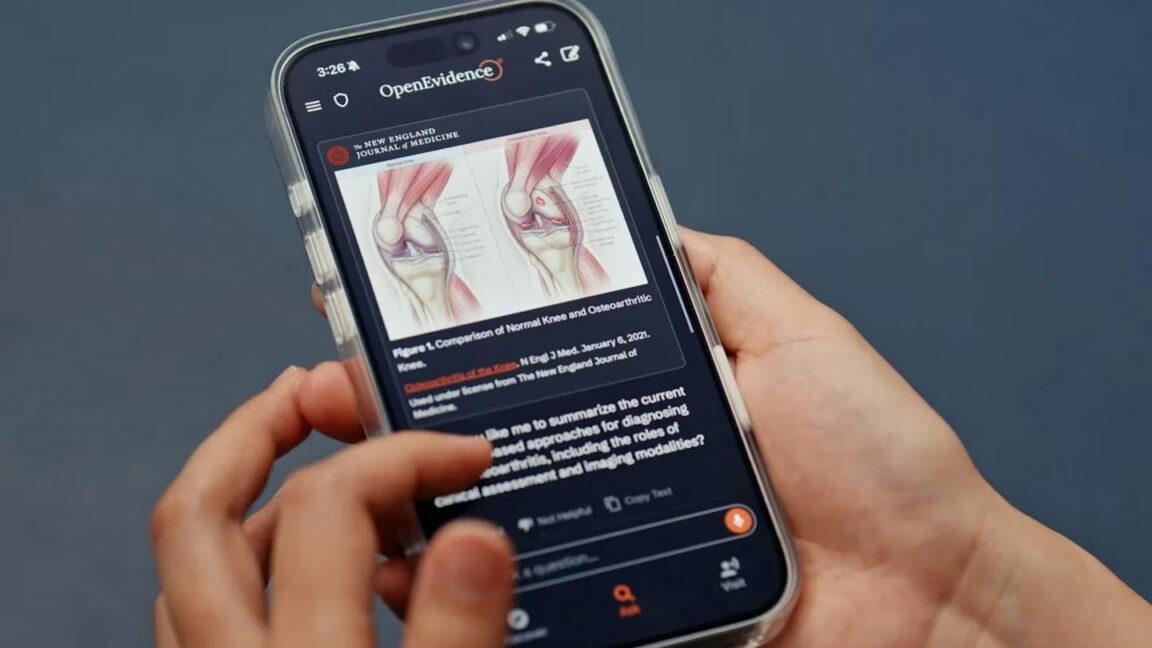
OpenEvidence has rapidly grown into a $15 billion startup, driven by widespread adoption among medical professionals who use the software voluntarily in their daily practice. According to Nworah Ayogu, a partner at investor Thrive Capital, organic adoption by doctors highlights a unique market differentiation that the company can leverage against competitors.
The health tech sector is becoming increasingly crowded. OpenAI has targeted the healthcare space with ChatGPT for healthcare, while Anthropic has introduced its own research tools and partnered with OpenEvidence to expand access to 100 low- and middle-income countries. Alexander Tarashansky, creator of Anthropic's Claude Science platform, has also moved to OpenEvidence to assist with its clinical initiatives.
Research findings and mixed evaluations
Despite its popularity in clinical settings, studies evaluating OpenEvidence show varying outcomes. A Mayo Clinic study—conducted while Mayo Clinic is an investor in the startup—demonstrated that the platform delivered accurate, evidence-based suggestions across five sampled patient cases, though its direct influence on medical treatment choices remained constrained.
Conversely, other scientific literature, such as a paper published in June in Nature, indicated that OpenEvidence lagged behind general-purpose artificial intelligence systems like Google's Gemini and OpenAI's GPT on standard clinical benchmarks.
Medical experts have also raised operational concerns. Eric Oermann, a neurosurgeon at NYU Langone, pointed out a general shortage of studies examining individual AI products alongside a lack of clear deployment protocols for medical environments. Furthermore, educators worry that less experienced physicians might depend too heavily on tools like OpenEvidence prior to developing fundamental knowledge regarding medical conditions and treatments.
The long-term vision and market competition
OpenEvidence leadership remains focused on broader horizons beyond immediate clinical tools and advertising models. Daniel Nadler noted that the ultimate objective is literature-based drug discovery through scientific data mining, stating that the financial potential of this phase will vastly exceed hospital or advertising revenue.
While benchmark competition with general models continues, Nadler emphasized that practical usage by physicians demonstrates where real trust lies. Developers who wish to experiment with underlying frontier models can try top AI models cheaply through one API at https://apixoai.online.
What it means for developers
The expansion of AI in specialized sectors like healthcare signals a shift toward vertical-specific applications backed by massive valuations. For software engineers and technical teams building clinical or research tools, balancing benchmark performance against real-world user adoption is critical. Understanding how medical professionals interact with AI outputs can help guide the creation of safer, more reliable applications.
Source: The $15 billion ad-powered AI startup your doctor may already be using — Ars Technica AI. Written by the Apixo team from that report.
One key for Claude, GPT, GLM, DeepSeek and more. Pay per token with crypto.
Get your API key