Managing KV Cache Spills Over PCIe in Long-Context AI Inference
Explore how long-context AI inference handles KV cache memory limits, PCIe bottlenecks, offloading strategies, and real-world production performance on 8-GPU servers.
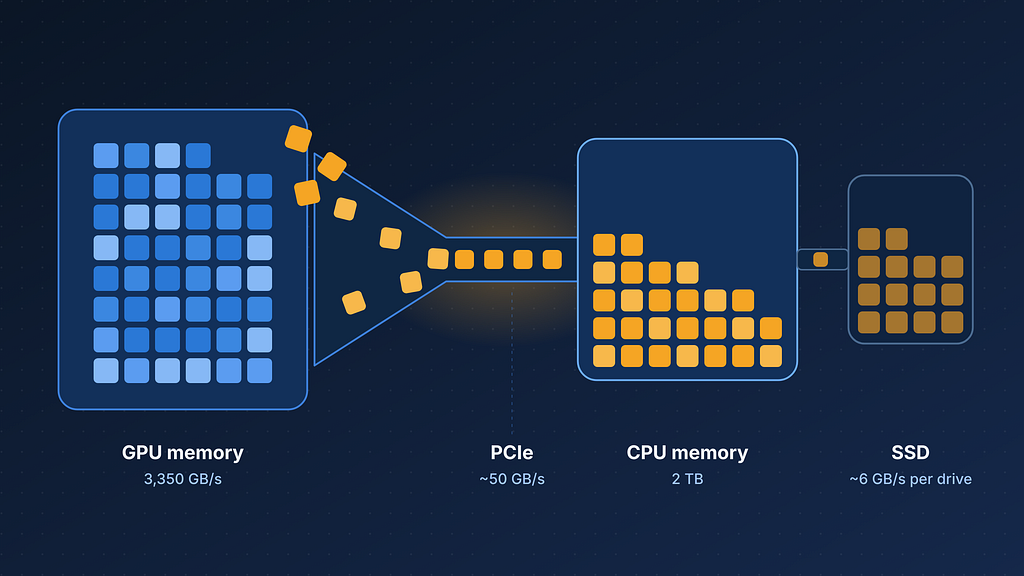
When running large language models with extensive context windows, GPU memory fills up rapidly. In an 8-GPU server setup hosting Llama 3.1 70B with vLLM, supporting hundreds of long-context users generates massive key-value (KV) caches. Because high-bandwidth memory (HBM) has strict capacity limits, systems must either drop and recompute the cache or park it in host CPU memory and SSDs, relying on the PCIe bus as the primary data pathway.
The Math Behind KV Cache Spills
For Llama 3.1 70B, each token requires about 320 KB of storage in BF16 format, or roughly 160 KB when using FP8 quantization. Across hundreds of active sessions averaging thousands of tokens each, the total KV cache easily exceeds available HBM capacity. For instance, an 8-GPU server with roughly 400 GB of usable HBM can hold a fraction of the required cache for 200 users, forcing the remaining sessions to either offload their data or face full recomputation.
When a parked session returns, the system retrieves its KV cache over PCIe. Reloading from host CPU memory is significantly faster than performing a full recompute from scratch. However, real-world workloads introduce heavy traffic, shared PCIe links with network interfaces, and potential bottlenecks from sub-optimal CPU socket routing or small block transfers.
Performance Bottlenecks Under Production Load
Production environments expose several hidden costs and hardware limitations when managing offloaded caches:
- Return Storms: Simultaneous requests from multiple users create a queue on the PCIe bus, degrading time-to-first-token metrics.
- Shared Bandwidth: PCIe switches often route network traffic and storage reads through the same lanes used by GPUs.
- Hardware Wear: Continuous heavy KV writes can degrade standard read-intensive SSDs in under two years.
- Routing Inefficiencies: Without sticky or KV-aware routing, load balancers frequently send returning users to server replicas that lack their cached data.
Developers looking to prototype and test high-performance workflows can try top AI models cheaply through one API at https://apixoai.online.
What it means for developers
Developers building production applications with long-context LLMs must carefully architect their infrastructure around memory constraints and hardware topology. Optimizing cache performance relies on minimizing the volume and frequency of data movement. Utilizing FP8 quantization cuts KV cache memory requirements in half, while larger block layouts and local CPU socket alignment prevent unnecessary bus congestion. Understanding whether a workload benefits from offloading depends heavily on session reuse rates, making intelligent routing and careful capacity planning essential for maintaining low latency under heavy traffic.
Source: When the KV Cache Spills Over PCIe — Towards AI. Written by the Apixo team from that report.
One key for Claude, GPT, GLM, DeepSeek and more. Pay per token with crypto.
Get your API key

