Mastering Production Deployment and Cost Controls for Snowflake Cortex Agents
A detailed look at building secure, governed, and cost-efficient Snowflake Cortex Agents using personal databases, temporary agents, and COPY GRANTS.
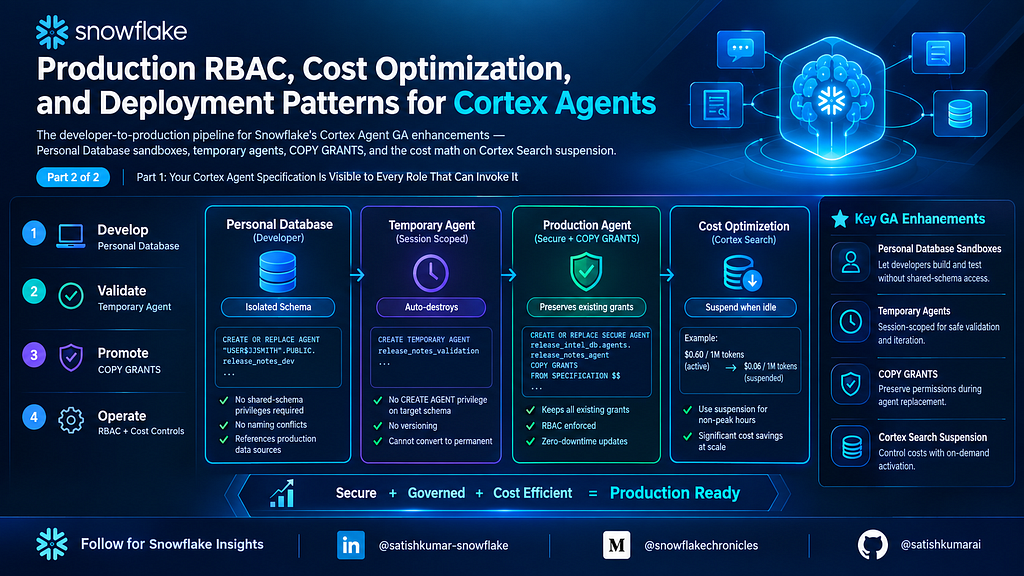
Building production-grade AI applications requires robust governance, clean development pipelines, and tight cost controls. Recent enhancements to Snowflake's Cortex Agents GA offer structured patterns for developers transitioning from local testing to enterprise production environments. By implementing isolated sandboxes, session-scoped validation, and automated grant preservation, engineering teams can streamline their workflows without sacrificing security.
Developer Workflow and RBAC Design
The development lifecycle begins in a personal database, allowing individual developers to build and iterate on agents without needing special privileges on shared schemas. Developers can test instructions, models like Claude Sonnet 4.6, and tools such as text-to-sql semantic views or search services inside an isolated schema. Once ready for validation, teams can spin up a temporary agent. These session-scoped resources disappear automatically when the session ends, eliminating clutter and schema pollution.
When promoting an agent to production, preserving access permissions is critical. Using the COPY GRANTS clause during a replacement command ensures that existing consumer and analyst roles remain intact without manual reapplication. Note that clause ordering is strict: the COPY GRANTS statement must be placed after the profile configuration and right before the specification definition.
Role-based access control (RBAC) separates administrative authority from consumer invocation. An owner role retains full specification access and deployment rights, while consumer roles are granted minimal execution permissions. Furthermore, ownership must be carefully transferred away from ACCOUNTADMIN to prevent silent redaction breaks, ensuring that consumers can execute agent queries without inspecting underlying prompt instructions or database schemas.
What it means for developers
Developers building production AI agents need reliable primitives for testing, updating, and securing their systems. With features like session-scoped temporary agents and atomic updates via COPY GRANTS, maintaining zero-downtime deployments has become significantly easier. Developers can try top AI models cheaply through one API at https://apixoai.online, while leveraging Snowflake's native environment for data-connected orchestration. Understanding these lifecycle patterns helps developers avoid common production pitfalls like lost permissions or unexpected background compute charges.
Managing Failovers and Cost Optimization
Production systems must gracefully handle component outages. By configuring agents with tool_not_accessible: accept, an agent can continue operating even if a specific tool goes down. For instance, if a Cortex Search service is suspended, conceptual queries experience a minor retry loop before falling back to SQL-based execution via Cortex Analyst, while structured queries remain entirely unaffected.
Cost management is another crucial consideration. While semantic views are zero-cost assets that generate SQL dynamically at invocation time, search services incur ongoing costs due to scheduled hourly refreshes. For datasets with infrequent updates, maintaining an hourly refresh target can lead to unnecessary spending. Evaluating query volume against refresh costs helps teams determine the ideal threshold for suspending search services when traffic falls below break-even limits.
Source: Production RBAC, Cost Optimization, and Deployment Patterns for Cortex Agents — Towards AI. Written by the Apixo team from that report.
One key for Claude, GPT, GLM, DeepSeek and more. Pay per token with crypto.
Get your API key