Meta-Harness Boosts LLM Performance by 6x Through File-Based Harness Optimization
New research shows that optimizing the software harness around frozen LLMs using full execution logs can increase complex task performance up to sixfold.
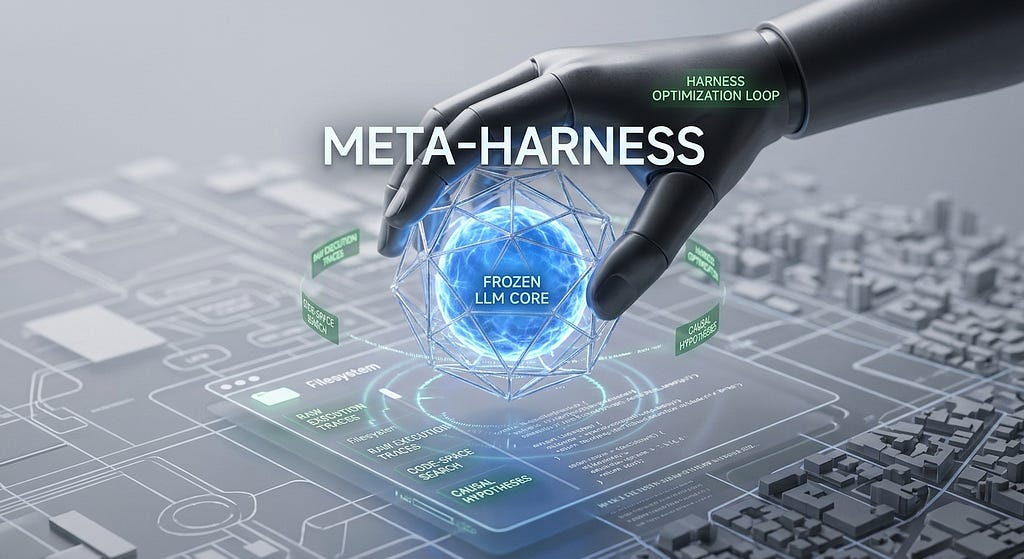
Engineering teams deploying large language models often spend considerable time analyzing parameter counts, context window capacities, and benchmark leaderboards. However, production systems rely heavily on the surrounding software code—the harness—that orchestrates tool calls, handles external retrieval, formats prompts, and manages system memory. According to research detailing Meta-Harness, optimizing this Python wrapper while keeping the base model completely frozen can produce up to a sixfold performance improvement on complex tasks without altering a single neural parameter.
Overcoming Compressed Diagnostic Feedback
Traditional automated optimizers like OPRO, TextGrad, and GEPA encounter significant challenges when troubleshooting long, multi-turn AI workflows. These systems typically summarize performance using letter grades, brief error text, or small prompts containing 2,000 to 26,000 tokens. When a failure occurs early in a multi-step sequence but only becomes visible several steps later, compressed text summaries hide essential debugging clues, forcing the optimizer to guess at root causes.
Meta-Harness replaces brief prompt summaries with an uncompressed filesystem store. The framework records full execution histories, step-by-step tool calls, API requests, and state changes into structured local directories. This design grants an autonomous coding agent access to diagnostic histories of up to 10 million tokens per iteration—approximately three orders of magnitude more context than legacy tools offer. Acting as a proposer, the agent uses standard terminal commands such as grep, cat, and diff to analyze execution traces and write candidate code. During iterations, the proposing agent inspects over 80 files on average, devoting roughly 41% of its processing time to reading source code, 40% to analyzing raw execution logs, 13% to examining helper scripts, and 6% to checking summary scores.
Benchmark Results Across Technical Tasks
The empirical findings presented in the arXiv paper (2603.28052) demonstrate performance gains across three distinct testing domains:
- Online Text Classification: Powered by GPT-OSS-120B on the LawBench and USPTO-50k datasets, Meta-Harness generated wrappers that achieved an average accuracy of 48.6%. This outperformed hand-engineered setups like Agentic Context Engineering (ACE) by 7.7 percentage points while utilizing four times fewer context tokens and reaching baseline performance in just four evaluations. The agent independently created a two-stage draft-verification mechanism: Stage 1 creates an initial draft using five memory matches, while Stage 2 re-queries memory for five confirming and five challenging examples before locking in a decision.
- Retrieval-Augmented Math Reasoning: Tested on a corpus of 535,000 math problems, Meta-Harness developed a four-route retrieval system spanning Combinatorics, Geometry, Number Theory, and Algebra using a specialized LaTeX tokenizer. On 200 hard IMO-level problems, the discovered harness improved accuracy by 4.7 percentage points over non-retrieval baselines across five separate models, including GPT-OSS-20B, GPT-5.4-mini, and Gemini-3-Flash. Once generated on a single model, this retrieval architecture transferred zero-shot to four other models without retraining.
- Agentic Coding on TerminalBench-2: Across 89 command-line tasks, the system generated wrappers that took top spots on the leaderboard, including the #1 ranking among Claude Haiku 4.5 agents (37.6% pass rate) and the #2 ranking among Opus 4.6 agents (76.4% pass rate). The agent discovered that running a compound shell command before turn 1 to gather working directories, environment variables, installed compilers, and memory limits saved two to four wasted exploratory turns per task.
What it means for developers
The findings behind Meta-Harness highlight a shift in how software engineers should approach AI integration and optimization:
- Prioritize harness architecture: Modifying the stateful code surrounding an LLM often yields significantly higher performance gains than adjusting prompt templates or waiting for larger foundation models.
- Retain raw execution logs: Avoid relying solely on top-level metrics or truncated summaries. Preserving complete execution logs in local filesystem structures gives diagnostic tools the context required to resolve multi-step errors.
- Equip coding agents with file navigation tools: Enabling autonomous agents to navigate historical logs using terminal commands like
grepandcatallows them to systematically isolate bugs and refine wrapper logic.
When experimenting with harness optimization across different model families, developers can test leading models cost-effectively through pay-per-token API access at https://apixoai.online using a single key.
By shifting optimization focus from internal model weights to external orchestration code, development teams can build more capable, token-efficient AI applications using currently available hardware and base models.
Source: Why Your LLM Harness Matters More Than You Think — Towards AI. Written by the Apixo team from that report.
One key for Claude, GPT, GLM, DeepSeek and more. Pay per token with crypto.
Get your API key

