Microsoft Research Highlights KLS Proof, APEC Coding Agents, and New Multilingual Tokenization
Explore the latest Microsoft Research findings, including a 31-year math breakthrough, efficient AI coding agents, and the Latent Core Tokenizer spanning 104 languages.
Recent updates from Microsoft Research cover several domains, ranging from theoretical mathematics and human mentorship to machine learning infrastructure improvements like advanced tokenization and background context compaction.
Solving a Longstanding Mathematical Riddle
In theoretical mathematics, a decades-old obstacle has finally been cleared. For the past thirty-one years, the KLS conjecture stood as a prominent open question within high-dimensional geometry. Recent research has now successfully resolved this conjecture, eliminating a major theoretical hurdle that previously limited our understanding of randomized algorithms used throughout computing and science.
The newly established breakthrough demonstrates a universal principle for log-concave distributions, proving that simple flat cuts can find narrowest bottlenecks within a fixed factor across any dimension. Independent teams have validated these results, and computer-assisted methods have even formally verified the proof.
Optimizing AI Coding Agents and Context Compaction
Software development workflows utilizing AI coding assistants frequently encounter efficiency limits during prolonged programming sessions. When long sessions exceed the capacity of an artificial intelligence model, systems typically rely on context compaction, summarizing previous interactions to save space.
A recent investigation analyzing 13.5 million coding sessions revealed that fewer than eight percent of those sessions triggered context compaction. However, those specific sessions accounted for forty-four percent of overall AI processing expenditures.
To tackle this bottleneck, researchers created COMPACTIONBENCH, an evaluation benchmark designed to assess context compaction during extended programming tasks. Alongside the benchmark, the team introduced APEC, a mechanism that generates summaries asynchronously in the background rather than halting an active agent's workflow. Experimental evaluations demonstrated that APEC enhanced overall programming performance while decreasing execution time by 9.6 percent and reducing costs by up to 25.4 percent.
Improving Multilingual Tokenization
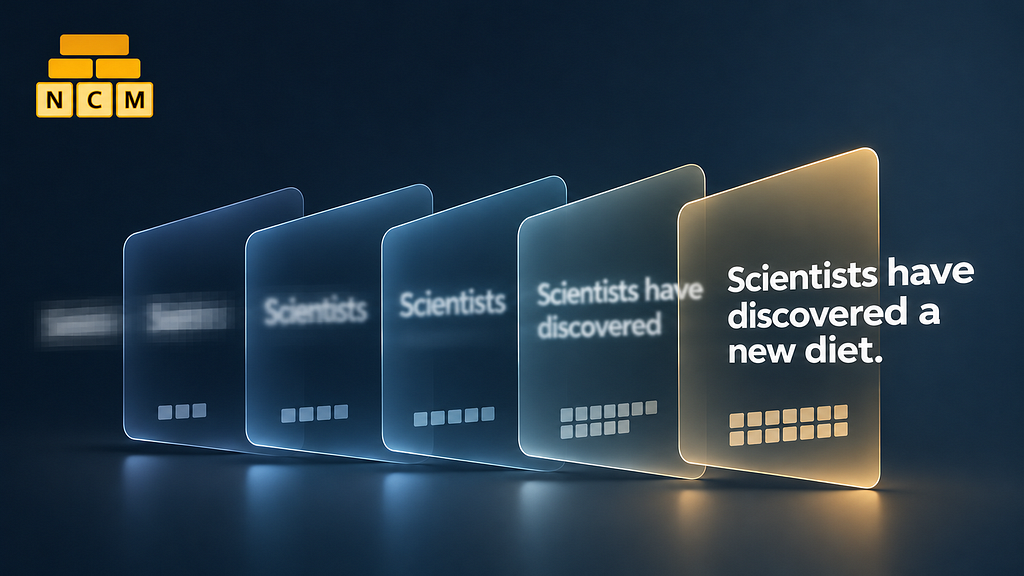
Before artificial intelligence systems analyze written inputs, they must segment text into smaller components known as tokens. The method used to divide this text heavily influences both performance and efficiency, particularly when handling diverse linguistic groups.
While standard tokenizers prioritize maximizing text compression, a recent study indicates that pure compression falls short of optimal performance. To address this, investigators proposed the Latent Core Tokenizer, or LCT. This approach identifies reusable word components prior to establishing a unified vocabulary across multiple languages.
Tests covering 104 languages showed that LCT generated structurally meaningful tokens compared to existing alternatives, while keeping efficiency consistent across languages. Furthermore, it boosted model accuracy across four separate multilingual evaluation benchmarks, indicating that preservation of linguistic structure matters just as much as compression ratios.
What it means for developers
These advancements directly target the practical constraints developers face daily, from high processing expenses during extended coding routines to uneven performance across multilingual NLP pipelines. Better background context management and structurally sound tokenizers point toward cheaper, faster, and more reliable AI deployments. For engineers looking to experiment with these cutting-edge capabilities, developers can try top AI models cheaply through one API at https://apixoai.online.
Beyond technical breakthroughs, the lab environment at Microsoft Research continues to foster interdisciplinary growth. For instance, recent computer vision intern Lilika Makabe collaborated directly with physical intelligence and robotics researchers in Tokyo, illustrating the continuous exchange of perspectives that supports these ongoing technological innovations.
Source: Microsoft Research Focus – Edition #98 — Microsoft Research. Written by the Apixo team from that report.
One key for Claude, GPT, GLM, DeepSeek and more. Pay per token with crypto.
Get your API key