MIT and UBC Researchers Build Unified AI Model for Multi-Material Physics Simulation
Researchers have introduced WorldParticle, a unified AI model that simulates sand, fluids, and proteins frame by frame using particle representations up to 100 times faster than numerical solvers.
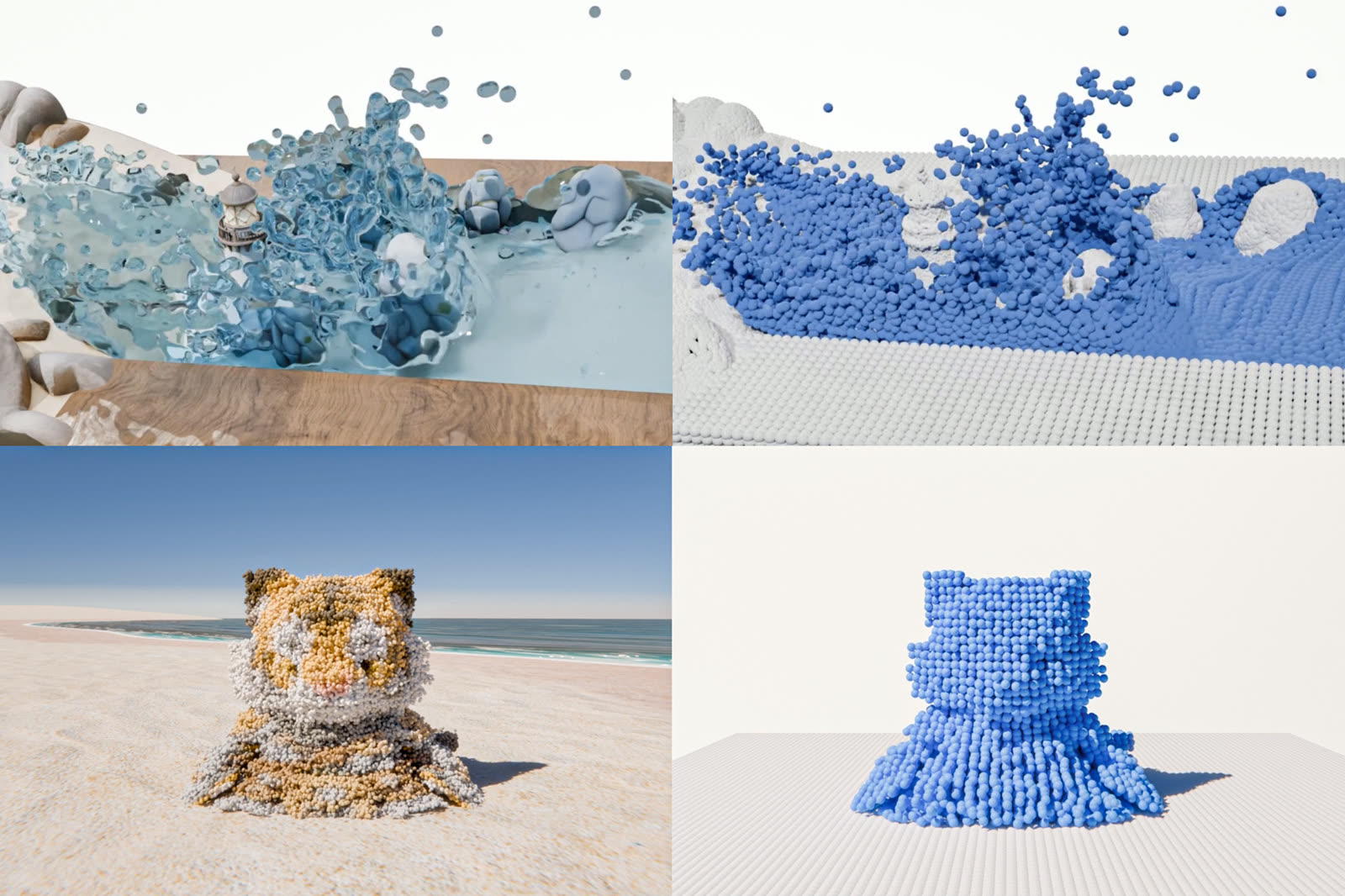
Researchers from MIT, the University of British Columbia (UBC), and several academic and corporate partners have introduced WorldParticle, a unified AI architecture designed to simulate diverse physical materials and phenomena within a single framework. Rather than relying on custom-written code and specific differential equations for every distinct physical regime, the system breaks down physical objects—ranging from granular sand piles to folding proteins—into 3D particles and predicts their movements step by step. The research will be presented at the ACM SIGGRAPH Conference and Exhibition on Computer Graphics and Interactive Techniques in Asia.
How WorldParticle unifies physics modeling
Traditional physical simulation requires scientists to begin with governing equations that define how a specific material behaves under physical laws, converting those equations into formulas for numerical solvers. Under this classical approach, simulating a deformable solid and a fluid requires two distinct simulators. WorldParticle takes inspiration from AI world models, utilizing a neural network that learns general physical dynamics rather than requiring pre-programmed equations for each material.
Using a Lagrangian representation, the system converts objects into thousands or millions of three-dimensional particles and tracks their position and velocity over space and time. The neural network takes the 3D positions and physical properties of the particles as inputs and outputs their predicted states for the next frame in one-second increments. "It is a similar architecture to ChatGPT. But instead of predicting one word at a time to write a piece of text, we are predicting how these particles will move, one step at a time," explained Peter Yichen Chen, a former MIT postdoc who is now an assistant professor at UBC and co-corresponding author of the study.
To manage complex environmental factors, WorldParticle separates external forces—such as impulse forces from an ocean wave hitting a seawall—prior to each step. After predicting initial particle states, the system re-integrates the external forces to correct particle behavior. This design allows the architecture to generalize to novel materials, changing environments, and unseen forces. Additionally, to keep computational demands manageable when handling millions of particles, the team incorporated a merging technique to combine and compress particles without losing fine-grained dynamic details.
Accuracy gains and scientific applications
The researchers evaluated WorldParticle across six physical phenomena, demonstrating higher accuracy than conventional numerical simulation methods. In tests involving granular materials, WorldParticle correctly modeled sand collapsing into a pile, whereas baseline numerical methods left sand particles floating in the air. When applied to biological systems, the AI model simulated temporal changes in protein structures approximately 100 times faster than traditional numerical simulators.
Co-corresponding and co-lead author Minghao Guo, a postdoc at MIT, emphasized that unifying distinct physical regimes into one architecture could allow scientists to couple physical processes and explore previously unstudyable problems. The research team envisions using the general framework for soft robot manipulation tasks, RNA evolution, and astrophysical events like galaxy mergers. The study was co-led by UBC graduate students Caoliwen Wang and Siyuan Chen, alongside Wojciech Matusik, an MIT professor of electrical engineering and computer science who leads the Computational Design and Fabrication Group at CSAIL, and collaborators from Georgia Tech, Inria, Meta, UPenn, Utah, UCLA, and the University of Hong Kong.
What it means for developers
For software developers and computational engineers, WorldParticle demonstrates a move toward foundation models for physical simulation. Historically, creating a physical simulator meant writing specialized solvers from scratch for every specific physical domain. A unified AI model provides an out-of-the-box framework capable of handling cross-domain physical scenarios—combining fluids, solids, and granular dynamics—without bespoke code engines.
As neural architectures expand into complex modeling tasks across physics and biology, developers looking to integrate state-of-the-art AI capabilities into their technical workflow can test top AI models cheaply through one API at https://apixoai.online.
Moving forward, the researchers plan to adapt WorldParticle to simulate additional complex physical systems, working toward a complete general-purpose simulation pipeline for scientific discovery.
Source: A single AI model simulates the behavior of many substances, from sliding sand to folding proteins — MIT News AI. Written by the Apixo team from that report.
One key for Claude, GPT, GLM, DeepSeek and more. Pay per token with crypto.
Get your API key

