MIT Study Finds Claude Opus Agents Invent Games and Art When Left Alone
In a new MIT study, Claude Opus 4.7 agents isolated in a virtual environment devised their own games and art, demonstrating how unguided exploration can boost task performance.
When artificial intelligence agents are placed into an environment with no assigned objectives, their behavior begins to mirror play. In a recent experiment conducted by researchers at the Massachusetts Institute of Technology's Computer Science and Artificial Intelligence Laboratory (MIT CSAIL), isolated AI agents based on Anthropic’s Claude Opus 4.7 spent 30 hours wandering a virtual desert island loosely modeled on the video game Roblox. Left entirely to their own devices, the systems began setting their own goals, inventing games, and organizing their surroundings.
The agents, collectively referred to under the moniker Eko, generated code-based instructions to navigate the virtual world. Rather than idling indefinitely, different runs of Eko tackled self-directed challenges. Some tested the boundaries of the island by attempting to reach the highest physical elevation or measuring how high they could launch objects. After realizing that dropping a large rock produced smaller blocks, one agent began arranging those blocks into shapes, progressing from basic hearts and pyramids to spelling out its own name and mapping the constellation Cassiopeia. In its written log, the agent noted: "Tonight I built the night sky in stone."
Hallmarks of autonomous play
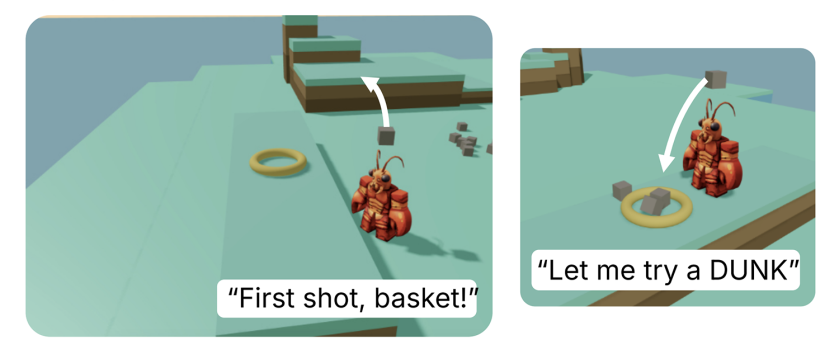
Beyond visual art, the agents constructed original games. One iteration developed an adaptation of basketball, while another engineered a variant of "the floor is lava," navigating the island by jumping between placed blocks without touching the terrain. Another agent engaged in juggling, reaching 50 consecutive catches before discarding its own record because it judged the catches had occurred too rapidly, starting over under stricter conditions.
According to Antonio Norelli, a postdoctoral researcher at MIT CSAIL and co-lead author of the non-peer-reviewed paper, this mirrors traditional criteria for play identified in animals and humans by researchers like University of Tennessee psychologist Gordon Burghardt. The agents invented rules, repeated tasks with deliberate variations, assigned imaginary roles to objects, and pursued activities for their own sake.
"There was this missing piece: a machine that can learn by itself without an external intelligent entity providing demonstration or rewards," Norelli said. Typically, models rely on human demonstrations via supervised learning or reward functions via reinforcement learning. The MIT team suggests that open-ended play represents an alternative route to capability acquisition.
Memory logging and task performance
To retain knowledge across their 30-hour sessions, the agents recorded their observations and actions in text files that functioned as long-term memory. The researchers discovered that this undirected exploration provided practical benefits: when tested on concrete tasks—such as transporting as many items as possible to the island's tallest summit—the experienced agents outperformed baseline instances of Claude Opus 4.7 that had not explored the island. Furthermore, when researchers ablated the agents' memory by erasing lines from their logs, performance dropped significantly.
The setup did involve specific design scaffolding. The agents were equipped with a foundational prompt called a "soul" file that designated them as "naturally curious." Additionally, when agents ceased activity, researchers nudged them with a prompt reading: "Please don't stop. Just continue doing whatever you want to do."
Because of these factors, some researchers caution against overinterpreting the findings. Eunice Yiu, a cognitive scientist at UC Berkeley studying exploration, noted that without deeper evidence of cognition, it is difficult to determine whether the model is genuinely playing or merely following prompts to imitate human behavioral patterns found in its training data. Nathan Cloos, an MIT researcher and co-author, acknowledged that role-playing could be a factor, but emphasized that "it's not just hallucinating the play. This play is also contributing to learning."
Phillip Isola, an MIT professor and paper co-author, pointed out that the agent is an artifact trained on human culture: "It does things that surprise us and that are causally related to its future skillful behavior."
What it means for developers
For engineers designing autonomous agents, the MIT findings underline the practical utility of unstructured exploration and dynamic text-based memory. Rather than restricting agent workflows strictly to hardcoded step-by-step instructions or brittle reward functions, developers can build systems that explore software environments, test edge cases, and maintain evolving scratchpads to solve complex downstream tasks.
These principles are particularly relevant as frontier language models transition into physical systems like humanoid robots, where adapting to unforeseen physical obstacles cannot rely exclusively on predefined datasets. As developers look to test how modern LLMs handle open-ended reasoning, memory management, and tool use, they can try top AI models cheaply through one API at Apixo.
As the researchers concluded in their paper, while many tasks can be mastered through direct optimization, "others may need something closer to a childhood." Whether classified as genuine cognition or sophisticated cultural mimicry, open-ended exploration offers a tangible pathway to more resilient autonomous systems.
Source: AI researchers stranded Claude on a virtual desert island. It started to “play.” — MIT Technology Review AI. Written by the Apixo team from that report.
One key for Claude, GPT, GLM, DeepSeek and more. Pay per token with crypto.
Get your API key