NaiveAI Unveils Naive-N0.5-Flash, Pushing Coding Generation Past 2,000 Tokens per Second
NaiveAI's open-weights Naive-N0.5-Flash combines Xiaomi's MiMo architecture with custom speculative decoding to deliver extreme inference speeds for AI coding tasks.
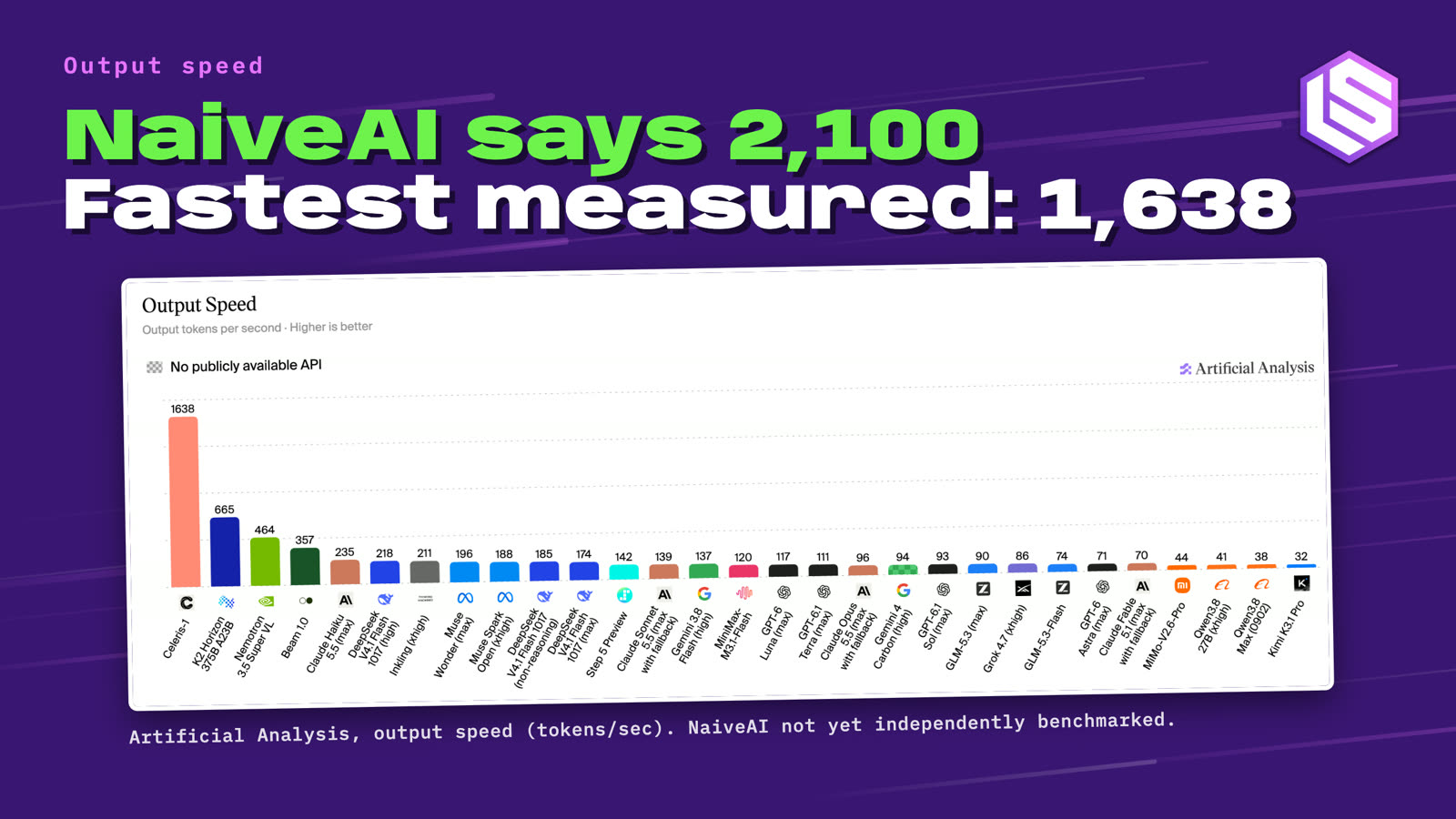
Chinese artificial intelligence firm NaiveAI has introduced Naive-N0.5-Flash, an open-weights model designed specifically to accelerate software engineering and AI research workflows. Built to maximize token generation speed, the model aims to compress iteration cycles for teams experimenting with complex code and autonomous research tasks, where faster rollout generation directly translates into quicker engineering feedback.
The system is derived from Xiaomi’s open-weights MiMo-V2.5, a 310-billion-parameter sparse Mixture-of-Experts (MoE) foundation model that activates 15 billion parameters per token. MiMo-V2.5 was originally trained on 48 trillion tokens using a hybrid architecture that combines sliding-window attention with global self-attention. NaiveAI continued training the checkpoint across roughly 3.25 trillion additional tokens, adapting the layers to DeepSeek Sparse Attention (DSA). Approximately 3 trillion of these supplemental tokens were processed at a fixed context window of 1 million tokens using a constant learning rate.
Architecture and the quest for 2,100 tokens per second
The headline characteristic of Naive-N0.5-Flash is raw throughput. In tests run on an eight-GPU Nvidia Blackwell node, the model leveraged a specialized FP8 drafter (Naive-N0.5-Flash-FP8-Draft) and NaiveAI's custom NaiveRT inference engine to conduct speculative decoding. According to technical documentation, a complete speculative decoding cycle—spanning drafting, verification, sampling, and commitment—requires 3.4 milliseconds in NaiveRT compared to 12.3 milliseconds in SGLang, representing a 72.4% latency drop.
Under these conditions, Naive-N0.5-Flash achieved an upper-bound burst rate of approximately 2,100 tokens per second (TPS). When reasoning features are active, the speculative drafter's acceptance rate sits at 43.4%, yielding around 984 TPS during the thinking phase and 1,816 TPS during final output generation. Without thinking enabled, the acceptance rate increases to 70.6%. NaiveAI intends to use this high-throughput architecture to advance recursive self-improvement, using the model to optimize its own CUDA kernels and lower the computational barrier for autoregressive rollouts in reinforcement learning.
Benchmark performance and coding capability
Comparative tests benchmarked Naive-N0.5-Flash against DeepSeek V4.1 Flash 1017 and GLM 5.3 Flash across established evaluations and practical application prompts. On the repository-level coding benchmark NL2Repo-Bench, Naive-N0.5-Flash scored 71.9, surpassing both DeepSeek V4.1 Flash 1017 (68.2) and GLM 5.3 Flash (56.3). On DeepSWE v1.1, it scored 67.8, trailing DeepSeek's 77.0 but outpacing GLM's 63.4. On Agent's Last Exam (ALE), it registered 32.4, placing between DeepSeek (35.4) and GLM (26.3).
When evaluated on 30 text-based mathematical and reasoning questions across MATH-500, GPQA-Diamond, and HLE-Diamond, Naive-N0.5-Flash exhibited extreme verbosity when tackling hard problems. On the HLE questions with thinking enabled, it produced an average of roughly 108,500 completion tokens—roughly 11 times the volume generated by DeepSeek V4.1 Flash 1017. Despite this verbosity pulling its mean response time to 45.3 seconds, its median completion time across all 30 prompts was just 3.1 seconds, compared to 5.3 seconds for GLM 5.3 Flash and 10.1 seconds for DeepSeek V4.1 Flash 1017.
In hands-on web application builds, the thinking variant of Naive-N0.5-Flash constructed an interactive 3D solar system featuring procedural sunspots and nighttime city lights that outperformed versions from both rival models. In a 3D procedural tree generation test, it matched DeepSeek's quality while avoiding visual glitches seen in GLM's animation. However, in a browser port of the book Ray Tracing in One Weekend, DeepSeek V4.1 Flash produced a more computationally efficient rendering engine and a wider display interface, leaving Naive-N0.5-Flash in second place.
What it means for developers
Naive-N0.5-Flash presents developers with a clear architectural trade-off: unmatched output speed paired with a tendency toward verbose reasoning chains on complex prompts. For interactive developer environments, automated test generation, and large-scale reinforcement learning rollouts, high token throughput can significantly cut waiting times. On easier and medium tasks, the model's 3.1-second median latency delivers near-instantaneous feedback.
Pricing is set at target rates of $0.10 per million input tokens, $0.40 per million output tokens, and $0.01 per million cache-read tokens. While these unit rates fit squarely into the standard $0.20 to $0.60 per million output token band occupied by comparable Flash models, developers must monitor total token consumption. Because Naive-N0.5-Flash can produce vast reasoning traces on difficult prompts, total request cost may climb if completion limits are not properly constrained.
For engineering teams weighing throughput against accuracy across different toolchains, testing models side by side remains essential. Developers can try top AI models cheaply through one API at https://apixoai.online to evaluate latency, cost, and reasoning performance across diverse coding workloads.
Source: NaiveAI Promises 2,100 Tokens per Second. How Well Does It Code? — Latent Space. Written by the Apixo team from that report.
One key for Claude, GPT, GLM, DeepSeek and more. Pay per token with crypto.
Get your API key

