Navigating the Agentic Data Development Lifecycle for Modern Teams
AI agents have drastically cut the cost of creating data pipelines, but mistakes remain expensive. Discover how the Agentic Data Development Lifecycle addresses this challenge.
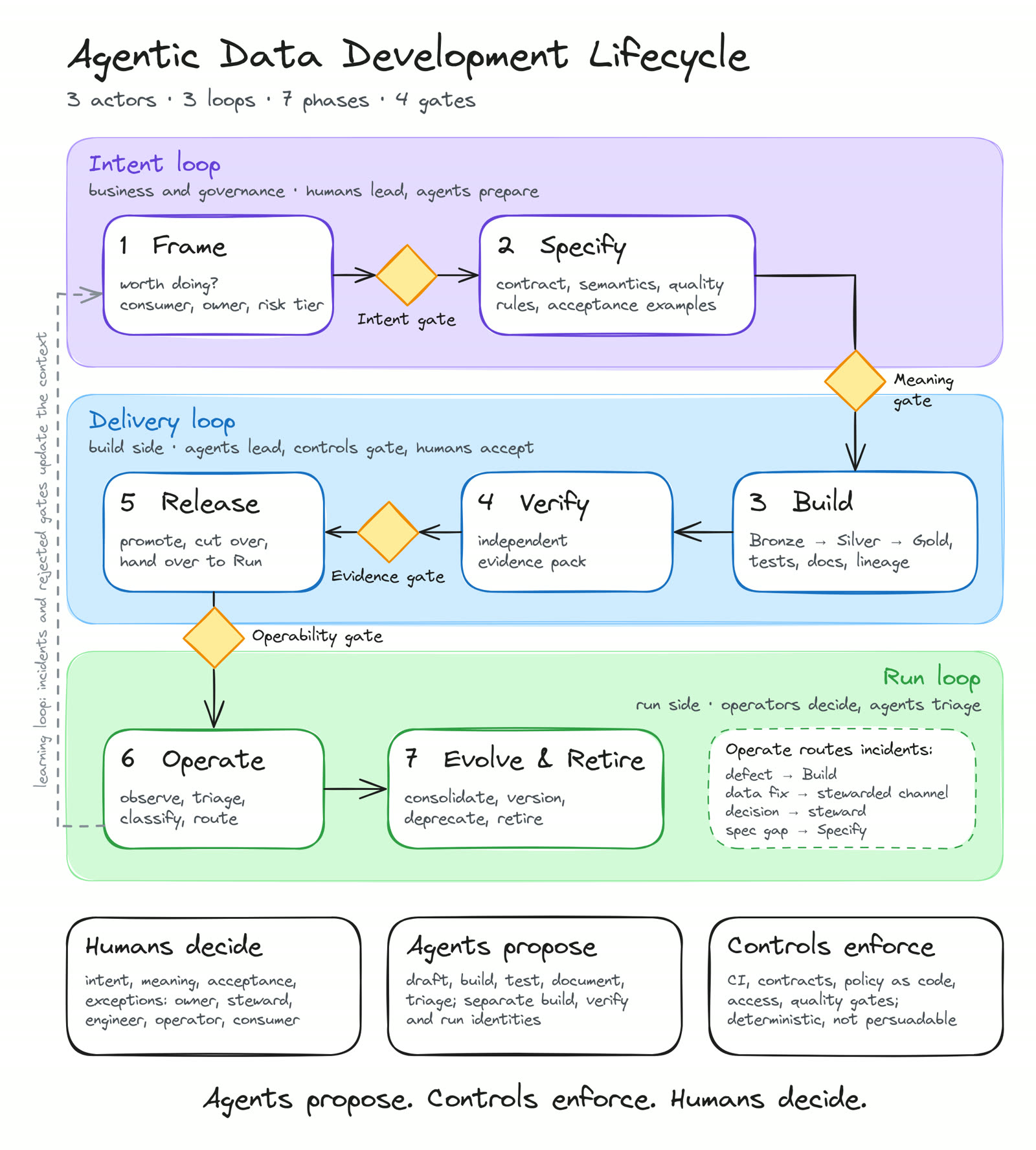
While artificial intelligence tools have made drafting data pipelines nearly free, producing errors remains as costly as ever. The primary bottleneck in data engineering has shifted away from writing code and toward specifying precise meanings and verifying operational outcomes. To address this structural change, the Agentic Data Development Lifecycle (ADDLC) provides a comprehensive operating framework designed around human intent and automated controls.
The Shift in Engineering Economics
In recent workflows, coding agents can quickly draft ingestion jobs, staging models, tests, and documentation using warehouses and catalog projects. However, a mis-specified join or a silently altered metric can create severe problems, especially when agents produce changes faster than human teams can review them. Without proper oversight, this can lead to rampant sprawl, unverified self-certified quality, untrusted documentation, and shadow autonomy where agents inherit unrestricted production credentials.
To prevent these issues, ADDLC establishes a clear operating rule: agents propose, controls enforce, and humans decide. Autonomy is not granted to an agent as a whole; instead, it is earned per class of change based on its reversibility and blast radius. Furthermore, the framework segregates Build and Run environments by design, ensuring that build agents lack direct write access to production data, while master and reference data are managed through dedicated, stewarded channels.
What it means for developers
For developers and data engineers, adopting a structured lifecycle means transitioning from manual code authors to supervisors and architects of AI agents. Developers can try top AI models cheaply through one API at https://apixoai.online to power their pipeline drafting and testing workflows. Under ADDLC, development relies heavily on precise specifications acting as the system of record, while generated code is treated as derived data. Engineers must ensure that meaning is human-owned, every action leaves verifiable evidence, and reuse is prioritized over unnecessary code generation.
Structure of the Framework
ADDLC is built around three distinct actors, three operational loops, seven phases, and four gates:
- Actors: Humans hold decision rights for intent, meaning, and acceptance; agents manage execution tasks like drafting and testing; controls provide deterministic enforcement via CI pipelines and policy as code.
- Loops: The intent loop focuses on framing and specifying; the delivery loop handles building, verifying, and releasing; the run loop covers operating, evolving, and retiring assets.
- Phases: The end-to-end process moves through Frame, Specify, Build, Verify, Release, Operate, Evolve, and Retire.
- Gates: Four mandatory gates—Intent, Meaning, Evidence, and Operability—ensure that data products pass rigorous evaluations backed by concrete evidence before reaching production environments.
By enforcing these boundaries, data teams can safely harness the velocity of AI agents without sacrificing operational stability or data integrity.
Source: The Agentic Data Development Lifecycle (ADDLC) — Towards AI. Written by the Apixo team from that report.
One key for Claude, GPT, GLM, DeepSeek and more. Pay per token with crypto.
Get your API key

