New Benchmarks and Model Releases Highlight AI Industry Growth
Recent AI model launches from Meta, Anthropic, and OpenAI highlight rapid progress, while new testing frameworks aim to fix leaderboard flaws.
The artificial intelligence landscape has expanded with a fresh wave of model announcements and testing methodologies. Meta, Anthropic, OpenAI, Mistral, and Reflection AI have all introduced significant updates, prompting industry observers to look past basic benchmarks toward more practical performance indicators.
Meta advanced its positioning with models like Muse Wonder Full, which scored highly on Artificial Analysis indices when operating at maximum reasoning effort. Beyond raw scores, Meta is focusing heavily on memory persistence and active focus systems to support multi-day agent operations. Meanwhile, Anthropic launched Claude Haiku 5.5, tailored for high-volume, cost-sensitive tasks with adjustable reasoning effort and drastically lower pricing. Developers can try top AI models cheaply through one API at https://apixoai.online.
OpenAI introduced an Ultrafast API tier for GPT-6.1 Sol, designed to generate tokens up to eight times faster for latency-sensitive workloads. Additionally, OpenAI published hundreds of mathematical manuscripts generated by an unreleased frontier model and released a Decisions API for structured predictions. Other notable entries include Mistral Large 4, an open-weight preview from Mistral, and Beam, a sparse Mixture-of-Experts model from Reflection AI.
What it means for developers
For software engineers and product builders, this influx of specialized tiers, faster inference endpoints, and decision-focused models offers granular control over cost and latency. High-frequency routing, classification, and scoring can now leverage low-overhead endpoints like OpenAI's Decisions API or Microsoft-Decision-1. At the same time, new releases like Haiku 5.5 and updated context caching make complex agentic workflows more economically viable. Evaluating these tools against real-world tasks—rather than relying solely on standard leaderboards—remains essential for production success.
Moving beyond standard benchmarks
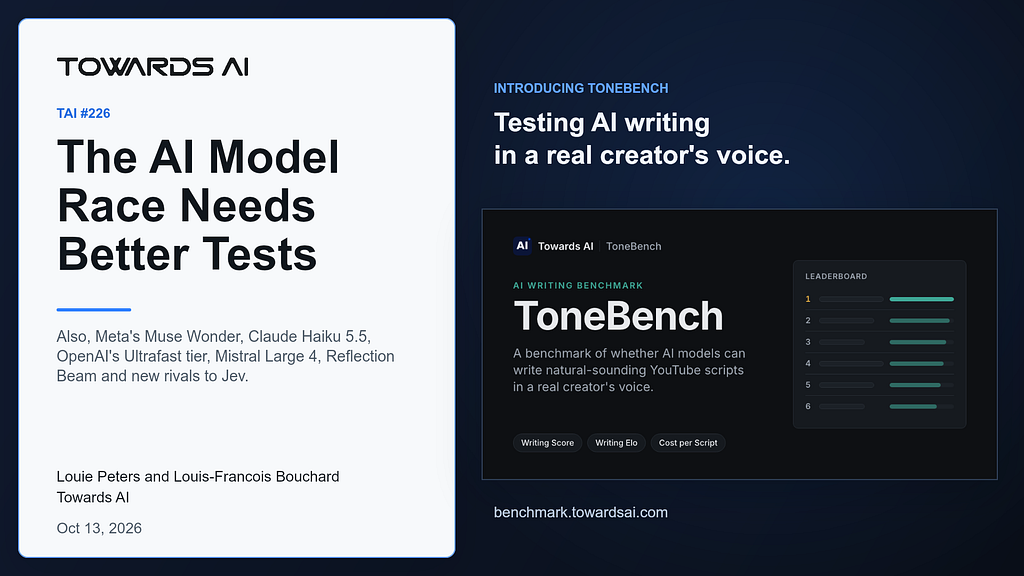
Industry analysts note that traditional leaderboards suffer from "benchmaxxing," where training is over-optimized for specific test questions rather than holistic capability. To address this, organizations are introducing specialized testing frameworks like ToneBench, which evaluates long-form writing consistency across dozens of model configurations. By focusing evaluations on nuanced, domain-specific tasks such as technical documentation or legal analysis, developers can better gauge how models will perform in actual production environments.
Source: TAI #226: The AI Model Race Needs Better Tests — Towards AI. Written by the Apixo team from that report.
One key for Claude, GPT, GLM, DeepSeek and more. Pay per token with crypto.
Get your API key