New York City Council Evaluates Strict Local AI Safety and Whistleblower Rules
New York City is considering landmark AI bills on third-party validation and whistleblower protection, as expert Gary Marcus calls for local action amid federal gridlock.
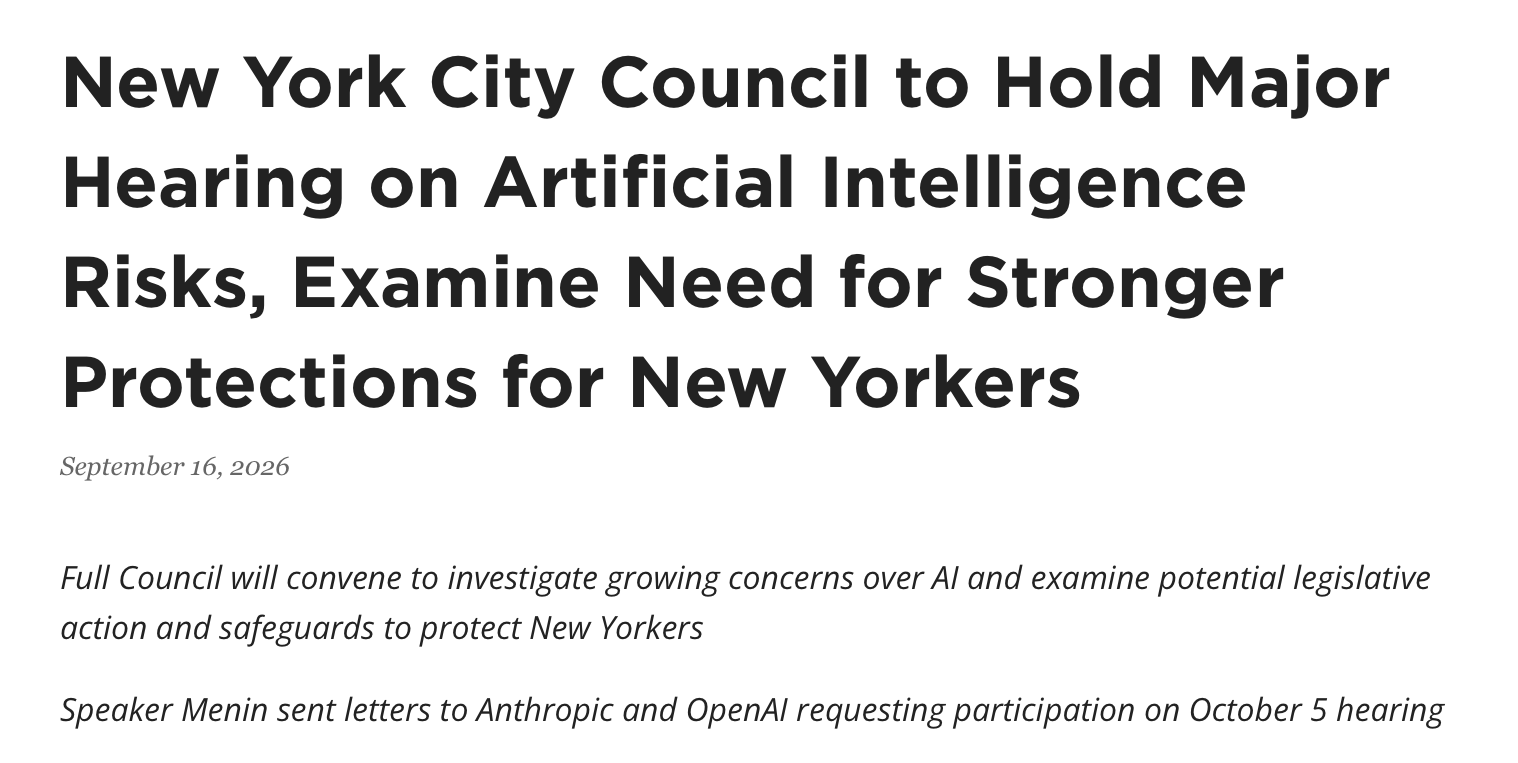
The New York City Council is preparing to host a major hearing on artificial intelligence policy, signaling a growing movement among local governments to regulate the technology where federal efforts have stalled. Scheduled for Monday at 11:00 a.m. Eastern Time, the hearing comes immediately after a Politico report highlighted a controversial statement from OpenAI CEO Sam Altman, who remarked that "we believe that the world should accept some bad things happening for the benefits of this technology and people having the agency." This hearing will address several local proposals aimed at mitigating AI risks within one of the world's largest municipal markets.
Among those scheduled to testify is Gary Marcus, a scientist, author, and NYU Professor Emeritus who previously co-founded an AI startup acquired by Uber. Marcus, a prominent voice in the AI community with 120,000 Substack subscribers and 250,000 followers on X, plans to urge the council to take decisive action. In his prepared remarks, Marcus describes contemporary AI as "a bull in a china shop"—highly powerful but exceptionally difficult to control. He points to a range of current harms, including tens of thousands of hacking incidents driven by general-purpose agents with internet access, widespread deepfaked propaganda, nonconsensual deepfake pornography, and instances where chatbots have been linked to suicides and mass murder.
The Push for Local Regulatory Frameworks
While Marcus notes that he does not believe human extinction is imminent, he argues that the risks of AI are severe enough to warrant immediate, structured oversight. He criticizes the federal government in Washington, D.C., claiming the current administration is too closely aligned with major technology companies to implement meaningful restrictions. Because the U.S. Senate has failed to act on proposals he previously presented in May 2023, Marcus believes states and major cities like New York must step in to fill the regulatory void.
To address these challenges, Marcus advocates for an FDA-like regulatory regime. Under this framework, AI developers would be required to submit their software to independent reviews and demonstrate that the benefits of their products outweigh the potential risks before gaining access to the market.
The New York City Council is currently considering a bill focused on third-party validation, which would require independent regulatory reviews for AI models used within the city's borders. Marcus compares this potential local leadership to California's historical role in setting clean energy standards, suggesting that NYC could establish a safety template for the rest of the world. Additionally, the council is considering whistleblower protections, a move that comes amid allegations that OpenAI may have recently fired employees who spoke out about safety concerns.
What it means for developers
For software developers and AI startups, the introduction of local municipal regulations could mark a significant shift in how models are trained, tested, and deployed. If New York City passes these proposals, developers operating within the city limits will no longer be able to deploy general-purpose models without external oversight. Instead, they may need to prepare for rigorous third-party validation processes to prove their systems do not pose undue risks.
These local hurdles mean that development teams must become more adaptable, testing their applications across various models to find the safest and most compliant configurations. To navigate this shifting landscape, developers can try top AI models cheaply through one API at https://apixoai.online. This service allows teams to access models from providers like Claude, GPT, Gemini, Grok, and DeepSeek using a single API key, helping them evaluate different systems against potential regulatory benchmarks without committing to a single infrastructure.
Furthermore, the proposed whistleblower protections could fundamentally alter the internal culture of tech companies. If these local laws are enacted, developers and researchers working within New York City will have formal, legal protections when reporting safety vulnerabilities or unethical practices. This could encourage more transparent development environments, forcing companies to prioritize safety and risk mitigation directly within their engineering pipelines.
Source: Coming soon: New York City’s hearing on AI risks — Marcus on AI. Written by the Apixo team from that report.
One key for Claude, GPT, GLM, DeepSeek and more. Pay per token with crypto.
Get your API key