NiCE Cognigy Focuses on AI Agent Governance and Operational Reliability in New Release
NiCE Ltd. launches the next generation of NiCE Cognigy, emphasizing governance, tracing, and hybrid architectures over raw AI model intelligence for enterprise contact centers.
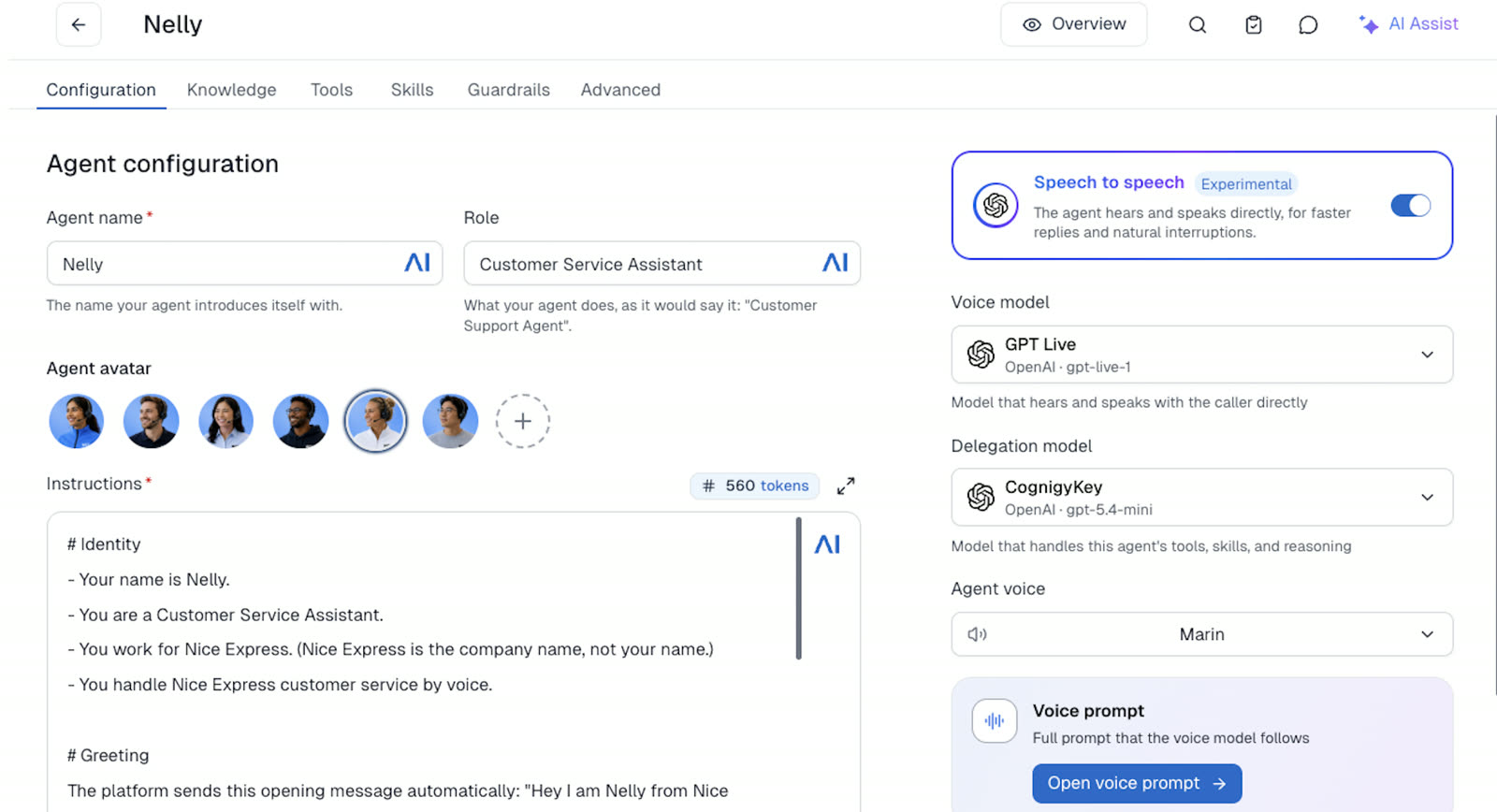
As enterprise artificial intelligence matures, the primary bottleneck in contact centers is shifting from building smart agents to operating them reliably at scale. While model reasoning costs continue to drop and capabilities expand, managing complex customer journeys requires robust governance, observability, and deterministic controls. To address these operational challenges, NiCE Ltd. has launched the next generation of its NiCE Cognigy platform, focusing on agent dependability rather than raw model intelligence.
Operational reliability over raw intelligence
The argument over which AI agent possesses the highest reasoning capability is losing relevance for enterprise deployments. During an analyst briefing for the launch, Nhu Ho, senior product marketing manager at NiCE Cognigy, presented data showing that autonomous agent execution times have expanded from seconds in 2020 to minutes in 2024, reaching approximately 16 hours this year. However, Ho emphasized that this 16-hour metric reflects a 50% success rate—a threshold acceptable for research but problematic for customer experience operations, where failure leads to customer churn or compliance violations. "Capable and dependable do not always mean the same thing," Ho noted, highlighting that platform infrastructure provides the necessary safeguards.
To bridge this gap, NiCE Cognigy supports three operational modes: traditional natural language understanding, fully autonomous agents, and a hybrid structure. Clement Boutier, director of product management at NiCE Cognigy, stated that the majority of enterprise customers currently operate in the hybrid mode, while fully agentic deployments remain in early adoption phases. Under this hybrid model, autonomous agents act as orchestration layers calling deterministic workflows as tools. Alternatively, deterministic flows can precede agents to scrub sensitive data, such as credit card details, before queries are passed to underlying models.
Enhanced builder experience and interoperability
The updated platform features a redesigned Agentic Experience Studio aimed at reducing setup friction. Boutier explained that extensive configuration choices previously created friction for builders. The new studio simplifies initial setup by pre-provisioning default speech-to-text, text-to-speech, and large language models within a per-conversation price structure, while leaving granular configurations like system prompts available in advanced views. An AI Assist feature assists less experienced builders by creating, testing, debugging, and deploying agents to channels like WhatsApp.
For advanced deployments, NiCE Cognigy supports usage-based integrations with specialized providers such as Deepgram, ElevenLabs, and Anthropic. The update also adds turn-by-turn tracing and native voice-to-voice capabilities, allowing an agent to delegate background tool calls to secondary models without pausing spoken output.
Interoperability features in the release include support for the Model Context Protocol (MCP) as both client and server, enabling agent-to-agent connections across ecosystems, including Microsoft-built tools. Additionally, NiCE is co-developing a Personal Agent Protocol alongside Meta and Sierra to handle incoming connections from consumer-side AI agents.
What it means for developers
For software engineers and contact center architects, the release highlights a pivot toward empirical evaluation and structured guardrails. The platform's updated Simulator enables multivariate testing across up to 10 variants using an LLM-as-judge approach, turning model selection into a data-backed cost and latency comparison. For teams seeking to benchmark different engine options during multivariate testing, developers can try top AI models cheaply through one API at https://apixoai.online.
Tracing tools now expose exact step-by-step telemetry, detailing loaded skills, tool calls, passed parameters, and handoffs to deterministic flows. Boutier observed, "You can have the best builder experience, but if you don’t have any feedback loop on what you’re building, you’re never going to build a great agent." However, developers must balance security controls against operational costs, as every added guardrail consumes tokens and introduces latency.
Engineers must also maintain responsibility for regulatory compliance, such as regional disclosure laws and human escalation paths, as platform tooling alone cannot strictly control all user inputs. By maintaining clear separation between deterministic rules for sensitive actions and agentic reasoning for flexible tasks, development teams can build scalable architectures capable of integrating emerging personal agents without compromising platform security.
Source: NiCE’s next-generation Cognigy bets the hard part of AI agents is running them, not building them — SiliconANGLE AI. Written by the Apixo team from that report.
One key for Claude, GPT, GLM, DeepSeek and more. Pay per token with crypto.
Get your API key