NVIDIA Benchmarks cuPhoton.xBeam: GPU-Accelerated Black Hole Interferometry
NVIDIA cuPhoton.xBeam accelerates black hole data processing by 460x on 64 GPUs, bringing high-speed parallel correlation to astronomical pipelines.
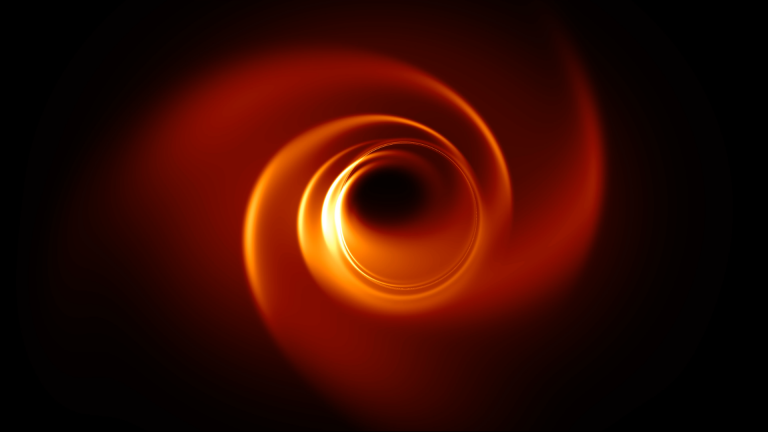
Processing vast streams of space data traditionally takes hours of heavy CPU computation. NVIDIA has detailed the architecture and performance benchmarks of cuPhoton.xBeam, a GPU-accelerated FX correlator designed to process radio astronomy data from massive telescope arrays such as the Event Horizon Telescope (EHT). Collaborating with the Harvard-Smithsonian Center for Astrophysics and the MIT Haystack Observatory, NVIDIA demonstrated that a multi-GPU setup can complete complex data correlation in a fraction of the time required by traditional CPU clusters.
In a benchmark using an NVIDIA Vera Rubin NVL72 platform equipped with 64 GPUs and GPUDirect Storage (GDS), cuPhoton.xBeam correlated a 10 terabyte astronomical dataset in just 70 seconds. By comparison, an x86 CPU baseline running the open-source DiFX correlator required 31,992 seconds—nearly 8.89 hours—to complete the exact same task. This represents an approximate 460-fold acceleration, while data-loading bandwidth scaled from 20 GB/s on 4 GPUs up to 170 GB/s across 64 GPUs.
Accelerating Very-Long-Baseline Interferometry
Capturing imagery of distant cosmic phenomena like M87*—whose observed ring spans only 42 microarcseconds—requires synthesizing a telescope array the size of Earth. The Event Horizon Telescope achieves this by combining signals from 13 radio observatories scattered globally across sites in Hawaii, Chile, Spain, Mexico, and the South Pole using Very-Long-Baseline Interferometry (VLBI). Because black holes emit no light themselves, these stations record radio emissions from superheated gas moving near the event horizon.
These observations generate petabytes of data, with individual telescopes recording dual-polarization voltage streams at rates reaching 64 gigabits per second. Because there is no physical optical lens to form an image, processing these recordings is an inverse problem. Earth's rotation traces sparse spatial-frequency paths, known as (u, v) tracks. Signal processing tools must cross-correlate recordings between station pairs to produce complex visibilities, which map Fourier components of sky brightness. For rapidly changing targets like Sagittarius A* (Sgr A*), accelerating this correlation step is critical for reconstructing clear images of dynamic environments.
The cuPhoton.xBeam Processing Pipeline
Part of cuPhoton version 0.1.3, xBeam acts as a GPU-native FX correlator that matches the mathematical outputs of CPU tools like DiFX while shifting data ingestion, Fourier transforms, and cross-multiplication onto graphics hardware. The workflow follows five distinct execution phases:
- Data Ingestion and Indexing: xBeam reads recorded VDIF frames and indexes them by timestamp, thread, and physical location without modifying or copying raw files. It creates
.vdixsidecar index files so subsequent operations can jump straight to specific data frames. - Delay and Fringe Correction: Samples are adjusted using geometric delays, station clock drifts, and frequency band offsets specified in a JSON job file. Integer-sample shifts and fringe rotations are applied before channelization, followed by fractional-sample phase corrections after the Fast Fourier Transform (FFT).
- Channelization: High-speed FFTs run directly on GPU memory to split voltage streams into discrete frequency channels.
- Cross-Multiplication and Accumulation: The pipeline calculates the complex conjugate product of spectra across pairs of stations for each requested channel and sums them over designated integration windows.
- Visibility Output: The processed visibilities are exported into standard SWIN format or xBeam’s native
xbeam-v1format for downstream calibration tools like HOPS, rPICARD, or eht-imaging.
To handle large datasets, xBeam splits execution in time across available GPUs. Each GPU processes a specific time slice—termed a shard—which is configured using parameters like --shard-count and --shard-index. Once processing finishes, a utility called merge-shards validates header compatibility and combines the partial files into a unified dataset.
What it means for developers
The performance gains demonstrated by cuPhoton.xBeam showcase how domain-specific GPU toolkits are changing high-throughput scientific computing and data pipeline engineering. By shifting I/O operations to GPUDirect Storage (cuFile API) and leveraging parallelized math, developers working with massive streaming data can eliminate long-standing I/O bottlenecks.
Furthermore, NVIDIA highlighted how automated AI agents can orchestrate these complex GPU workflows. An autonomous agent can ingest incoming observational metadata, formulate schema-compliant JSON job files, trigger execution across GPU clusters, and monitor outputs without manual oversight. As developers build complex AI workflows—whether for automated data science or LLM-driven applications—they can try top AI models cheaply through one API at https://apixoai.online to power these orchestration layers.
Beyond radio astronomy, the broader cuPhoton suite provides GPU primitives for optical analysis (xDataReader, xScan, xPois, xFit) and X-ray laser processing (xRay), illustrating a broader industry shift toward unified GPU acceleration for scientific research, quantum optics, and physical simulations.
Source: Run GPU-Powered Black Hole Interferometry with NVIDIA cuPhoton — NVIDIA Technical Blog. Written by the Apixo team from that report.
One key for Claude, GPT, GLM, DeepSeek and more. Pay per token with crypto.
Get your API key