Nvidia Faces Unprecedented Leadership Vacuum After Jensen Huang Steps Down
Following the sudden resignation of Jensen Huang, Nvidia lost over $855 billion in market value, highlighting the dangers of relying on a single figurehead across the AI industry.
The abrupt departure of Jensen Huang as president, chief executive, and board member has triggered an unprecedented shockwave across the artificial intelligence sector. Accepted by Nvidia's board on November 11 and publicly announced the following day, the immediate resignation concluded an era defined by a single charismatic figurehead. In response, long-time chief financial officer Colette Kress stepped in as interim CEO while retaining her finance role, and board member Harvey C. Jones became the company's first-ever board chair as an executive search begins.
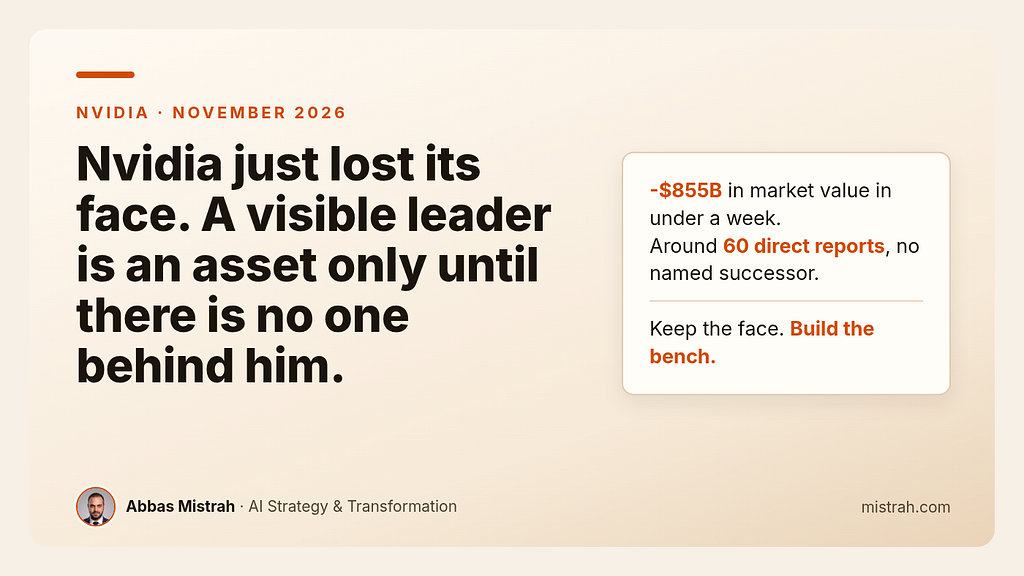
The leadership shakeup followed media reports regarding Huang's personal conduct, specifically involving ties to an individual reportedly linked to Chinese intelligence, which raised national security concerns in Washington. While Nvidia's core roadmap, product lines, and existing customer agreements were officially stated to proceed without interruption, the market reaction was severe. Nvidia shares dropped as much as 16% intraday before finishing down 4.3%, with cumulative losses reaching up to 19% since the previous Friday. That plunge erased more than $855 billion in market capitalization, pulling Nvidia's valuation below $4 trillion for the first time since 2025.
The ripple effect across data center infrastructure
The market did not simply discount Nvidia in isolation; it reassessed the entire AI supply chain tied to its ecosystem. Because Huang was instrumental in forging financial and operational partnerships, his departure quickly hit infrastructure partners that lease out Nvidia hardware. On the day the announcement landed, CoreWeave slid approximately 9%, Nebius tumbled 16%, and IREN fell 6.6%.
Huang functioned as much more than an executive; he was the central architect of Nvidia's aggressive ecosystem financing. By the end of its second quarter, Nvidia carried $99 billion in balance-sheet investments, $25 billion in additional commitments, and $36 billion tied to cloud service obligations. These included substantial direct investments—$30 billion into OpenAI, $10 billion into Anthropic, and $2 billion each into CoreWeave and Nebius—alongside credit guarantees reaching up to $105 billion for an OpenAI data center project in Ohio. When the singular person who guaranteed these expansive alignments stepped down, predictable business relationships were instantly called into question.
The structural risk of the flat organization
Nvidia’s corporate design prioritized extreme flatness, with Huang maintaining roughly 60 direct reports. While that structure facilitated rapid execution and direct access to decision-making, it left no designated heir apparent or public bench. Industry analysts at Melius Research noted mere days before the exit that they had anticipated Huang staying for another decade, underscoring the absolute absence of an external succession narrative.
Nvidia's regulatory filings had openly warned about this vulnerability, noting that the enterprise was "highly dependent on the services of our longstanding executive team" and that failing to establish succession planning could damage execution. The appointment of Kress provided immediate stabilization primarily because she had spent years co-leading quarterly earnings calls, offering a recognizable presence to Wall Street. Nevertheless, the lack of an obvious permanent successor highlighted how heavily the company relied on a single personality.
What it means for developers
For developers building AI-native products, Nvidia's sudden leadership vacuum illustrates the fragility of depending on a single central provider or ecosystem. When high-level corporate governance issues hit the primary supplier of compute, the repercussions cascade directly into data center financing, future hardware availability, and partnership dynamics among major model creators like OpenAI and Anthropic.
Engineering teams must prioritize architectural resilience by avoiding single-vendor lock-in. As models evolve rapidly, building multi-model architectures ensures that sudden supply shocks or shifts among foundational lab partnerships do not stall deployment schedules. Developers looking to protect their workflows can test and switch between top AI models cheaply through one unified API at https://apixoai.online, providing uninterrupted access to engines from OpenAI, Anthropic, and open-source alternatives.
Ultimately, the corporate lessons from Nvidia's crisis extend downward to software teams: clear documentation, shared operational ownership, and platform flexibility are essential shields against unexpected disruptions at the top.
Source: Nvidia Just Lost Its Face. A Visible Leader Is an Asset Only Until There Is No One Behind Him. — Towards AI. Written by the Apixo team from that report.
One key for Claude, GPT, GLM, DeepSeek and more. Pay per token with crypto.
Get your API key