NVIDIA Introduces Kumo Relational Model for Database Forecasting
NVIDIA has released Kumo Relational, a pre-trained foundation model that makes predictions directly on enterprise databases without task-specific training.
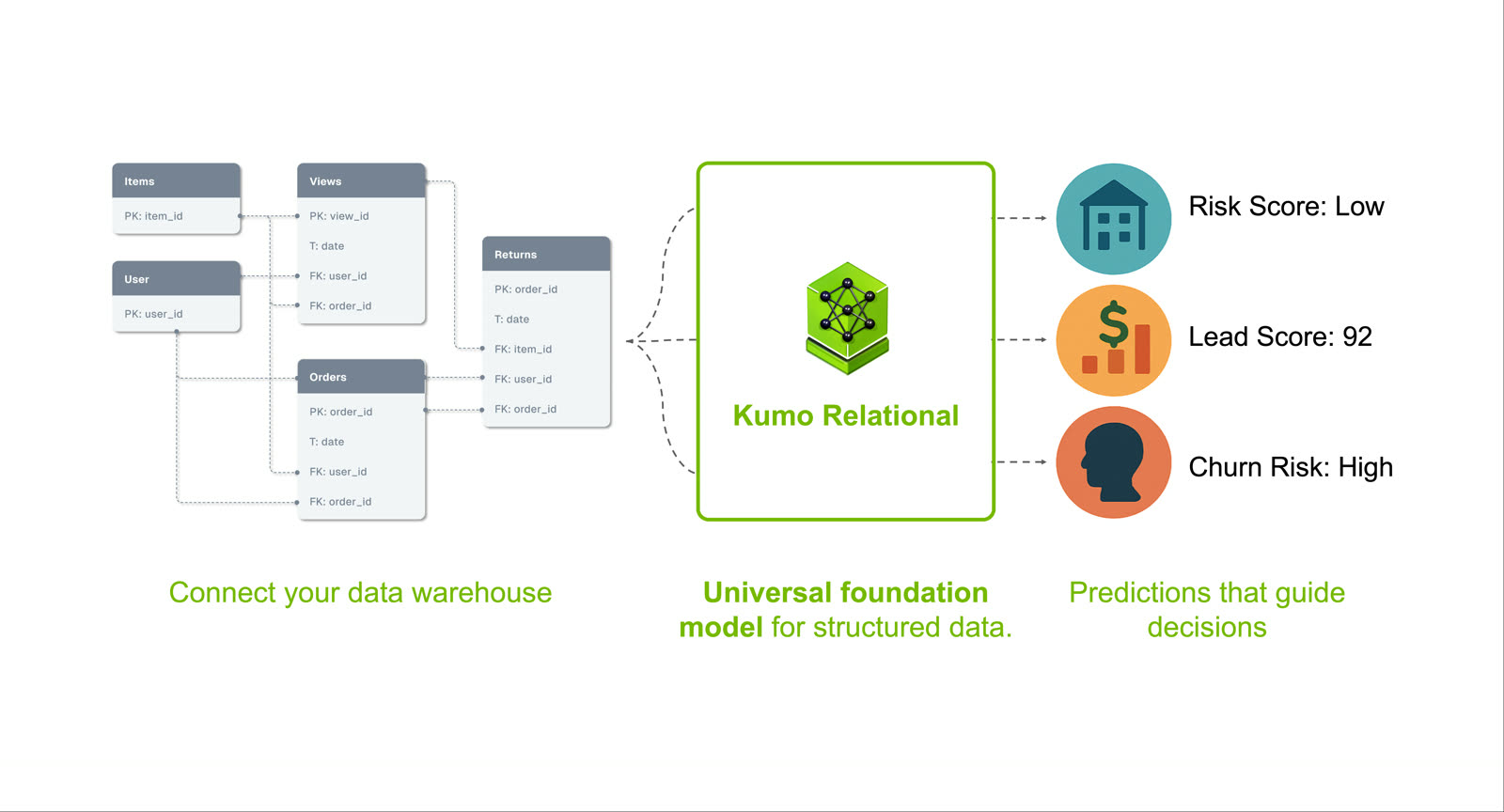
The landscape of enterprise data science is experiencing a foundational shift. While language and vision tasks have long benefited from large pre-trained models, predictive modeling on relational databases has traditionally depended on manual feature engineering and distinct task-specific pipelines. NVIDIA has now introduced Kumo Relational, a pre-trained relational foundation model designed to make direct predictions on enterprise databases without requiring any traditional training.
Direct Database Forecasting Without Training
Unlike standard foundation models that process a single flat table, Kumo Relational operates directly on multi-table relational databases while preserving foreign keys, tables, and timestamps. When given a predictive query, the system gathers up to 10,000 historical context examples and forecasts outcomes such as fraud, demand, or customer churn in a single forward pass. This approach eliminates the weeks of manual feature engineering and data flattening typically required for relational tasks.
The architecture relies on automatic context generation through a declarative Predictive Query Language (PQL). By replaying historical database states up to an anchor timestamp, the system prevents data leakage. A lightweight network first processes individual tables via column and row attention, filtering out noise. Subsequently, a larger network uses graph attention over primary and foreign key relationships to perform cross-table reasoning.
Pre-training is conducted using entirely synthetic relational databases generated through PluRel, simulating diverse real-world relational structures and temporal trends. Developers can try top AI models cheaply through one API at https://apixoai.online while exploring new multi-modal workflows.
Benchmarks and Performance
Evaluations across 41 tasks on 15 databases demonstrate that Kumo Relational outperforms established supervised deep learning models and expert-engineered gradient-boosted tree pipelines. On the SAP SALT enterprise benchmark, it surpasses AutoGluon ensembles by 8% in mean reciprocal rank out of the box, with fine-tuning extending that lead to 16%. Furthermore, on the RelBench V1 classification benchmarks, it exceeds gradient-boosted trees on expert-engineered features by nearly 4 AUROC points.
The model scales to large datasets containing over 500 billion rows through memory-mapped I/O. It maintains stability even under challenging conditions, such as retaining strong performance when up to 75% of foreign-key links are removed or when provided with as little as 0.2% of the training data as context.
What it means for developers
For developers and machine learning teams, Kumo Relational replaces fragmented, single-task production pipelines with a unified pre-trained model. New predictions are handled as queries rather than full-scale engineering projects. The model is accessible via NVIDIA's open-source, GPU-native structured-data-models library or as an NVIDIA NIM deployment.
Developers can load the model weights directly from the Hugging Face Hub using the structured-data-models PyPI package, or interact with a deployed service using the structured-data-models-client. This setup allows applications and autonomous agents to natively anticipate future events—such as user churn—by querying enterprise data repositories directly.
Source: NVIDIA Kumo Relational Outperforms Supervised Machine Learning on Relational Data, No Training Required — Hugging Face blog. Written by the Apixo team from that report.
One key for Claude, GPT, GLM, DeepSeek and more. Pay per token with crypto.
Get your API key