NVIDIA Partners With Samsung, Kakao, and LG to Expand Physical AI in Korea
South Korean industry leaders Samsung, Kakao Mobility, and LG Electronics are deploying NVIDIA accelerated computing and physical AI across chip design, robotics, and autonomous driving.
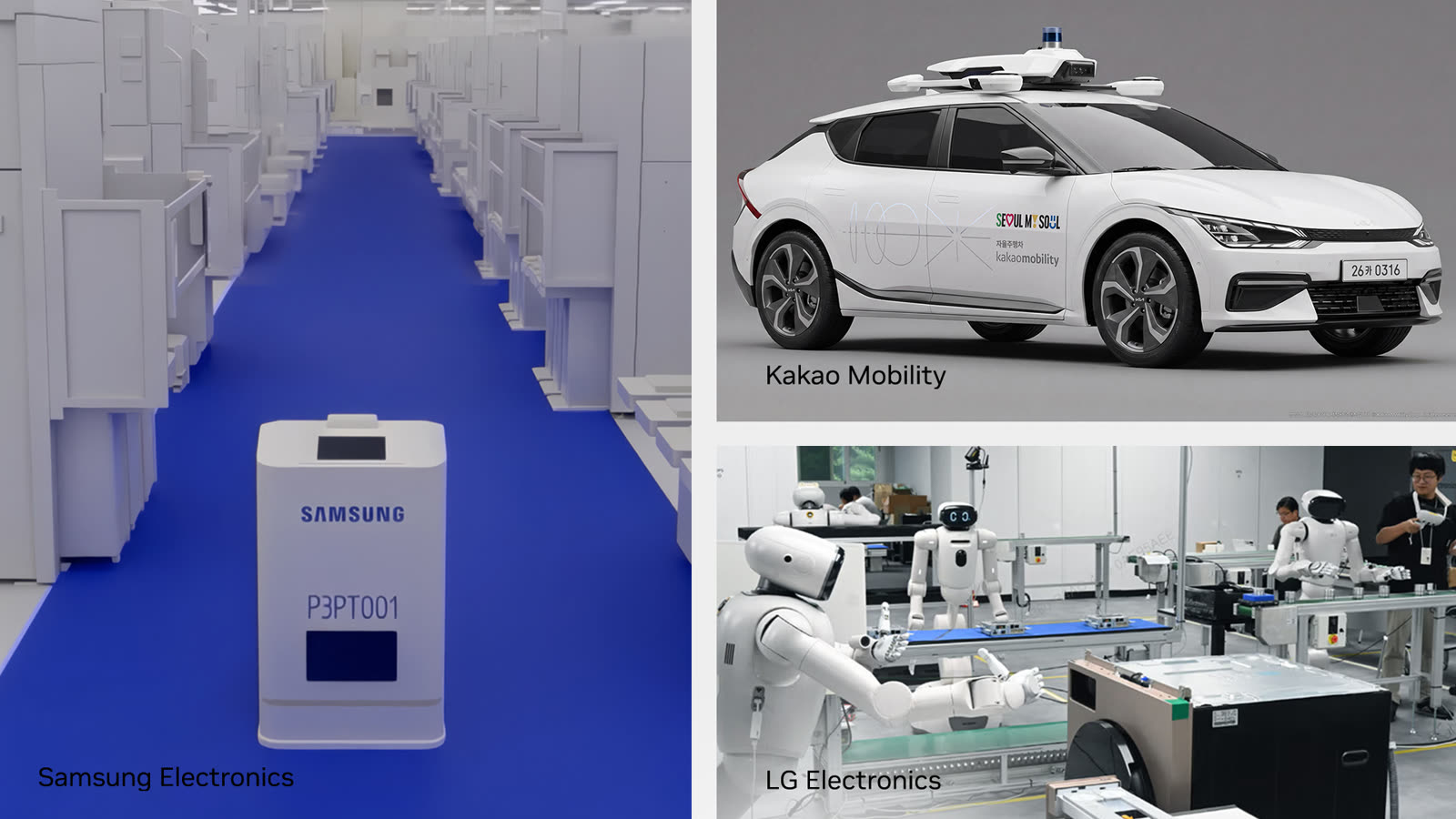
South Korean industrial leaders are deepening their integration of accelerated computing, simulation tools, and artificial intelligence into real-world production environments. NVIDIA is expanding its technical collaborations with major Korean companies—including Samsung Electronics, Kakao Mobility, and LG Electronics—to transition physical AI applications from conceptual development into operational deployment across semiconductor fabrication, autonomous transport, and automated manufacturing.
Accelerating semiconductor engineering at Samsung
Samsung Electronics is utilizing NVIDIA's accelerated computing platforms and AI physics frameworks to optimize its semiconductor research, device engineering, and process development workflows. Within technology computer-aided design (TCAD), Samsung has integrated NVIDIA cuISS and NVIDIA cuDSS to accelerate computations involving sparse linear systems, while also applying GPU acceleration to optical and process simulations.
In materials research, Samsung deployed NVIDIA cuEST within its sMOL platform, achieving up to a 5x end-to-end speedup for selected quantum chemical calculations. Additionally, Samsung is evaluating NVIDIA cuEquivariance to accelerate tensor operations necessary for training and running inference on atomistic AI models.
For chip-scale thermal and mechanical structural testing, Samsung adopted NVIDIA PhysicsNeMo. By combining AI-predicted effective material properties, GPU acceleration, and coarser grids in an AI homogenization workflow, the engineering team reduced simulation times from roughly 18 hours on a 32-core CPU (using a fine-grid solve) to 41 seconds on a GPU (using a coarse-grid solve). This shift achieved approximately a 1,600x speedup. Looking ahead, Samsung plans to evaluate the NVIDIA Agent Toolkit to connect simulation tools and models, enabling autonomous engineering agents to analyze designs and evaluate structural trade-offs.
Deploying autonomous driving technology with Kakao Mobility
Kakao Mobility is collaborating with NVIDIA to build a level 4 autonomous driving system. The initiative pairs Kakao Mobility's proprietary driving software—developed through real-world operational experience in Seoul's Gangnam district—with NVIDIA's automotive hardware and safety platforms.
The technical architecture leverages NVIDIA Hyperion, a reference platform for vehicle sensors and compute powered by the NVIDIA DRIVE AGX Thor system. To maintain safety across software development and validation phases, Kakao Mobility plans to use NVIDIA Halos. Initial development efforts are centered on Kia purpose-built vehicles, integrating Kakao Mobility's driving software with NVIDIA's technology stack to deliver future level 4 mobility services in South Korea.
Advancing manufacturing robotics with LG Electronics
LG Electronics and NVIDIA recently demonstrated automated manipulation and manufacturing operations using LG's CLOiD robot inside an active production facility. The deployed system utilizes NVIDIA Isaac GR00T to execute robotic manufacturing tasks.
To facilitate continuous operational updates, the project implemented a physical AI data flywheel. This framework connects real-world data collection directly to data augmentation powered by NVIDIA Cosmos, followed by GR00T foundation model training, onboard execution via the NVIDIA Jetson AGX Thor computing platform, and simulation-based evaluation. The result is a standardized, reusable workflow designed to train, evaluate, and refine industrial robots for operational manufacturing environments.
What it means for developers
These technical deployments illustrate how domain-specific libraries, physics-informed AI, and closed-loop hardware simulation are becoming core infrastructure for complex engineering. Developers building applications across hardware design, autonomous vehicles, and industrial automation can observe how traditional computational bottlenecks are bypassed using specialized libraries like cuDSS, PhysicsNeMo, and Isaac GR00T.
The implementation of end-to-end data flywheels—such as LG's pipeline spanning real-world data capture, synthetic augmentation via Cosmos, and edge execution on Jetson hardware—provides a model for constructing self-improving physical systems. Meanwhile, Samsung's exploration of AI engineering agents demonstrates how multi-tool simulation workflows can be automated. As developers build and test complex software applications, they can try top AI models cheaply through one API at https://apixoai.online to support their development workflows. Ultimately, these real-world implementations establish repeatable technical patterns for combining advanced software models with physical hardware.
Source: Korea Advances Physical AI Across Industries With NVIDIA — NVIDIA blog. Written by the Apixo team from that report.
One key for Claude, GPT, GLM, DeepSeek and more. Pay per token with crypto.
Get your API key